
Solar self-consumption in Spain: €1,100 investment and 7.5 years to break even
According to one forum user, a €1,100 solar kit saves €150 a year and takes 7.5 years to pay for itself; the Chinese inverter and the backup toll drag down the return.
English · Original discussion in Spanish · Published
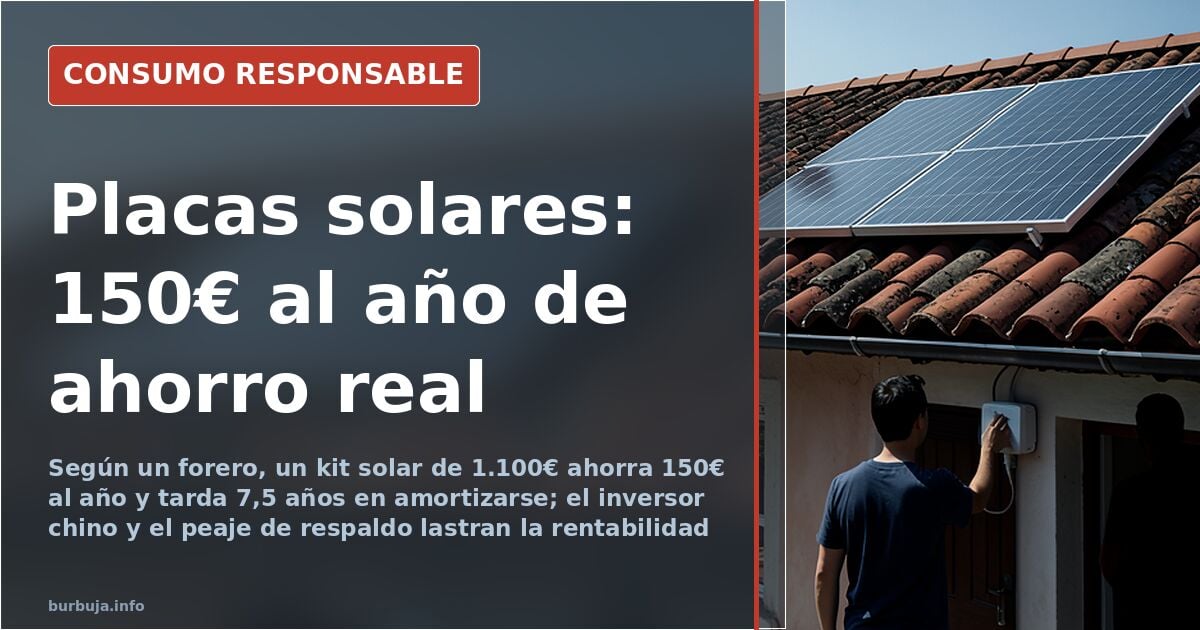
Solar self-consumption: €1,100 investment and 7.5 years to break even
Four 140-watt panels, a 1,200-watt Chinese inverter and a fuse box. Total: around €1,100. The real savings, measured with the bill in hand rather than the manufacturer's spreadsheet, come to about €150 a year, according to the calculations of a forum user sharing his experience. The numbers work, but they work worse than promised on paper: instead of the 5.5-year payback the theoretical calculation gave, the solar self-consumption installation takes 7.5 years to pay for itself. And that's with electricity at €0.16 per kilowatt hour.
The gap has a name: the inverter. A €280 gadget — which ended up considerably more expensive after paying customs — with a real output of around 80%, when quality microinverters claim 95%. In November, the calculation promised 50 kWh and reality delivered 37. In October, 59. The late-afternoon shadows did the rest.
The kilowatt you give away and the one you're fined for
The technical side is half the story. The other half is regulatory. As argued in the thread, the framework surrounding grid-connected self-consumption requires legalising the installation, installing a second meter readable by the utility, and absorbing a bureaucratic cost of no less than €1,500, even if the kit costs €400. And if you feed surplus power back in, you give it away. On top of that comes the so-called backup toll (peaje de respaldo, a Spanish grid charge), which you pay simply for being connected, even if you don't inject a single watt.
One response from some people is physical disconnection: separate circuits, an installation declared as off-grid for a garden shed, and nobody enters the house without a court order. Another school of thought holds that the problem is not so much the rules as the design: those who size it properly and do the work themselves avoid the shock. The range the handiest users quote is around €2,500 to €3,000 for a home with normal consumption, provided you do the work yourself.
Let no one rush out to buy panels without first understanding what an HSP is. Peak sun hours range from 7.68 in July to 1.88 in December in the same city and at the same tilt. Multiplying by peak power gives theoretical generation; the real figure is always lower.
Five years on: the inverter repaired seven times
The trinc-up tempers the initial enthusiasm. After five years, the installation is still producing, but the electricity savings come to around 30% of consumption — not of the bill, because the fixed charge is where the squeeze comes. The Chinese inverter has been to the workshop seven times. The accumulated savings over that period are estimated at €700 to €800. There's one spare transistor left and a decision to downgrade the unit to backup.
The full calculation, with the month-by-month table of theoretical versus actual generation, leaves a differential that explains why it's worth reading the fine print before signing for the kit. The conclusion is inescapable: the return exists, but it's modest, and it depends on factors the brochure doesn't mention.
In the end, the figure that doesn't add up isn't the payback period. It's the minimum bill: €43.27 for zero consumption.
Also available in: Deutsch
Summary of a discussion on Burbuja.info - Foro de economía, actualidad y política., translated from Spanish and reviewed before publication. Read the full discussion (67 replies).
More summaries
-
Hussars: quality menswear or just posturing?
Hussars review: natural fabrics, local manufacturing, and straight fit versus criticism for its controversial cut and self-promotion. Is it worth the price?
-
Fiat Tipo at €17,500: the reliability debate
A buyer weighs up a €17,500 Fiat Tipo diesel with a four-year warranty against doubts about the brand's reliability and resale value.
-
Spray-painting a car in the street for 50 euros: the experiment that turned out decent
He spray-painted the bonnet and roof of his car in the street for 50 euros and 15 cans of acrylic. The result, "totally decent", opens the debate on cost.
-
Cordless hair clipper: why the charger won't run the motor
The clipper's charger delivers 2.2 volts and 1000 mAh, designed to charge the battery, not to power the motor. Replacing the soldered battery, according to one forum user, costs…
-
HP printer that prints without printing: how to beat built-in obsolescence
An HP stops printing with a new cartridge due to a 3-euro fault that requires scrapping the machine. Monochrome laser wins the economic argument.
-
Rechargeable batteries: four for €6.99 and made in Japan
Four 1,700 mAh AA rechargeable batteries for €6.99, made in Japan: the charging-time calculation and the charger that decide whether the purchase is worth it.