
Schäuble message urges Germans to wear sweaters amid energy crisis
A message attributed to the Bundestag president recommends sweaters, candles and flashlights as Germany faces potential power cuts.
English · Original discussion in Spanish · Published
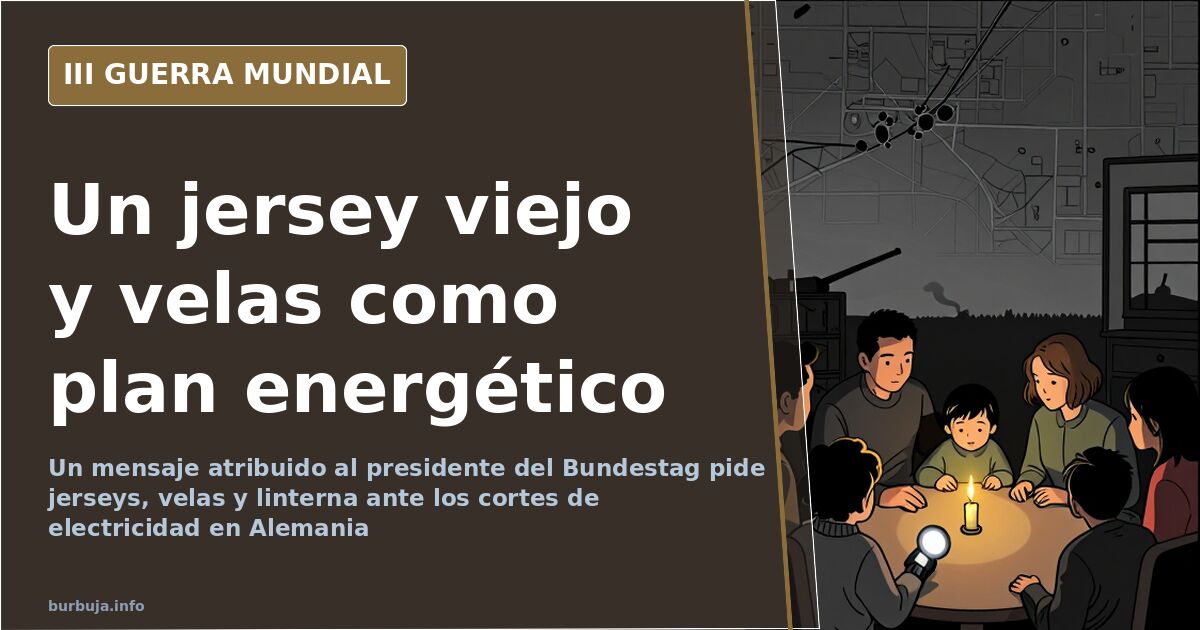
Germany facing the cold: sweater, candles and a flashlight
"If you put on an old sweater, everything will be fine." This phrase, attributed to Bundestag President Wolfgang Schäuble, is the starkest summary of how energy shortages are being communicated in Germany: power cuts, cold homes and a message urging people to bundle up. In that message, the leader asks citizens not to take it "tragically" and to have candles, matches and a flashlight at hand. Electricity, he implies, "is very important, but sometimes it may not be." With such instructions, the question circulating was another: how long before the public loses patience?
What has Schäuble asked Germans to do?
The message is explicit: don't dramatize, use warm clothing and prepare a minimal emergency kit. An old sweater, candles, matches and a flashlight, and above all, knowing where these items are stored in case the power goes out suddenly. The recommendation comes in a context of electricity cuts and a winter that looks harsh for households. In the attributed message, the president of the German lower house acknowledges that electricity "is, of course, very important," but adds that sometimes it may not be, a nuance that has angered many.
No one disputes that a sweater doesn't solve a bill. What grates is that the instruction comes from the Bundestag presidency rather than from a utility company's official notice. Put on a sweater and don't protest is not exactly an industrial plan.
The "let them eat cake" attributed to elites
The comparison with Marie Antoinette appeared quickly, with a textbook correction included: the classic quote wasn't "let them eat cake," but let them eat brioche. It doesn't matter which version: the scene described is that of an elite who, faced with scarcity, only knows how to ask for resignation from those suffering it. Here the brioche is a sweater and the cake, a candle.
Some formulate it as the effect of elites disconnected from the real cost of living. And there is a recurring scene in the commentary: the suspicion that the person giving advice doesn't feel cold, neither at home nor in the Congress cafeteria. It is not a verified accusation, it is the reading made of the asymmetry between the message and the messenger.
Who wins and who loses from the cut in Russian gas?
The dominant thesis is that the distribution is simple: Anglos win, Europeans lose. While Russian gas is replaced by more expensive purchases, German industry watches its decades-long advantage evaporate: privileged access to cheap energy. That differential is what allowed it to compete with Asia, including China, and without it, the setback is hardly reversible.
Some argue in the thread that this is not just a bad winter but a structural loss. The years of cheap energy served to develop technology and export capacity; from now on, industrial trains are missed that can no longer be caught. German competitiveness was, largely, a matter of energy bills.
Is the shortage real or staged?
Here skepticism takes another path. It is argued that Germany warmed itself during two wars against half of Europe with far fewer resources, and that it is hard to believe that now, in a non-belligerent country, such scarcity would occur. The conclusion drawn by this current: the restriction is more about political decision than physics.
To this skepticism is added another: that of the quote itself. Some claim there is no proof that Schäuble uttered those words, and that the text circulates without verification. Both doubts coexist: that of the official response and that of the episode that triggered it.
The track record of the Bundestag president
Schäuble is not unknown. As recalled in the thread, an assassination attempt suffered in 1990 left him with sequelae, although he survived. European Commission President Ursula von der Leyen appears in the conversation due to her time heading Defense, to which a participant attributes corruption, an accusation not supported by any evidence in the thread.
From Schäuble himself, another episode is remembered, recorded in the free encyclopedia: on December 2, 1999, in a Bundestag meeting, several MPs booed him for his contacts with arms dealer Karlheinz Schreiber. Sensitive material that mixes, for better or worse, with the textile advice of this crisis.
The Congress café and the open question
The closing of the conversation has a detail that disorients more than any speech: a participant speculates that coffee costs €0.60 and continental breakfast €1.40 in the German Congress, and another points to a €500 aid for those preferring to spend the winter in the Canary Islands. There is no consensus on whether the sweater phrase was real. The thread, in any case, reflects a discomfort that cannot be fixed with a candle.
"If you put on an old sweater, everything will be fine." This phrase, attributed to Bundestag President Wolfgang Schäuble, is the starkest summary of how energy shortages are being communicated in Germany: power cuts, cold homes and a message urging people to bundle up. In that message, the leader asks citizens not to take it "tragically" and to have candles, matches and a flashlight at hand. Electricity, he implies, "is very important, but sometimes it may not be." With such instructions, the question circulating was another: how long before the public loses patience?
What has Schäuble asked Germans to do?
The message is explicit: don't dramatize, use warm clothing and prepare a minimal emergency kit. An old sweater, candles, matches and a flashlight, and above all, knowing where these items are stored in case the power goes out suddenly. The recommendation comes in a context of electricity cuts and a winter that looks harsh for households. In the attributed message, the president of the German lower house acknowledges that electricity "is, of course, very important," but adds that sometimes it may not be, a nuance that has angered many.
No one disputes that a sweater doesn't solve a bill. What grates is that the instruction comes from the Bundestag presidency rather than from a utility company's official notice. Put on a sweater and don't protest is not exactly an industrial plan.
The "let them eat cake" attributed to elites
The comparison with Marie Antoinette appeared quickly, with a textbook correction included: the classic quote wasn't "let them eat cake," but let them eat brioche. It doesn't matter which version: the scene described is that of an elite who, faced with scarcity, only knows how to ask for resignation from those suffering it. Here the brioche is a sweater and the cake, a candle.
Some formulate it as the effect of elites disconnected from the real cost of living. And there is a recurring scene in the commentary: the suspicion that the person giving advice doesn't feel cold, neither at home nor in the Congress cafeteria. It is not a verified accusation, it is the reading made of the asymmetry between the message and the messenger.
Who wins and who loses from the cut in Russian gas?
The dominant thesis is that the distribution is simple: Anglos win, Europeans lose. While Russian gas is replaced by more expensive purchases, German industry watches its decades-long advantage evaporate: privileged access to cheap energy. That differential is what allowed it to compete with Asia, including China, and without it, the setback is hardly reversible.
Some argue in the thread that this is not just a bad winter but a structural loss. The years of cheap energy served to develop technology and export capacity; from now on, industrial trains are missed that can no longer be caught. German competitiveness was, largely, a matter of energy bills.
Is the shortage real or staged?
Here skepticism takes another path. It is argued that Germany warmed itself during two wars against half of Europe with far fewer resources, and that it is hard to believe that now, in a non-belligerent country, such scarcity would occur. The conclusion drawn by this current: the restriction is more about political decision than physics.
To this skepticism is added another: that of the quote itself. Some claim there is no proof that Schäuble uttered those words, and that the text circulates without verification. Both doubts coexist: that of the official response and that of the episode that triggered it.
The track record of the Bundestag president
Schäuble is not unknown. As recalled in the thread, an assassination attempt suffered in 1990 left him with sequelae, although he survived. European Commission President Ursula von der Leyen appears in the conversation due to her time heading Defense, to which a participant attributes corruption, an accusation not supported by any evidence in the thread.
From Schäuble himself, another episode is remembered, recorded in the free encyclopedia: on December 2, 1999, in a Bundestag meeting, several MPs booed him for his contacts with arms dealer Karlheinz Schreiber. Sensitive material that mixes, for better or worse, with the textile advice of this crisis.
The Congress café and the open question
The closing of the conversation has a detail that disorients more than any speech: a participant speculates that coffee costs €0.60 and continental breakfast €1.40 in the German Congress, and another points to a €500 aid for those preferring to spend the winter in the Canary Islands. There is no consensus on whether the sweater phrase was real. The thread, in any case, reflects a discomfort that cannot be fixed with a candle.
Summary of a discussion on Burbuja.info - Foro de economía, actualidad y política., translated from Spanish and reviewed before publication. Read the full discussion (166 replies).
More summaries
-
German Leopards to Ukraine: doubts over their real impact
Germany announces it will send Leopard tanks to Ukraine amid debate over whether they will attack Russia, when they will arrive and how many there are
-
Gisbert and Sivaya: Romance Amid Ukraine War Narratives
Analysis of media coverage for Rubén Gisbert and Liu Sivaya during the Ukraine war. Is this digital propaganda or reality?
-
1911 Britannica Claim on Ukraine Origins
The 1911 Encyclopedia Britannica placed Ukraine within Russia, fueling narratives about the state's origins and NATO expansion.
-
Nord Stream sabotage: three pipelines damaged, no culprit
Unprecedented damage to three Nord Stream offshore lines; blame is split between Moscow and Washington with no confirmed perpetrator.
-
Spain's archives challenge 1899 ruling on Essequibo
Spanish documents place the Essequibo in Venezuela, challenging the 1899 arbitral award amid oil disputes.
-
Ukraine's Historical Rights Debate
The clash between narratives denying Ukraine's historical roots and those claiming Kyivan Rus as a common origin remains unresolved.