
Nord Stream sabotage: three pipelines damaged, no culprit
Unprecedented damage to three Nord Stream offshore lines; blame is split between Moscow and Washington with no confirmed perpetrator.
English · Original discussion in Spanish · Published
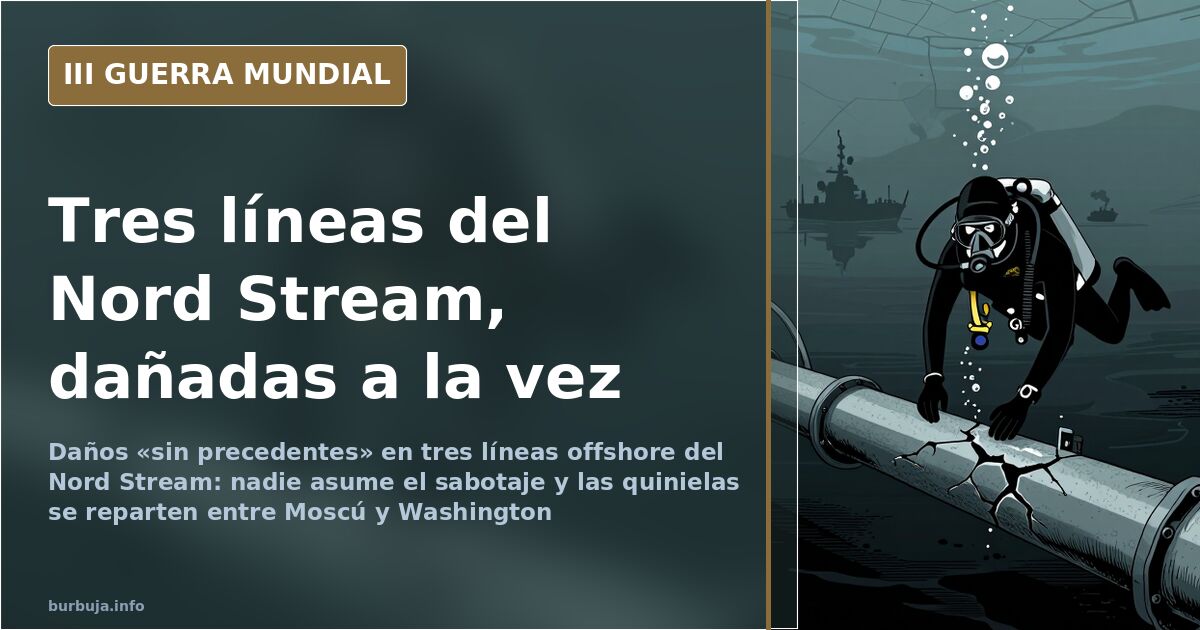
Three Nord Stream lines damaged: no one claims responsibility
The system operator does not attribute the damage to an accident. It reports "unprecedented" simultaneous damage to three offshore Nord Stream lines and states that it is impossible to estimate how long it will take to restore the gas transport infrastructure. In plain terms: three steel pipes on the Baltic seabed breached at once, with no authority pointing to a culprit with concrete evidence.
From there, analyses split into two camps that share almost nothing. One looks to Washington and London. The other, to the Kremlin. And the question that drives the debate is the same as always, the one that rules any trading room: Who benefits?
Who gains from the destruction of Nord Stream?
The most repeated argument against Russian authorship fits in one sentence: the one holding the key doesn't need dynamite. Simply opening or closing the valve is enough to leave half of Europe shivering. Blowing up infrastructure built and paid for by Gazprom, especially in international waters, makes little sense when gas can be redirected via other routes and the small amount still sold commands higher prices.
Opposing this is the reading published by CNN: according to a senior US civilian official and a military official, Russia remains the prime suspect, because no other actor has the capability and will to execute such an operation. There is also a third, more prosaic theory pointing to Moscow for non-heroic reasons. If the pipe is broken, Gazprom avoids paying compensation for supply halts, maritime traffic in the area becomes complicated, and chaos, in certain circles, pays off.
The Baltic Pipe inaugurated the same day
One detail appears repeatedly in analyses and is not coincidental: while leaks were detected, Poland and Denmark were launching the Baltic Pipe, the conduit set to deliver 10 billion cubic meters of Norwegian gas to Poland annually. A new pipeline to replace Russian gas, presented just as the Russian one breaks. This coincidence has fueled various interpretations, including the idea that the real target was the new pipeline and the attack fell short. Neither this nor any other hypothesis has been confirmed.
How to sabotage a gas pipeline: the pig clue
The most technical version circulating points to the pig, the device sent through the pipeline to clean and inspect it. You insert the tool with an explosive charge, launch it from an access point, and avoid being caught mid-operation. How many entry points does the system have? For those defending this thesis, two: the German side and the Russian side. This seemingly minor detail turns any attribution into an act of faith.
The Baltic Sea, monitored top-to-bottom by NATO
Pure geography. Since World War II, the Baltic has been controlled by NATO countries or allies: no submarine moves there without being heard. Therefore, one widely cited school of thought argues that an attack of this scale could only be carried out by those who dominate the sea, not by those who must deploy submarines from Arctic bases to avoid getting trapped. Those supporting Russian authorship counter with a simpler argument: Moscow also has submarines and the capacity to operate in these waters.
CNN's three days and propaganda outrunning evidence
The battle also plays out on the calendar. Information placing Russia as the prime suspect took three days to publish. For some analysts, this delay rules out Washington: if the leak benefited Americans, they wouldn't have waited 72 hours. Others argue the opposite: propaganda of various kinds circulated online from the first minute, before any data existed.
Historical analogies pile up in the same speculations: the Maine, the Gulf of Tonkin, episodes used to justify war before a single piece of proof emerged. And accusations fly in both directions, depending on whom you believe.
What the sabotage costs Europe
Beyond authorship, some argue that the European consumer loses in any scenario. Analyses insist that Germany is the linchpin holding up the rest of the structure, and leaving it without a supply route drags down the euro and continental industry. The most repeated expression is bringing Europe to its knees, with the usual nuance: some place the knee on Moscow, others on Washington.
The one thing no one disputes
With or without proof, the verifiable fact remains as stated initially: three offshore lines damaged simultaneously, "unprecedented" damage, and no estimate of when gas flow will resume. The rest, for now, is after-dinner geopolitics. And the unsettling detail: the only energy infrastructure actually inaugurated that day was the one bringing Norwegian gas to Poland.
The system operator does not attribute the damage to an accident. It reports "unprecedented" simultaneous damage to three offshore Nord Stream lines and states that it is impossible to estimate how long it will take to restore the gas transport infrastructure. In plain terms: three steel pipes on the Baltic seabed breached at once, with no authority pointing to a culprit with concrete evidence.
From there, analyses split into two camps that share almost nothing. One looks to Washington and London. The other, to the Kremlin. And the question that drives the debate is the same as always, the one that rules any trading room: Who benefits?
Who gains from the destruction of Nord Stream?
The most repeated argument against Russian authorship fits in one sentence: the one holding the key doesn't need dynamite. Simply opening or closing the valve is enough to leave half of Europe shivering. Blowing up infrastructure built and paid for by Gazprom, especially in international waters, makes little sense when gas can be redirected via other routes and the small amount still sold commands higher prices.
Opposing this is the reading published by CNN: according to a senior US civilian official and a military official, Russia remains the prime suspect, because no other actor has the capability and will to execute such an operation. There is also a third, more prosaic theory pointing to Moscow for non-heroic reasons. If the pipe is broken, Gazprom avoids paying compensation for supply halts, maritime traffic in the area becomes complicated, and chaos, in certain circles, pays off.
The Baltic Pipe inaugurated the same day
One detail appears repeatedly in analyses and is not coincidental: while leaks were detected, Poland and Denmark were launching the Baltic Pipe, the conduit set to deliver 10 billion cubic meters of Norwegian gas to Poland annually. A new pipeline to replace Russian gas, presented just as the Russian one breaks. This coincidence has fueled various interpretations, including the idea that the real target was the new pipeline and the attack fell short. Neither this nor any other hypothesis has been confirmed.
How to sabotage a gas pipeline: the pig clue
The most technical version circulating points to the pig, the device sent through the pipeline to clean and inspect it. You insert the tool with an explosive charge, launch it from an access point, and avoid being caught mid-operation. How many entry points does the system have? For those defending this thesis, two: the German side and the Russian side. This seemingly minor detail turns any attribution into an act of faith.
The Baltic Sea, monitored top-to-bottom by NATO
Pure geography. Since World War II, the Baltic has been controlled by NATO countries or allies: no submarine moves there without being heard. Therefore, one widely cited school of thought argues that an attack of this scale could only be carried out by those who dominate the sea, not by those who must deploy submarines from Arctic bases to avoid getting trapped. Those supporting Russian authorship counter with a simpler argument: Moscow also has submarines and the capacity to operate in these waters.
CNN's three days and propaganda outrunning evidence
The battle also plays out on the calendar. Information placing Russia as the prime suspect took three days to publish. For some analysts, this delay rules out Washington: if the leak benefited Americans, they wouldn't have waited 72 hours. Others argue the opposite: propaganda of various kinds circulated online from the first minute, before any data existed.
Historical analogies pile up in the same speculations: the Maine, the Gulf of Tonkin, episodes used to justify war before a single piece of proof emerged. And accusations fly in both directions, depending on whom you believe.
What the sabotage costs Europe
Beyond authorship, some argue that the European consumer loses in any scenario. Analyses insist that Germany is the linchpin holding up the rest of the structure, and leaving it without a supply route drags down the euro and continental industry. The most repeated expression is bringing Europe to its knees, with the usual nuance: some place the knee on Moscow, others on Washington.
The one thing no one disputes
With or without proof, the verifiable fact remains as stated initially: three offshore lines damaged simultaneously, "unprecedented" damage, and no estimate of when gas flow will resume. The rest, for now, is after-dinner geopolitics. And the unsettling detail: the only energy infrastructure actually inaugurated that day was the one bringing Norwegian gas to Poland.
Summary of a discussion on Burbuja.info - Foro de economía, actualidad y política., translated from Spanish and reviewed before publication. Read the full discussion (146 replies).
More summaries
-
Nord Stream: who loses from the sabotage and who wins
The Nord Stream sabotage reopens the debate over who wins: the US is already shipping its gas to Europe and the Russian pipeline is out of action
-
Russia cripples Ukraine’s energy grid in massive strike
A massive Russian strike cuts Ukraine’s nuclear capacity by up to 90%, marking a decisive phase in the ongoing energy and territorial siege.
-
Texas Farm Explosion Kills Over 18,000 Cows
Over 18,000 cows died in a Texas farm explosion, a figure comparable to the entire dairy herd of Spain's Basque Country.
-
Russia fails to secure pro-Russian territories after one year
One year into the war, Russia has not surpassed pre-conflict borders in pro-Russian zones, with elite units depleted.
-
Russia’s '32 km Advance' in Southern Ukraine: Conflicting Claims
Conflicting reports on Russia's southern front range from 1 to 32 km, with some maps reportedly redrawn to match new claims.
-
Military and Economic Analysis of the War in Ukraine
Analysis of the war in Ukraine: contrasting military dynamics, geopolitical causes, and the conflict's energy impact.