
Spain's archives challenge 1899 ruling on Essequibo
Spanish documents place the Essequibo in Venezuela, challenging the 1899 arbitral award amid oil disputes.
English · Original discussion in Spanish · Published
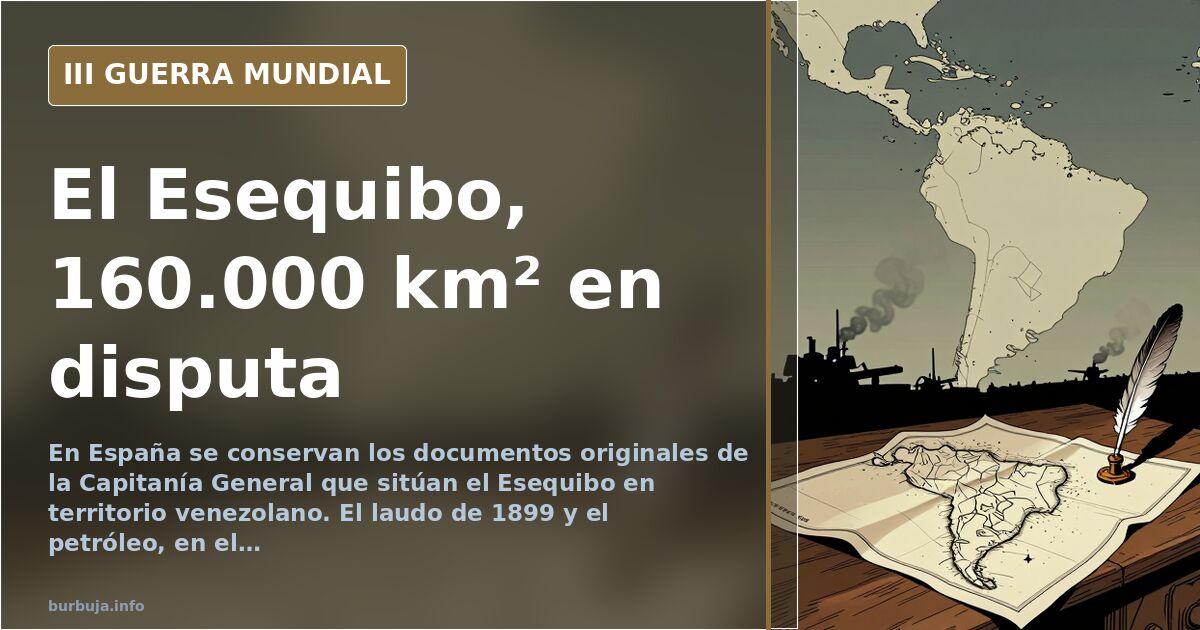
Essequibo: Spanish papers contest 1899 arbitration
Venezuela’s claim to the Guayana Esequiba rests on archival evidence, not rhetoric. The core argument is that Spain holds original records from the Captaincy General of Venezuela placing territory west of the Essequibo River under Spanish administration. This basis asserts legal Venezuelan sovereignty and invalidates the 1899 arbitral award—signed hastily, according to this view—which Venezuela never recognized.
The legal principle invoked is uti possidetis iuris: colonial territories transfer to independent states. Critics argue Spain lacked permanent settlements there, but proponents counter that Venezuela’s Amazonas state also had no modern population until the early 20th century without losing sovereignty. Jungle does not require cities for administration.
Documents and the 1899 agreement
The dispute narrative begins in 1822 when Venezuelan diplomats protested British settlers’ presence. Claims that Bolívar gifted Guyana to Britain are denied due to lack of documentary evidence. Spain’s recognition of Venezuelan independence in the 1840s allegedly transferred territorial rights, including the Essequibo.
The 1899 award is described as a rushed pacolaudo, legally weaker than Catalan or Russian referendums. The US reportedly intervened for Venezuela citing the Monroe Doctrine, leaving the territory disputed. In 1966, London granted Guyana independence while maintaining de facto control over the contested area, sparking the modern conflict.
Oil, sanctions, and resource division
Economic interests drive the situation. With massive oil sanctions on Venezuela since 2016, Essequibo crude became strategic. Washington’s purchase of Russian oil and exploitation of the disputed field with commissions are noted. Analysts suggest Guyana, with about one million inhabitants, could become wealthy like Qatar, funding a military to prevent impoverished Venezuela from reclaiming land.
Parallels to Western Sahara are drawn, involving Segarro and Israel. The plunder thesis cites demographics: Venezuela grew from 2 million people in 1900 to 30 million by 2010, while Norway rose from 2 to 5 million. The conclusion is stark.
Internal debate: Claim or wait?
Methods vary. One faction argues the claim is just despite leadership flaws, suggesting simultaneous recovery of Gibraltar, Falklands, and Essequibo under Hispanic unity. Another blames Anglophile elites for independence and fragmentation into weak republics.
Skeptics warn military adventurism would end like Iraq or Panama in 1989, noting average Venezuelans couldn’t sustain real war. Counterarguments state the US lacks pretext while engaged elsewhere, advocating at least a deterrent show of force.
Surprising data
Territorial size matters: Venezuela covers 1,076,000 km² versus Norway’s 383,000 km² excluding Svalbard. The Essequibo, pure jungle, goes to whoever can defend it militarily. Experts predict resolution won’t come via courts, but when someone calculates acting costs less than watching maps.
Venezuela’s claim to the Guayana Esequiba rests on archival evidence, not rhetoric. The core argument is that Spain holds original records from the Captaincy General of Venezuela placing territory west of the Essequibo River under Spanish administration. This basis asserts legal Venezuelan sovereignty and invalidates the 1899 arbitral award—signed hastily, according to this view—which Venezuela never recognized.
The legal principle invoked is uti possidetis iuris: colonial territories transfer to independent states. Critics argue Spain lacked permanent settlements there, but proponents counter that Venezuela’s Amazonas state also had no modern population until the early 20th century without losing sovereignty. Jungle does not require cities for administration.
Documents and the 1899 agreement
The dispute narrative begins in 1822 when Venezuelan diplomats protested British settlers’ presence. Claims that Bolívar gifted Guyana to Britain are denied due to lack of documentary evidence. Spain’s recognition of Venezuelan independence in the 1840s allegedly transferred territorial rights, including the Essequibo.
The 1899 award is described as a rushed pacolaudo, legally weaker than Catalan or Russian referendums. The US reportedly intervened for Venezuela citing the Monroe Doctrine, leaving the territory disputed. In 1966, London granted Guyana independence while maintaining de facto control over the contested area, sparking the modern conflict.
Oil, sanctions, and resource division
Economic interests drive the situation. With massive oil sanctions on Venezuela since 2016, Essequibo crude became strategic. Washington’s purchase of Russian oil and exploitation of the disputed field with commissions are noted. Analysts suggest Guyana, with about one million inhabitants, could become wealthy like Qatar, funding a military to prevent impoverished Venezuela from reclaiming land.
Parallels to Western Sahara are drawn, involving Segarro and Israel. The plunder thesis cites demographics: Venezuela grew from 2 million people in 1900 to 30 million by 2010, while Norway rose from 2 to 5 million. The conclusion is stark.
Internal debate: Claim or wait?
Methods vary. One faction argues the claim is just despite leadership flaws, suggesting simultaneous recovery of Gibraltar, Falklands, and Essequibo under Hispanic unity. Another blames Anglophile elites for independence and fragmentation into weak republics.
Skeptics warn military adventurism would end like Iraq or Panama in 1989, noting average Venezuelans couldn’t sustain real war. Counterarguments state the US lacks pretext while engaged elsewhere, advocating at least a deterrent show of force.
Surprising data
Territorial size matters: Venezuela covers 1,076,000 km² versus Norway’s 383,000 km² excluding Svalbard. The Essequibo, pure jungle, goes to whoever can defend it militarily. Experts predict resolution won’t come via courts, but when someone calculates acting costs less than watching maps.
Summary of a discussion on Burbuja.info - Foro de economía, actualidad y política., translated from Spanish and reviewed before publication. Read the full discussion (146 replies).
More summaries
-
Venezuela backs Essequibo annexation amid uncertainty
Venezuela supports annexing the Essequibo region, claimed since colonial times. Oil interests are suspected, but invasion remains uncertain.
-
UK sends 14 Challenger 2s: first destroyed in Zaporizhzhia
A British Challenger 2 tank was destroyed on the Zaporizhzhia front, marking the first confirmed loss of the 14 units sent by the UK.
-
Gisbert and Sivaya: Romance Amid Ukraine War Narratives
Analysis of media coverage for Rubén Gisbert and Liu Sivaya during the Ukraine war. Is this digital propaganda or reality?
-
Putin Outsmarted Us: Russia Prepares for Great War
Russia mobilizes 300,000 troops for a potential Great War while Europe faces tank shortages and rising public debt.
-
Russia strikes Ukraine: one dead, 15 injured
Massive Russian missile and drone attack on Ukraine kills one and injures fifteen amid sinking of Novocherkassk in Feodosia.
-
US and UK Product Boycott Divides Europe
A consumer boycott of US and UK products is gaining traction in Europe. Is it effective or symbolic? An analysis of the proposal and its alternatives.