
German Leopards to Ukraine: doubts over their real impact
Germany announces it will send Leopard tanks to Ukraine amid debate over whether they will attack Russia, when they will arrive and how many there are
English · Original discussion in Spanish · Published
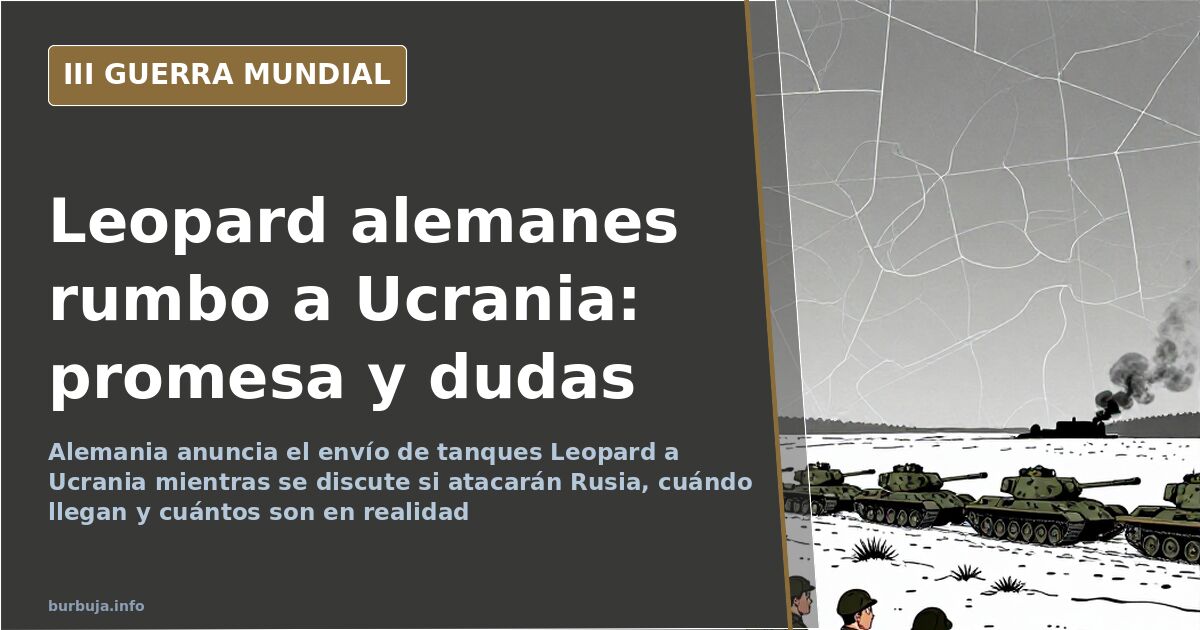
Germany will send Leopard tanks to Ukraine amid doubts over impact
The paradox is textbook: Germany will send Leopard tanks to Ukraine and the announcement is celebrated in two opposing camps that share absolutely nothing. For some, it shows Europe is holding firm. For others, it confirms that Moscow has just received the best propaganda gift of the decade: the news, it is said sarcastically, will help keep the Russian Federation united “for the next 80 years.” The framing behind the headline is no small matter: German tanks returning to Eastern Europe eighty years later.
How many Leopards will Germany send and when will they be at the front?
There is no official figure on the table, and that gap feeds skepticism. The circulating reference, attributed to Der Spiegel, speaks of “a company”: between 10 and 14 tanks. From there, demands skyrocket rhetorically: maybe 200, maybe 2,000, maybe better 2,030 by adding one more zero. The distance between what is promised and what one side considers necessary is, in itself, the argument.
Timelines trinc the same path. One current holds that the tanks will not be operational until 2024, which would leave Russia room to keep advancing with a fraction of its force, 10%, according to that same reading. On the other side, the opposite thesis: an official announcement always comes late, so if Berlin makes it public, it is because the tanks are already in Ukraine. Only seeing them in combat will resolve the doubt.
The logistical detail is also used as a weapon. A company is few vehicles for a front hundreds of kilometers long, but it is a huge political symbol; and there lies the knot: there is less debate about what the tanks can do and more about what their announcement means.
Will the Leopards attack Russia or only operate on Ukrainian soil?
The most repeated answer is no. The tanks would not attack Russia, but Russian forces and those of other nationalities deployed on Ukrainian soil. Crossing the border is described as a tail-risk scenario—a “black swan”—that no capital would be willing to assume. It is the nuance that separates the striking headline from operational reality.
Not everyone sees the problem there. Another reading holds that the shipment completes what was missing for Ukraine to face its next offensive with hundreds of Western tanks ahead. And a third current adds a demographic argument: it is claimed that a country with 150 million inhabitants, when its geography would admit many more, lacks the human base to sustain a prolonged war of attrition. The war is also fought in the numbers.
From the Bayraktars to the Leopards: the saga of miracle weapons
The sequence is listed with a mocking tone. Turkish Bayraktar drones were going to change the war. Then NLAW missiles. Then Javelins. Later HIMARS—“but it’s the HIMARS,” repeated as a catchphrase—. And now the Leopards. Behind them, they say, will come the turn of “sticks and stones.” The irony points to a recognizable pattern: each system is sold as the definitive one and turns the previous one into insufficient overnight.
That criticism works with two numbers. The first, cost: one million per missile launched. The second, the casualty ratio, which that current puts at ten Ukrainians for every Russian and considers incompatible with any change of script. The real effect of HIMARS, it is argued, was not so much direct damage as the blow to the power grid, with supply and communications deficits behind it. Whoever expected a turnaround on the map is still waiting for it.
The clash of doctrines: what it means to fight like NATO
Here the conversation becomes technical and tangled. One position holds that Ukraine resisted for two reasons: abandoning Soviet doctrine and training in that of a modern Western army. The counterreply is immediate and very specific: and what are those doctrines? The exchange drifts into an uncomfortable standoff, with one side pointing out that no modern army keeps its air force unused and the other demanding that what is asserted be made concrete.
There are links to foreign press to support the thesis of doctrinal change, and there is also an unanswered question: if the Western model is so superior, why does it need so much time and so much material for it to show. No one closes the circle, and that is precisely the interesting part.
From 1991 to the Crimea fleet: the most ideological reading
Part of the issue rewrites the chronology to its liking: Ukraine was between 1991 and 2014 a country friendly with Russia, with a common economic space, agreements signed in 1998 and the Russian fleet stationed in Crimea. The change, according to that version, came with what it describes as a coup d’état and a government that would have banned formations that totaled 80% of the votes. It is the least verifiable piece of the exchange and other currents reject it outright.
But it explains why everyone reads the dispatch of the Leopards as one more chapter in a clash of blocs, and not as a simple delivery of military material. Decades of crossed narratives fit into a three-line statement.
With those coordinates, the question hovering over the issue is the only one no statement resolves: what ultimately became of those tanks? Because between 10 and 2,030 there is a world, and neither extreme serves to decide a war.
The paradox is textbook: Germany will send Leopard tanks to Ukraine and the announcement is celebrated in two opposing camps that share absolutely nothing. For some, it shows Europe is holding firm. For others, it confirms that Moscow has just received the best propaganda gift of the decade: the news, it is said sarcastically, will help keep the Russian Federation united “for the next 80 years.” The framing behind the headline is no small matter: German tanks returning to Eastern Europe eighty years later.
How many Leopards will Germany send and when will they be at the front?
There is no official figure on the table, and that gap feeds skepticism. The circulating reference, attributed to Der Spiegel, speaks of “a company”: between 10 and 14 tanks. From there, demands skyrocket rhetorically: maybe 200, maybe 2,000, maybe better 2,030 by adding one more zero. The distance between what is promised and what one side considers necessary is, in itself, the argument.
Timelines trinc the same path. One current holds that the tanks will not be operational until 2024, which would leave Russia room to keep advancing with a fraction of its force, 10%, according to that same reading. On the other side, the opposite thesis: an official announcement always comes late, so if Berlin makes it public, it is because the tanks are already in Ukraine. Only seeing them in combat will resolve the doubt.
The logistical detail is also used as a weapon. A company is few vehicles for a front hundreds of kilometers long, but it is a huge political symbol; and there lies the knot: there is less debate about what the tanks can do and more about what their announcement means.
Will the Leopards attack Russia or only operate on Ukrainian soil?
The most repeated answer is no. The tanks would not attack Russia, but Russian forces and those of other nationalities deployed on Ukrainian soil. Crossing the border is described as a tail-risk scenario—a “black swan”—that no capital would be willing to assume. It is the nuance that separates the striking headline from operational reality.
Not everyone sees the problem there. Another reading holds that the shipment completes what was missing for Ukraine to face its next offensive with hundreds of Western tanks ahead. And a third current adds a demographic argument: it is claimed that a country with 150 million inhabitants, when its geography would admit many more, lacks the human base to sustain a prolonged war of attrition. The war is also fought in the numbers.
From the Bayraktars to the Leopards: the saga of miracle weapons
The sequence is listed with a mocking tone. Turkish Bayraktar drones were going to change the war. Then NLAW missiles. Then Javelins. Later HIMARS—“but it’s the HIMARS,” repeated as a catchphrase—. And now the Leopards. Behind them, they say, will come the turn of “sticks and stones.” The irony points to a recognizable pattern: each system is sold as the definitive one and turns the previous one into insufficient overnight.
That criticism works with two numbers. The first, cost: one million per missile launched. The second, the casualty ratio, which that current puts at ten Ukrainians for every Russian and considers incompatible with any change of script. The real effect of HIMARS, it is argued, was not so much direct damage as the blow to the power grid, with supply and communications deficits behind it. Whoever expected a turnaround on the map is still waiting for it.
The clash of doctrines: what it means to fight like NATO
Here the conversation becomes technical and tangled. One position holds that Ukraine resisted for two reasons: abandoning Soviet doctrine and training in that of a modern Western army. The counterreply is immediate and very specific: and what are those doctrines? The exchange drifts into an uncomfortable standoff, with one side pointing out that no modern army keeps its air force unused and the other demanding that what is asserted be made concrete.
There are links to foreign press to support the thesis of doctrinal change, and there is also an unanswered question: if the Western model is so superior, why does it need so much time and so much material for it to show. No one closes the circle, and that is precisely the interesting part.
From 1991 to the Crimea fleet: the most ideological reading
Part of the issue rewrites the chronology to its liking: Ukraine was between 1991 and 2014 a country friendly with Russia, with a common economic space, agreements signed in 1998 and the Russian fleet stationed in Crimea. The change, according to that version, came with what it describes as a coup d’état and a government that would have banned formations that totaled 80% of the votes. It is the least verifiable piece of the exchange and other currents reject it outright.
But it explains why everyone reads the dispatch of the Leopards as one more chapter in a clash of blocs, and not as a simple delivery of military material. Decades of crossed narratives fit into a three-line statement.
With those coordinates, the question hovering over the issue is the only one no statement resolves: what ultimately became of those tanks? Because between 10 and 2,030 there is a world, and neither extreme serves to decide a war.
Summary of a discussion on Burbuja.info - Foro de economía, actualidad y política., translated from Spanish and reviewed before publication. Read the full discussion (150 replies).
More summaries
-
Lavrov warns: if Europe attacks Russia, 'it will be a very short war'
Lavrov: if Europe attacks Russia, the war 'will be very short.' German hospitals are planning for the arrival of mass casualties, according to a tweet cited in the forum.
-
Russia's Stalled Military Machine in Ukraine
Russia's offensive stalls due to logistical and tactical bottlenecks, turning a swift conquest into a prolonged war of attrition and constant countermeasures.
-
Ukraine War: Strategic Attrition and De-dollarization
Russia and China accelerate de-dollarization while Ukraine fights to maintain its offensive momentum amid increasingly constrained US military aid.
-
Ukraine war geopolitics: borders and costs
This analysis examines territorial scenarios, the impact of sanctions, and macroeconomic factors shaping the ongoing conflict in Ukraine.
-
Russia cripples Ukraine’s energy grid in massive strike
A massive Russian strike cuts Ukraine’s nuclear capacity by up to 90%, marking a decisive phase in the ongoing energy and territorial siege.
-
Ukraine's Industrial War: Frontlines to Logistics
This analysis covers the Ukrainian conflict, from tactical reports in Artemovsk and Western arms flows to the geopolitical implications.