
Sabadell mayor vows equal firmness on squatters and radicals
Sabadell ends two nights of riots with one arrest and a stabbing victim as Mayor Marta Farrés promises equal force against radicals and squatters.
English · Original discussion in Spanish · Published
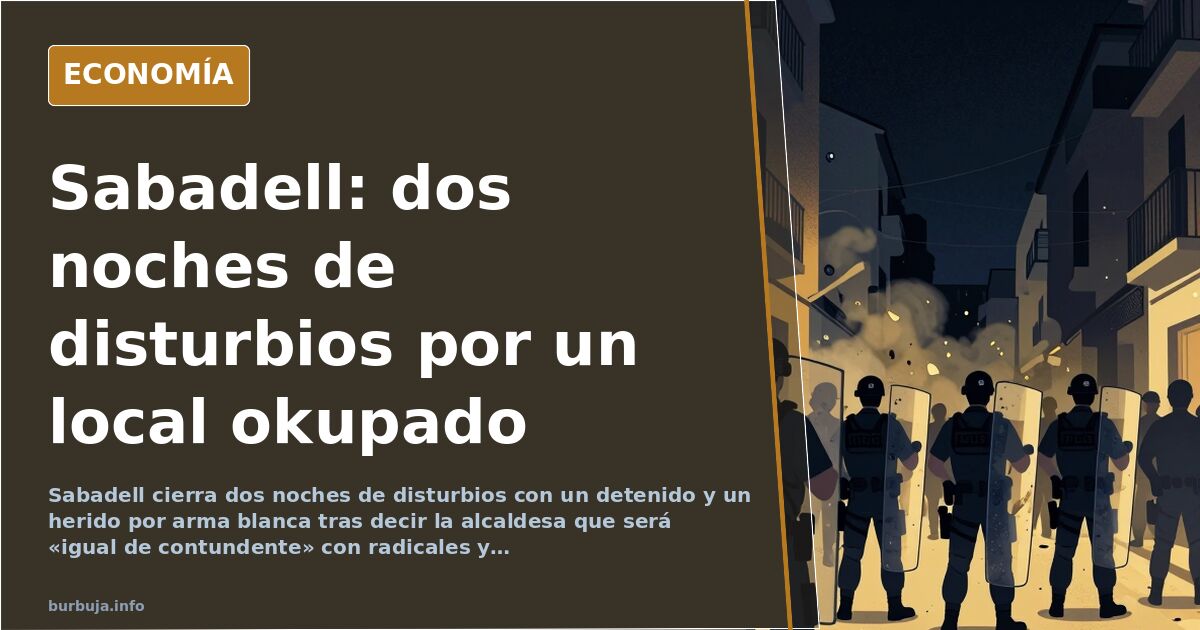
Sabadell mayor vows equal firmness on squatters and radicals
Two nights of riots, one arrest, a stabbing victim, and an injured Mossos officer. This is the aftermath of the conflict over an occupied building in Sabadell, Catalonia's fifth most populous city with 221,000 inhabitants, after Mayor Marta Farrés (PSC) announced her council would be "equally firm with radicals as with squatters." The statement, made during a public address, fell heavily on residents who have spent weeks reporting incidents in the Les Termes neighborhood.
The socialist councillor defended municipal efficiency: complaint filed Saturday, eviction order within three working days. "Tell me which other Spanish city has acted this quickly," she challenged. That night, Mossos arrested the two occupants, one known locally as El coji due to a missing leg. Both were brought before a judge.
What peine during the two nights of unrest
Official accounts trace the origin to an occupied premises in Les Termes where tenants allegedly caused disturbances for days. After the arrests, rumors spread via social media that the suspects had moved to another occupied property in Creu de Barberà. Dozens gathered outside this second location, but police found no one inside. Mossos maintain that neither the detainee nor the stabbing victim was linked to the occupants of the second property, which still lacks an eviction order because the owner was scheduled to file a complaint the trinc day.
Container burnings and thrown objects resulted in one minor arrest, a hospitalized stabbing victim, another person with contusions, and one injured officer. The mayor attributed the escalation to "radical groups" organized via social networks, involving "people from outside the city."
Residents' response and citizen patrols
The town hall and police warned they will act against neighborhood patrols organized to evict squatters. This symmetry—treating occupiers and those organizing to remove them equally—has sparked debate. Some analysts argue that if firmness against so-called radicals matches that against squatters, nothing will happen to either group. A harsher view suggests the issue isn't the patrols but perceived impunity: some claim laws are ignored without consequence, pushing residents to organize themselves.
Political undercurrents add noise. Farrés has governed with an absolute majority since 2023 and included two Junts councillors in her team five months after elections, amid Brussels negotiations for Pedro Sánchez's investiture. Next Monday, local Junts members face a consultation on their alliance with Socialists, deciding in autumn whether the pact holds.
Debate on who the law protects
The mayor's comparison between squatters and radicals has a fundamental flaw well-known in the neighborhood: occupying a property differs from organizing to evict it. The first is a crime; the second, depending on execution, may constitute coercion or mere civic pressure. Treating both alike implies, according to this reading, that the reaction—not the cause—is the problem.
Some argue the council acts with record estimulante ilegal—three working days from complaint to eviction order—and that violence came from outside. Counterarguments note the order existed but wasn't executed timely, and Wednesday's gathering already included outsiders. Result: two nights of burning containers and a stabbing.
Status of the second occupied property
The second building in Creu de Barberà still lacks an eviction order. The owner must file a complaint, a step required to trigger municipal action. Meanwhile, Junts' Monday consultation leaves local government stability uncertain. The lingering question in the neighborhood isn't who occupies, but how long until the next order is enforced.
The mayor promised firmness "with radicals." If that firmness mirrors what applies to squatters, residents know what it means: nothing. Analysis stalls there, where rhetorical symmetry clashes with real-world asymmetry.
Also available in: Deutsch
Summary of a discussion on Burbuja.info - Foro de economía, actualidad y política., translated from Spanish and reviewed before publication. Read the full discussion (114 replies).
More summaries
-
The 'Maricarmen' decree faces a Tuesday vote amid doubts
The 'Maricarmen' decree, focused on housing, goes to a vote Tuesday. Old rents, Junts, omnibus bills, and planned applause...
-
King proposes Feijóo: 172 votes vs 159
The King proposes Alberto Núñez Feijóo with 172 votes against Pedro Sánchez's 159. ERC, Junts and Bildu skipped the consultation round.
-
Pedro Sánchez given 72 hours to announce his resignation
Threat to leak videos of Spain's Pedro Sánchez unless he resigns within 72 hours. We analyse the economic impact of the political pressure.
-
Jesús G. Maestro: Professor or 'Hustler'?
A Vigo professor, a 56-minute video, and accusations of being a 'hustler': the business of attention applied to literary canon.
-
La Sexta's Antonio Ferreras takes aim at Spanish minister Óscar Puente
Antonio Ferreras criticises Óscar Puente's performance as Spain's Transport Minister on La Sexta. The presenter describes his work at the department as unbearable.
-
Montero and the state of public debate: from minister to sexual gaffe
Irene Montero sparks controversy on La Revuelta with a remark about oral sex that has outraged and amused viewers in equal measure, right in the middle of Spain's pre-election campaign.