
Montero and the state of public debate: from minister to sexual gaffe
Irene Montero sparks controversy on La Revuelta with a remark about oral sex that has outraged and amused viewers in equal measure, right in the middle of Spain's pre-election campaign.
English · Original discussion in Spanish · Published
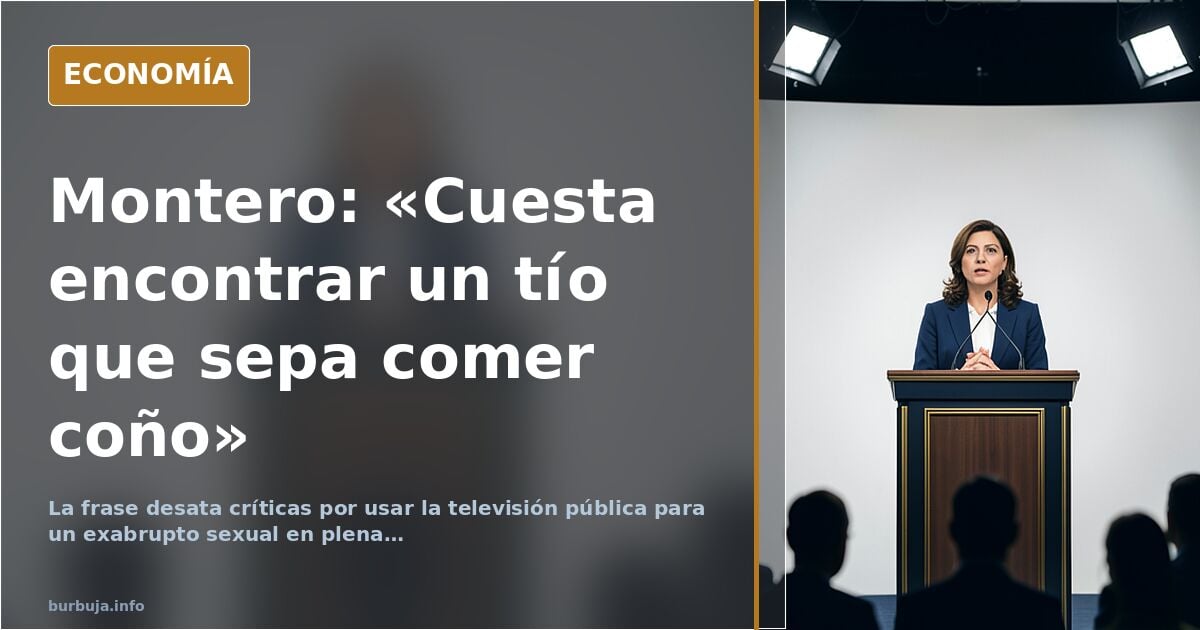
Irene Montero turns public television into a sensual joke
The Spanish politician has found a new genre: unintentional comedy. During an interview on La Revuelta, former Equality Minister and Podemos leader Irene Montero dropped a line that set social media alight: "It's hard to find a guy who knows how to eat shishi." Far from remaining a mere anecdote, the remark has served to take the pulse of public debate and of a political class that mistakes spontaneity for ridicule.
The context doesn't help. Montero appeared on Broncano's show alongside Gabriel Rufián, leader of Esquerra Republicana, in the middle of the campaign ahead of Spain's general election on 29 November. Invitations to the other candidates were still open, but it was the remark that stole the show. Within hours, the statement had become a meme, a headline and ammunition for her opponents. The question is unavoidable: are we looking at excessive candour, or a symptom of politics turning into a bar-room spectacle?
From minister to late-night talk-show regular
It is not the first time Montero has made headlines with off-script remarks. Her time at the helm of the Ministry of Equality was marked by constant controversies, from the "only yes means yes" law to her clashes with the press. Now, without a ministerial post, she seems to have found in TV studios a space where provocation replaces argument. The quip about the difficulty of finding men with certain skills is not a reflection on sensual: it is a calculated stunt designed to win over the audience and reap easy retweets.
The problem is less what she says than the setting in which she says it. Public television, funded by everyone's money, becomes a stage for wisecracks that have little to do with political debate. Some argue these formats bring politics closer to the people; others believe they degrade it. The truth is the line between the two is increasingly blurred, and Montero seems to navigate that ambiguity with ease.
The echo on social media: between mockery and outrage
The reaction was swift. On forums and social networks, the remark was met with a mix of astonishment and derision. Some compared the level of debate to that of the famous Cicciolina, while others wondered whether this is the kind of message a former minister should be sending in prime time. The irony flowed freely: from those calling for the quip to be added to the party's manifesto to those pointing out that fiscal policy and energy prices remain unresolved.
The conversation quickly turned to the role of public media and politicians' responsibility in shaping public discourse. Some argued that this kind of statement is a symptom of the trivialisation of politics, while others, tongue in cheek, noted that at least Montero talks about something people care about. Whatever the case, the anecdote has highlighted the gulf between the political class and citizens' real problems.
The cost of the gaffe: credibility and policy
Beyond the joke, the remark raises a deeper question: what is left of Podemos' political project when its leaders resort to this kind of remark? The party, once a decisive force in government, heads into the 29 November election showing clear signs of wear. The sensual anecdote does nothing to win back the trust of an electorate demanding serious proposals on jobs, housing or healthcare.
Economic and social policy demands more than stunts. While Montero talks about segarro skills, unemployment, inflation and public debt figures remain unresolved, with no one seemingly willing to debate them with the same intensity. The wisecrack, in short, is a symptom: of a political class that has learned to cash in on scandal before learning to manage complexity.
With the election just around the corner, the question is not whether Montero will surprise us with another off-colour remark, but whether voters will reward this style or punish it. Recent history suggests that spectacle sells, but it also tires. And when fatigue sets in, the punishment is usually merciless.
Also available in: Deutsch
Summary of a discussion on Burbuja.info - Foro de economía, actualidad y política., translated from Spanish and reviewed before publication. Read the full discussion (40 replies).
More summaries
-
Irene Montero hands Abascal knee pads on La Revuelta for use with Netanyahu
Irene Montero hands Santiago Abascal a pair of knee pads on the Spanish TV show La Revuelta. The gesture is part of the Podemos leader's campaign against international leaders.
-
Irene Montero 'gifts' knee pads to Abascal on La Revuelta, for use with Netanyahu
Irene Montero sends knee pads to Santiago Abascal in a stunt aired on La Revuelta, the Spanish TV show. An X post links the gesture to Netanyahu and Trump. Here is the context.
-
Irene Montero 'gifts' knee pads to Abascal on La Revuelta, meant for Netanyahu
Irene Montero hands Santiago Abascal a pair of knee pads on La Revuelta, in a gesture alluding to Netanyahu and Trump. Here's what's behind it.
-
The decline of specialist forums: what does the economy lose?
Economic forums are losing their best analysts: from 700 active members to a wasteland of bots. Data, causes and consequences of a silent exodus.
-
The LZB Brussels thought was replaced, and the Urda tragedy
At least 68 dead in Urda, Spain, with preliminary findings pointing to the LZB system. Iryo's warning came 23 days earlier.
-
The Israeli cyberattack hoax covering up Adif's breakdown in Spain
An Adif system down, trains halted, and a theory that already has a foreign culprit. The data points to maintenance, not an Israeli cyberattack.