
Jesús G. Maestro: Professor or 'Hustler'?
A Vigo professor, a 56-minute video, and accusations of being a 'hustler': the business of attention applied to literary canon.
English · Original discussion in Spanish · Published
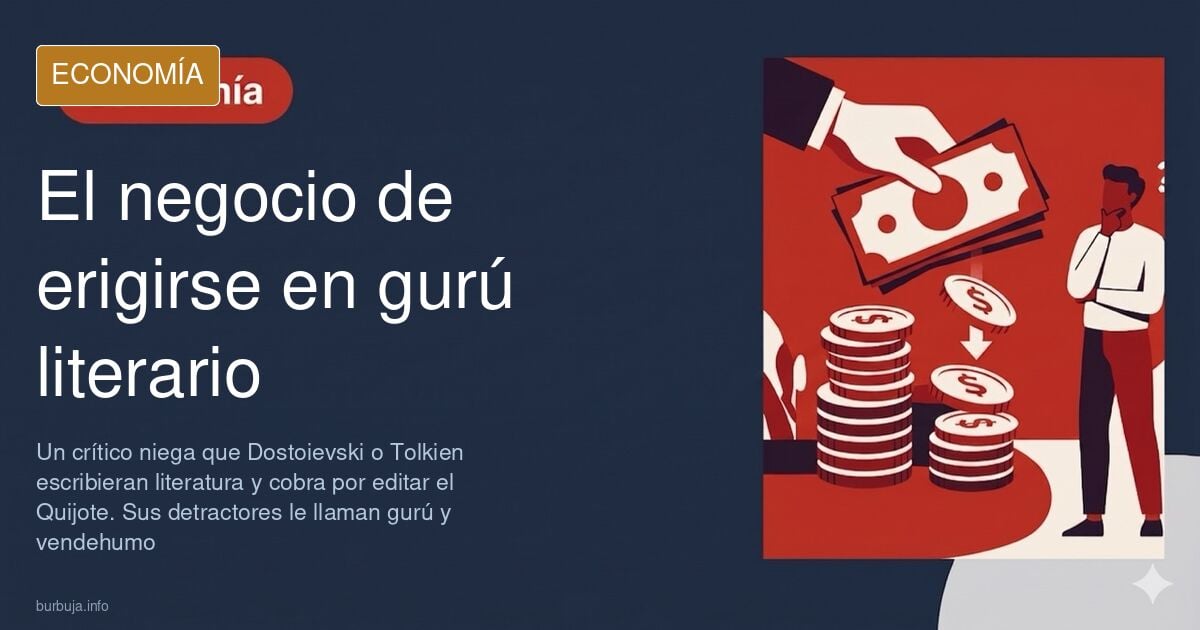
Don Quixote, a Professor, and the Attention Economy
A tenured Professor of Literary Theory at the University of Vigo has spent years defending an idea that critics find uncomfortable: that almost everything read outside of Spain is inferior. English, he argues, is "tremendously limiting", and according to those who challenge him, neither Dostoevsky nor Bolaño fit his definition of literature. A forum user defending him recounts reading The Hobbit in 1992 and finding it boring and childish. Don Quixote, however, is presented as the pinnacle of civilization. The question now has a name: is Jesús G. Maestro a 'hustler' (vendehumos)?
What a Professor Sells: The Business of Attention
The economic critique is the most frequent. While fitness gurus sell courses for €49.99, his defenders draw a distinction in scale: he holds a lifetime professorship and has produced thousands of pages of essays, not a weekend workshop. Others argue that scale doesn't change the model. Short videos, pithy statements, disabled comments on his channel, and an audience that fuels subscriptions and sales. The machinery is the same as any content creator's: capture attention and convert it into revenue.
From Hispanism to Don Quixote as the Bible
The second accusation isn't about money, but about faith. It's argued that his crusade against Anglo culture and German idealism hides a cultural nationalism that places Don Quixote above any foreign canon. Those who trinc him see it as a method; his detractors, as sectarian Manichaeism: the enlightened versus the blind. His intellectual lineage traces back to Gustavo Bueno's philosophical materialism, a school of thought that doesn't tolerate dissent well. The most uncomfortable detail, they say, is that the author himself doesn't laugh while reading the novel he claims to defend.
The Critic Also Sells: Two Altars, One Market
And then there's the underlying irony. The video that ignited the controversy is 56 minutes long and was made by another popularizer who is accused of criticizing the 'hustler' while promoting his own novels. Two altars, one market. The most common analogy is that of a musician who talks endlessly about instruments and technique but never actually plays. Online, those who don't sell a course sell a book; those who don't sell a book sell a piece of their soul.
One question remains, which no one fully answers: can someone who hasn't published a single novel judge what is and isn't literature? His defense is that his role is that of a theorist, analyzing how others create. His critics argue that this is meta-language disguised as academic authority. And in the middle is the reader, who just wanted to know if it's worth listening to him.
A tenured Professor of Literary Theory at the University of Vigo has spent years defending an idea that critics find uncomfortable: that almost everything read outside of Spain is inferior. English, he argues, is "tremendously limiting", and according to those who challenge him, neither Dostoevsky nor Bolaño fit his definition of literature. A forum user defending him recounts reading The Hobbit in 1992 and finding it boring and childish. Don Quixote, however, is presented as the pinnacle of civilization. The question now has a name: is Jesús G. Maestro a 'hustler' (vendehumos)?
What a Professor Sells: The Business of Attention
The economic critique is the most frequent. While fitness gurus sell courses for €49.99, his defenders draw a distinction in scale: he holds a lifetime professorship and has produced thousands of pages of essays, not a weekend workshop. Others argue that scale doesn't change the model. Short videos, pithy statements, disabled comments on his channel, and an audience that fuels subscriptions and sales. The machinery is the same as any content creator's: capture attention and convert it into revenue.
From Hispanism to Don Quixote as the Bible
The second accusation isn't about money, but about faith. It's argued that his crusade against Anglo culture and German idealism hides a cultural nationalism that places Don Quixote above any foreign canon. Those who trinc him see it as a method; his detractors, as sectarian Manichaeism: the enlightened versus the blind. His intellectual lineage traces back to Gustavo Bueno's philosophical materialism, a school of thought that doesn't tolerate dissent well. The most uncomfortable detail, they say, is that the author himself doesn't laugh while reading the novel he claims to defend.
The Critic Also Sells: Two Altars, One Market
And then there's the underlying irony. The video that ignited the controversy is 56 minutes long and was made by another popularizer who is accused of criticizing the 'hustler' while promoting his own novels. Two altars, one market. The most common analogy is that of a musician who talks endlessly about instruments and technique but never actually plays. Online, those who don't sell a course sell a book; those who don't sell a book sell a piece of their soul.
One question remains, which no one fully answers: can someone who hasn't published a single novel judge what is and isn't literature? His defense is that his role is that of a theorist, analyzing how others create. His critics argue that this is meta-language disguised as academic authority. And in the middle is the reader, who just wanted to know if it's worth listening to him.
Summary of a discussion on Burbuja.info - Foro de economía, actualidad y política., translated from Spanish and reviewed before publication. Read the full discussion (81 replies).
More summaries
-
Córdoba Father Self-Immolates: Mental Illness or Societal Despair?
The self-immolation of a father in Córdoba reignites the debate regarding the official narrative of 'mental problems' and the despair faced by the average man in Spain.
-
Euthanasia in Old Age: Autonomy vs. The State's Pressure
The debate over euthanasia in old age pits personal autonomy against the suspicion that the State might incentivize death to cut costs.
-
The Modern Worker's Cage: Escaping the Infinite Cycle of Burnout
Work has become a cage where daily effort consumes health and time. Discover why we push ourselves so hard and how to break the cycle.
-
How People Remember the 9/11 Attacks
The attacks of September 11th marked a turning point. Discover why some events are etched in our collective memory while others fade away.
-
Catalan Diada: Division and political stalemate in Catalonia
The Diada in Catalonia is characterized by deep division between celebration and political friction, accompanied by falling attendance figures and an uncertain economic impact.
-
Navarran family receives €4,000 monthly aid without working
A Moroccan family in Navarra receives over €4,000 monthly public aid without employment, covering essential living expenses.