
Russian War Faith Crumbles: From Moscow to Kherson
Moskva sinking, HIMARS strikes and Kherson loss fuel doubts on Putin's military effectiveness.
English · Original discussion in Spanish · Published
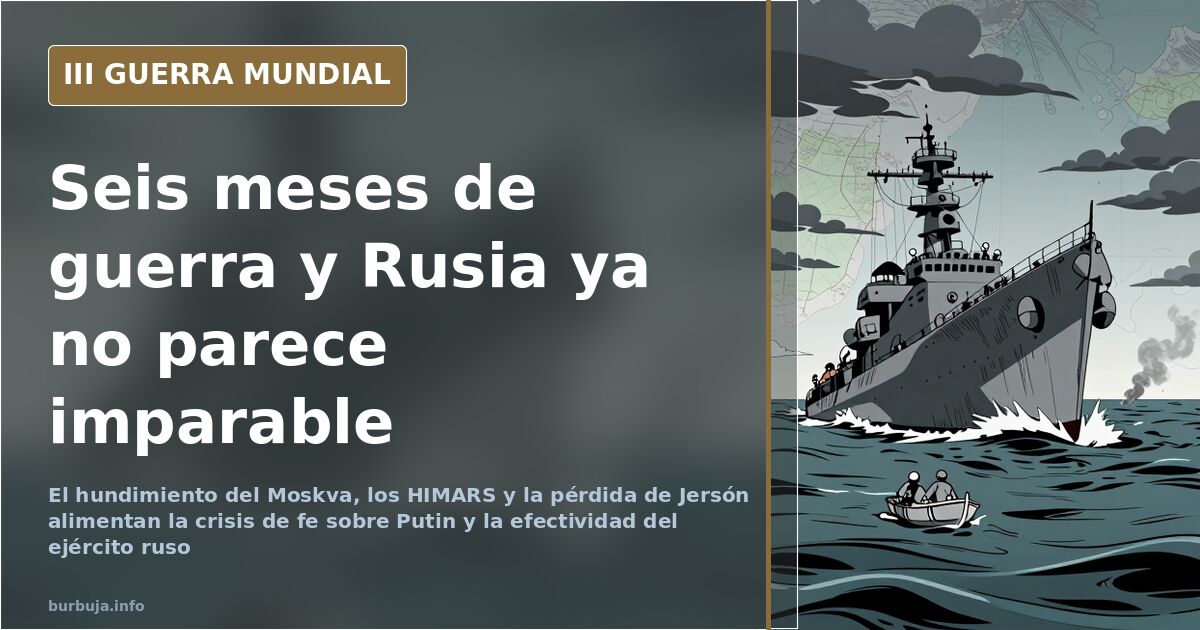
Can a war assumed won in three days be lost?
Six months after the special military operation began, the question is no longer when Kyiv will fall, but whether Moscow can keep what it seized in week one. The sinking of the cruiser Moskva, the withdrawal from Snake Island, setbacks in Kharkiv and Lyman, and the subsequent loss of Kherson have turned certainty into reasonable doubt. What started as an act of faith — Russia as a world power with Eurasia’s best army — has become a crisis of confidence that slogans no longer mask. And this isn’t raised by adversaries. It’s raised by supporters.
Where did doubts about the Russian army begin?
First symptoms didn’t come from the ground front. The sinking of the cruiser Moskva was the first blow to naval prestige, and leaving Snake Island confirmed Black Sea dominance wasn’t guaranteed. After that, every claimed victory was read with suspicion. This isn’t opposition rhetoric: it’s confession from those who backed the operation without reservation.
The official narrative cracked elsewhere. The Russian-speaking east of Ukraine was expected to welcome invaders as liberators. Thirty years of independence had done the opposite. The result, per available data, is a bogged-down invading force forced to fight a population that won’t surrender — not even those speaking Russian at home.
HIMARS and range breaking rear lines
HIMARS launch systems changed the equation. Analysis suggests precision artillery destroyed thousands of tons of Russian ammunition, forcing dispersal of depots, logistics hubs and command posts. Some argue these systems are unstoppable against deployed air defenses and their growing range makes airspace protection futile.
Critical point came with attacks on Crimea, considered Russian territory. Talk shifted from Kyiv feints to defeat. Uncomfortable question lingers: if rear areas aren’t protected, what exactly do air defenses protect?
Why doesn’t Donbas offensive advance?
Donbas fortifications have been built over eight years. Not improvised trenches, but layered defensive systems requiring position-by-position dismantling, consuming time, men and ammo. That explains — not justifies — an advance pace many deem unworthy of a major army. Most optimistic circulating prediction placed defense collapse by month-end; prudent ones much later.
Territorial gains in Donetsk and Luhansk fall short of expectations. Against this, some recall Ukraine could have negotiated federal status and that losing means losing everything: eastern industrial heartland, Azov Sea access and illusion NATO would defend it.
Miscalculation on Ukrainian nationhood
For years Moscow insisted Ukraine was administrative invention. Invasion produced opposite: reinforced Ukrainian nationalism and hostility toward Russia along entire western border. Lithuania, Latvia, Estonia, Poland or Romania appear among neighbors viewing Moscow unfavorably. This is the operation’s unaccounted cost.
Kherson, Lyman and propaganda wear
Loss of Kherson and setbacks in Lyman achieved what front couldn’t: dividing believers. One side argues Russia can’t afford defeat, as it opens door to worse continental scenario. Other admits disaster. “This is a mess and ridicule was tremendous,” summarizes one stance before blaming poor planning and leadership vision lack.
Clash isn’t ideological, it’s faith-based. For some, city fall creates theological problem. For others, reckoning with propaganda selling quick victory.
Russian gas and fading European lever
Background reveals weapon Moscow deemed decisive. Several European countries agreed paying Russian gas in rubles and Hungary still buys, but real threat is opposite: Europe finding alternative suppliers rendering gas useless as leverage. There lies medium-term risk for part of analysis. Not in Donbas map.
Are there sides in this war?
Minority current dismantles entire framework. If no sides exist and conflicts are business deals with victims, faith crisis is flawed premise: can’t lose faith in something never cause. Most comfortable and least verifiable exit.
Excuse not returning Kherson
Remaining comfort of recent months: blame falls not on soldiers doing their best, but planners failing from start. Reassuring. Doesn’t return Kherson.
Also available in: Deutsch
Summary of a discussion on Burbuja.info - Foro de economía, actualidad y política., translated from Spanish and reviewed before publication. Read the full discussion (121 replies).
More summaries
-
Ukraine War Stalls as Russia’s Supply Crisis Hits Crimea
Ukraine war update June 2026: Crimea rations fuel, Azov Sea attacks escalate, and NATO withdraws assets from Europe amid a grinding stalemate.
-
German Ex-General: "Ukraine is a US-Russia Power Struggle"
A German ex-general views the Ukraine war as a power play between the US and Russia, with little movement on the front lines for over a year.
-
Russia's Hidden Army: Myth or Soviet Scrap?
Russia entered Ukraine with 200,000 soldiers and nearly a million in reserve. The 2,000 T-90 tanks haven't appeared: hidden arsenal or Soviet junk?
-
Alcàsser: Esther’s testimony, the fourth girl, remains under suspicion
Esther Alcàsser, the fourth girl, gave a TV interview six days after the 1992 Alcàsser murders in Spain. Her account and timeline discrepancies fuel ongoing controversy.
-
Ukraine war resembles 1914, but with drones
Artillery, trenches and drones: the Ukraine front mirrors the attrition of 1914, with a flying eye that kills. A parallel that divides analysts.
-
Russia's alleged contempt for Spain: the myth dividing pro-Russian voices
One claim holds that Russians look down on Spaniards, but it rests on anecdotes and internet comments. The debate reveals more about the Spanish inferiority complex than about Russia.