
Russia's Hidden Army: Myth or Soviet Scrap?
Russia entered Ukraine with 200,000 soldiers and nearly a million in reserve. The 2,000 T-90 tanks haven't appeared: hidden arsenal or Soviet junk?
English · Original discussion in Spanish · Published
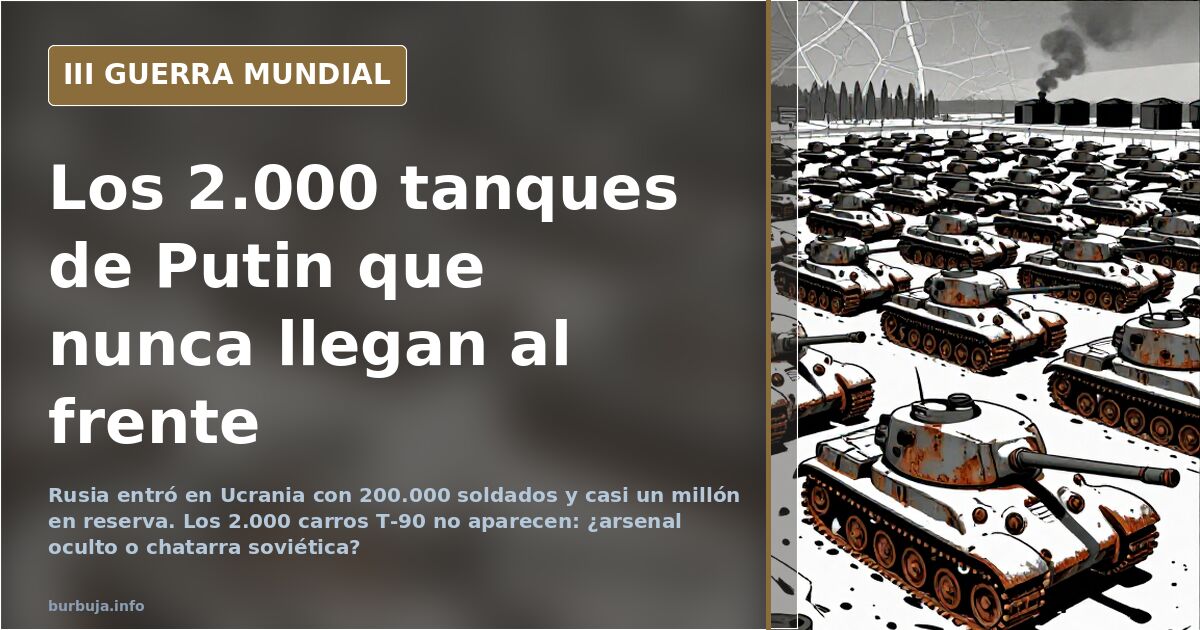
Pilingui's Hidden 2,000 T-90 Tanks: Unseen in Ukraine
Rusia entered Ukraine with 200,000 soldiers spread across three or four fronts, out of a theoretical army of almost a million men. Images emerging since then show abandoned trucks due to lack of fuel, expired rations, and armored vehicles older than their drivers. The question has lingered for months without a clear answer: is the good equipment waiting its turn, or did it never exist?
An Army of a Million, Yet Only 200,000 Seen
The first clash is arithmetic. Russia commands an army of nearly a million personnel and deploys around 200,000 in Ukraine. Some are convinced: the 'heavy hitters' haven't been deployed, and the nearly 2,000 T-90 tanks remain in their barracks. Others recall that there are also 12,000 Chechens in the rear guard and up to 16,000 Syrians ready to be cannon fodder.
The optimistic version suggests Moscow is holding back forces in case NATO crosses a line it hasn't yet. The skeptical version counters with the simplest argument: what's stuck in the mud is the Russian army, and those boasting of superweapons haven't shown anything to contradict it.
The Budget That Undermines the Superpower Narrative
The headline numbers don't support the epic narrative. Russian military spending doesn't even reach 10% of the US total and is already behind India's. From that amount, the maintenance of the Soviet legacy and the deterrent nuclear arsenal must be subtracted. What remains, according to the harshest calculation circulating, barely covers commissions and 'shoddy work' in a state with structural corruption.
Against this stands an uncomfortable argument for those who measure armies by their bills: the US spends on bases worldwide and always buys the most expensive. Russia doesn't have that deployment and can concentrate its spending. Furthermore, its weaponry has seen the most real combat use on the planet. Both facts are true and don't cancel each other out.
From 'Kyiv in Two Days' to a Three-Month War
Here lies the crux. When the invasion began, most assumed a lightning war. Within fifteen days, the same narrative was recycled into a textbook 'two or three-month war.' The suspicion isn't new: every time the calendar fails, a doctrine appears to justify it retroactively.
The underlying problem is the lack of certainty about anything. Not about who truly commands, nor about intentions, nor about what portion of the destruction is incompetence and what is scripted. A war fought on two planes simultaneously—the front line and the narrative—always leaves that door open.
Strategic Reserves or Inherited USSR Junk?
There's a far-fetched explanation and a pedestrian one. The first claims that abandoned vehicles without fuel aren't a sign of logistical misery but of such rapid advances that supply lines were cut by counterattacks. It recalls that Israel lost over 1,000 tanks in the Yom Kippur War without anyone declaring its army finished.
The more down-to-earth explanation points to a 'use and discard' doctrine, crew survival rates, and a country that manufactures a lot but maintains little. Comparisons with the Israeli or US pace in Iraq are what leave the army some are still waiting for in the worst light.
The Logistics That Betray: Iran, Belarus, and North Korea
If anything dismantles the theory of a hidden arsenal, it's what's being bought externally. Belarus sends ammunition by train; Russia requests material from North Korea, which poses for photos but delivers little; and it buys artillery and drones from Iran. China, according to this reading, watches from the sidelines. This isn't the picture of a country hiding its best, but one running out of replacements.
The cost isn't just military. Europe depends on Russian gas and oil, and the choice of which pipeline to close and which not continues to affect electricity bills and supermarket shortages. The war is also fought on the tariff.
An unknown remains that neither GDP nor columns of tanks can resolve. If the good equipment exists and isn't being deployed, someone is deciding that thousands of soldiers should die before it's brought out. If it doesn't exist, then the superpower has been selling smoke for years. In either case, the result on the ground is identical.
Rusia entered Ukraine with 200,000 soldiers spread across three or four fronts, out of a theoretical army of almost a million men. Images emerging since then show abandoned trucks due to lack of fuel, expired rations, and armored vehicles older than their drivers. The question has lingered for months without a clear answer: is the good equipment waiting its turn, or did it never exist?
An Army of a Million, Yet Only 200,000 Seen
The first clash is arithmetic. Russia commands an army of nearly a million personnel and deploys around 200,000 in Ukraine. Some are convinced: the 'heavy hitters' haven't been deployed, and the nearly 2,000 T-90 tanks remain in their barracks. Others recall that there are also 12,000 Chechens in the rear guard and up to 16,000 Syrians ready to be cannon fodder.
The optimistic version suggests Moscow is holding back forces in case NATO crosses a line it hasn't yet. The skeptical version counters with the simplest argument: what's stuck in the mud is the Russian army, and those boasting of superweapons haven't shown anything to contradict it.
The Budget That Undermines the Superpower Narrative
The headline numbers don't support the epic narrative. Russian military spending doesn't even reach 10% of the US total and is already behind India's. From that amount, the maintenance of the Soviet legacy and the deterrent nuclear arsenal must be subtracted. What remains, according to the harshest calculation circulating, barely covers commissions and 'shoddy work' in a state with structural corruption.
Against this stands an uncomfortable argument for those who measure armies by their bills: the US spends on bases worldwide and always buys the most expensive. Russia doesn't have that deployment and can concentrate its spending. Furthermore, its weaponry has seen the most real combat use on the planet. Both facts are true and don't cancel each other out.
From 'Kyiv in Two Days' to a Three-Month War
Here lies the crux. When the invasion began, most assumed a lightning war. Within fifteen days, the same narrative was recycled into a textbook 'two or three-month war.' The suspicion isn't new: every time the calendar fails, a doctrine appears to justify it retroactively.
The underlying problem is the lack of certainty about anything. Not about who truly commands, nor about intentions, nor about what portion of the destruction is incompetence and what is scripted. A war fought on two planes simultaneously—the front line and the narrative—always leaves that door open.
Strategic Reserves or Inherited USSR Junk?
There's a far-fetched explanation and a pedestrian one. The first claims that abandoned vehicles without fuel aren't a sign of logistical misery but of such rapid advances that supply lines were cut by counterattacks. It recalls that Israel lost over 1,000 tanks in the Yom Kippur War without anyone declaring its army finished.
The more down-to-earth explanation points to a 'use and discard' doctrine, crew survival rates, and a country that manufactures a lot but maintains little. Comparisons with the Israeli or US pace in Iraq are what leave the army some are still waiting for in the worst light.
The Logistics That Betray: Iran, Belarus, and North Korea
If anything dismantles the theory of a hidden arsenal, it's what's being bought externally. Belarus sends ammunition by train; Russia requests material from North Korea, which poses for photos but delivers little; and it buys artillery and drones from Iran. China, according to this reading, watches from the sidelines. This isn't the picture of a country hiding its best, but one running out of replacements.
The cost isn't just military. Europe depends on Russian gas and oil, and the choice of which pipeline to close and which not continues to affect electricity bills and supermarket shortages. The war is also fought on the tariff.
An unknown remains that neither GDP nor columns of tanks can resolve. If the good equipment exists and isn't being deployed, someone is deciding that thousands of soldiers should die before it's brought out. If it doesn't exist, then the superpower has been selling smoke for years. In either case, the result on the ground is identical.
Summary of a discussion on Burbuja.info - Foro de economía, actualidad y política., translated from Spanish and reviewed before publication. Read the full discussion (230 replies).
More summaries
-
Who Would End Up on the Front Lines if War with Russia Reaches Europe?
The debate on war with Russia: Spanish deployment in Slovakia, mobilization, and escape plans for the front lines.
-
Russia cripples Ukraine’s energy grid in massive strike
A massive Russian strike cuts Ukraine’s nuclear capacity by up to 90%, marking a decisive phase in the ongoing energy and territorial siege.
-
Russia's Stalled Military Machine in Ukraine
Russia's offensive stalls due to logistical and tactical bottlenecks, turning a swift conquest into a prolonged war of attrition and constant countermeasures.
-
Ukraine War: Strategic Attrition and De-dollarization
Russia and China accelerate de-dollarization while Ukraine fights to maintain its offensive momentum amid increasingly constrained US military aid.
-
Ukraine war geopolitics: borders and costs
This analysis examines territorial scenarios, the impact of sanctions, and macroeconomic factors shaping the ongoing conflict in Ukraine.
-
Ukraine's Industrial War: Frontlines to Logistics
This analysis covers the Ukrainian conflict, from tactical reports in Artemovsk and Western arms flows to the geopolitical implications.