
Ukraine war resembles 1914, but with drones
Artillery, trenches and drones: the Ukraine front mirrors the attrition of 1914, with a flying eye that kills. A parallel that divides analysts.
English · Original discussion in Spanish · Published
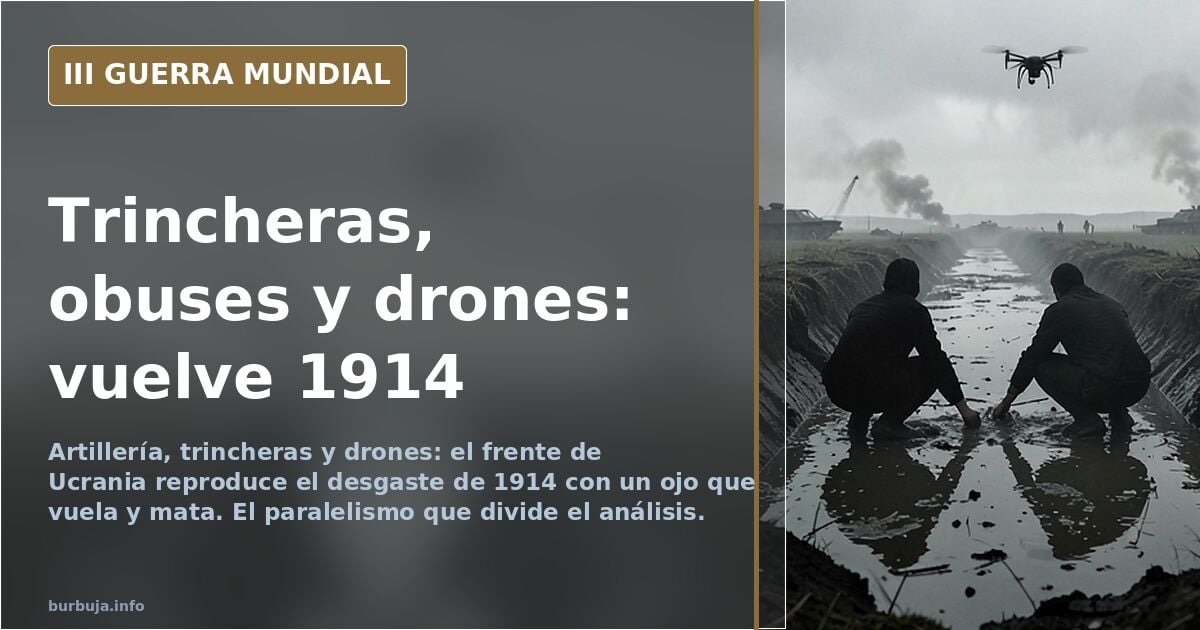
From the Great War to drone warfare: the front that never moves
A soldier fires 900 rounds per minute with an assault rifle. In 1914 he carried a bolt-action rifle and little else. Setting aside that technological gulf, much of the analysis conveys the feeling of watching a film that has already been made: artillery pounding positions, trenches that never move, advances measured in metres and infantry crawling through the mud. The thesis that opens the discussion is that the war in Ukraine has returned to an attrition model reminiscent of the First World War, with one addition that did not exist back then: drones.
The comparison is no whim. The initial plan for a rapid assault failed within the first weeks and the front froze, just as peine in 1914 when the German advance towards Paris was halted. From then on, defensive innovations — the machine gun, barbed wire, and now the drone and the portable anti-tank missile — turned any offensive into a bloodletting exercise. The question hanging over it all is whether this means we are back in 1916, or whether technology has changed the rules so much that the parallel falls apart the moment you scratch the surface.
Artillery: king of the battlefield, a century later
The first argument supporting the resemblance is artillery. In the Great War, the bombardments preceding any assault lasted days and consumed millions of shells. Now attacks are launched by small groups of soldiers to pin the enemy in place, and then the artillery does the work. The difference, and it is enormous, lies in precision: laser-guided munitions allow a shell to land right inside a trench, something unthinkable a century ago, when hundreds of bombs were needed to hit a target.
That precision has not reduced the volume. Russia fires tens of thousands of shells daily, a figure that no NATO country, even adding all their industries together, can match in the short term. The figure circulating in the analysis is stark: combined Western production falls short of the 40,000 shells a day being fired at the front. Artillery still decides the outcome, but now with the help of an eye hovering over the battlefield.
Drones: the observation balloon of the 21st century
Here lies the novelty that breaks the mould. Drones can locate the enemy and drop a bomb into a trench, and their output, though it may seem modest — one flight, one soldier — is devastating for a simple reason: they are dirt cheap compared with any other weapon. More effective than a sniper and costing next to nothing, they have become the tool that corrects artillery fire, exactly the role played by observation balloons at the start of the First World War.
The comparison with the balloon is no flights of fancy. Back then, observers were lifted into the air in aerostats to aim and correct artillery fire; today a drone with a camera does the job. The difference is that the drone also kills. And its permanent presence over the front has turned any movement into a risk. Some argue that drones, rather than guided missiles — whose cost keeps them scarce — are the true revolution of this war.
Tanks and aircraft: defence rules
The second pillar of the parallel is the paralysis of offensive means. Tanks are on the defensive because portable anti-tank weapons are highly effective. Aircraft are barely seen because air defences have proved more effective than anyone expected. And guided missiles, the great novelty compared with 1914, are so expensive that they are used sparingly.
The result is a battlefield where the attacker pays a brutal price. Infantry machine guns, by contrast, do not play the role they did in the Second World War because advances are not massive but careful, almost probing. It is the logic of attrition: the aim is not to break the front but to bleed dry whoever tries to break it.
Nuclear weapons: the elephant that is not in the room
Nobody wants to be the first to use them. That is the most repeated consensus. The comparison with Hitler, who did not use chemical weapons even with the Russians entering Berlin, serves to illustrate the idea that the most destructive weaponry ends up as a decorative object. Basically, it is as if they did not exist, the opening argument concludes.
The nuance added by another part of the analysis is that it is not just about not wanting to be first, but that whoever launches them dies shortly afterwards. The rational calculation of suicide does not outweigh the hot-headed impulse. Deterrence works, even if only through sheer survival instinct.
The human cost and the question left open
The upshot of all this is a battlefield of artillery and infantry rifles, as in 1914, at an enormous cost in lives. Infantry remains indispensable for holding territory, and in Western Europe no country can raise troops the way Russia or Ukraine can. All the NATO countries combined could not mobilise half a million effective soldiers to fight, according to the estimate being used.
The paradox is that the most technological war in history resembles, in its course, the most analogue one. And the question nobody quite answers is whether that is because technology has not changed the rules that much, or because the rules of attrition have been the same since gunpowder was invented. Meanwhile, the front does not move and the shells keep falling.
Also available in: Deutsch
Summary of a discussion on Burbuja.info - Foro de economía, actualidad y política., translated from Spanish and reviewed before publication. Read the full discussion (58 replies).
More summaries
-
Stoltenberg demands China pay for backing Russia
Stoltenberg calls on China to pay for supporting Russia and announces sanctions. The debate looks at the cost for Europe and the shift toward the BRICS.
-
Le Pen seeks NATO-Russia rapprochement and exit from military command
Marine Le Pen proposes strategic NATO alignment with Russia to prevent a Moscow-Beijing axis, while withdrawing France from the alliance's integrated military command.
-
Ukrainian teenagers pack explosives for FPV drones
A student packs explosives for FPV drones in Ukraine. The comparison with the Hitler Youth and the debate over minors in the war.
-
Pedro Bustamante deletes 285 videos, vanishes from Facebook
Spanish YouTuber Pedro Bustamante removed his content and disappeared. Rumors place him in Munich, reading German press.
-
Four K-52 helicopters shot down: the video that came from a video game
The footage of four Russian K-52 helicopters being shot down turned out to be a round of Arma 3. War propaganda is now being manufactured with video games.
-
Russia's alleged contempt for Spain: the myth dividing pro-Russian voices
One claim holds that Russians look down on Spaniards, but it rests on anecdotes and internet comments. The debate reveals more about the Spanish inferiority complex than about Russia.