
Russian electronic warfare causes US JDAM bombs to fail in Ukraine
Leaked Pentagon documents suggest that Russian GPS jamming and faulty fuses are causing US JDAM precision bombs to miss targets in Ukraine.
English · Original discussion in Spanish · Published
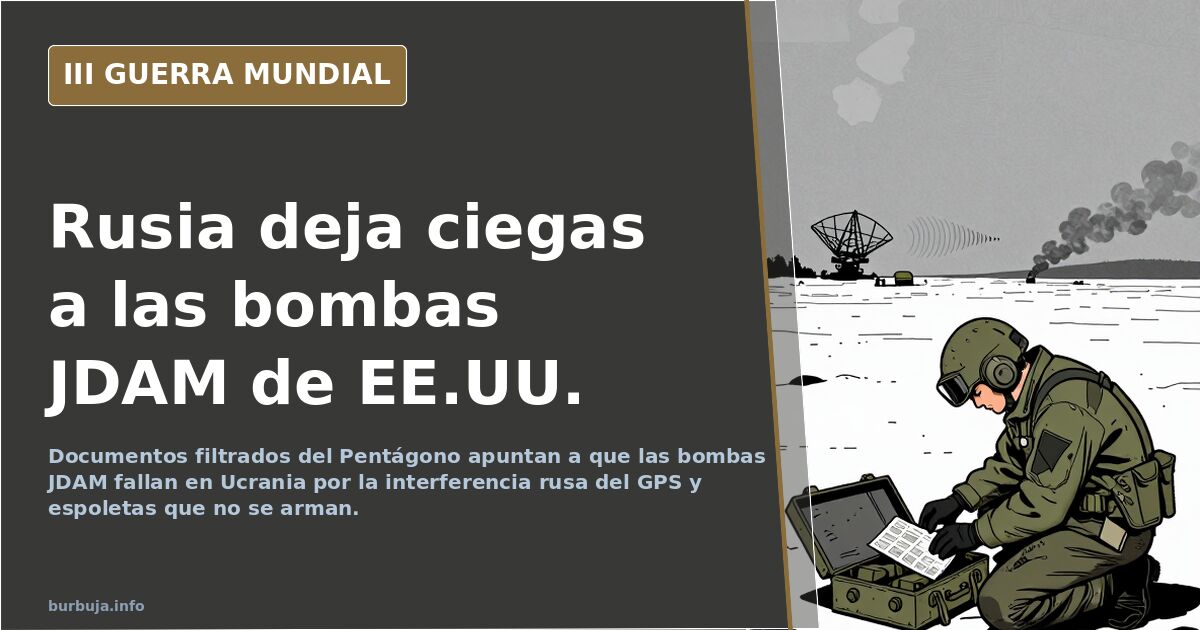
US JDAM-ER bombs failing in Ukraine due to GPS interference
The Pentagon began shipping kits in December that convert unguided aerial munitions into precision bombs. Weeks later, these weapons are failing more often than expected. Leaked intelligence documents from recent days—confirmed by a Department of Defense official—point to two causes: fuses that fail to arm upon release and, primarily, Russian interference with the guidance signal. In some cases, the bombs failed to detonate entirely.
The JDAM-ER is the extended-range version of Joint Direct Attack Munitions, deployable from bombers and fighters. The guidance kits are manufactured by Boeing, which has referred inquiries to the US Government. Pentagon spokesperson Lieutenant Colonel Garron Garn noted the "great success" of security assistance in defending Ukrainian sovereignty but declined to comment on battle damage or intelligence assessments.
What the leaks reveal about JDAM bombs
A Joint Chiefs of Staff slide outlines the technical issue, the solution applied by the Ukrainian Air Force to ensure fuses arm correctly, and a diagram of the munition. It also includes a failure rate count from recent attacks, detailing dates and the number of weapons required to neutralize each target. One recurring figure: four out of nine long-range JDAMs used by Ukrainian forces failed to hit Russian targets, likely due to interference. The accompanying recommendation is to neutralize jammers before deploying the bombs.
US officials believe Russian interference causes JDAMs and occasionally other weapons, such as guided rockets, to lose their target. "I believe there may be concern that the Russians could be interfering with the signal used to guide the JDAMs," summarizes Mick Mulroy, a former Pentagon official and retired CIA officer. The outlet that published the matter could not independently verify this information.
How do you deceive a satellite-guided bomb?
The principle is old and inexpensive. The bomb calculates its position by triangulating signals from positioning satellites that broadcast continuously. Jamming involves emitting radio frequency at higher power on the same band to block reception. There is a more sophisticated variant: tuning into the real signal, recording it, and retransmitting it with a delay and higher power so the receiver calculates a false position. This is called meaconing and does not require hacking.
A simple explanation is circulating: satellites are like lighthouses that repeat every second, "I am here and this is the time." If someone broadcasts on the same frequency while impersonating those lighthouses, the position goes haywire, and the weapon may fall 500 meters early, in an empty field or elsewhere. There are also mentions of a US reconnaissance drone that ended up in Iranian hands, though there is no consensus on whether deception affected the radio link or the positioning signal.
Why launch altitude determines the outcome?
To maximize range, the JDAM-ER requires altitude: the higher the altitude, the longer the glide time and the more kilometers covered. The problem is that at those heights, the aircraft becomes a visible target for radars and air defenses deployed in the area. Reported figures suggest launches occur between 50 and 80 kilometers from the target, distances that only make sense from high altitudes.
This creates a dilemma: climb, launch, and flee, or fly low and sacrifice range. Some argue that Russian bombs of the same type do not suffer this problem because they are launched outside the reach of Ukrainian air defenses. The difference is not in the device, but in who can afford to fly high.
Pacific Fleet collisions
Those arguing that signal interference is more potent than currently acknowledged point to an uncomfortable episode. US Pacific Fleet vessels, equipped with radars, sonars, and systems to track hundreds of targets simultaneously, collided with merchant ships under difficult-to-explain circumstances. Reports cite five cases in a short period and more than eight in a year.
For some, this is proof that positioning signal deception works. For others, it is bad luck and accumulated navigation errors. In any case, the case serves to illustrate how much reliance on an external signal has become a vulnerability.
Increased spending and less scrutiny
Skepticism runs through much of the issue. It is argued that alarms about malfunctioning weaponry are actually ways to request more money and maintain the flow of funds to the industry. Some point out that no weapon proves its reliability in a controlled environment: it must be used in a real war to know what happens, and systems like guided rockets or precision artillery projectiles use the same satellite logic. The use of the latter is said to have dropped significantly in attacks on rear positions.
While the precision of Western bombs is debated, it is being repeated that the ones not failing are Russian: up to twenty a day on Ukrainian positions, with 1,500 kg bombs falling at the front. This figure should be taken with a grain of salt. However, it is jarring: the system being announced as the most advanced is the one missing its mark.
The Pentagon began shipping kits in December that convert unguided aerial munitions into precision bombs. Weeks later, these weapons are failing more often than expected. Leaked intelligence documents from recent days—confirmed by a Department of Defense official—point to two causes: fuses that fail to arm upon release and, primarily, Russian interference with the guidance signal. In some cases, the bombs failed to detonate entirely.
The JDAM-ER is the extended-range version of Joint Direct Attack Munitions, deployable from bombers and fighters. The guidance kits are manufactured by Boeing, which has referred inquiries to the US Government. Pentagon spokesperson Lieutenant Colonel Garron Garn noted the "great success" of security assistance in defending Ukrainian sovereignty but declined to comment on battle damage or intelligence assessments.
What the leaks reveal about JDAM bombs
A Joint Chiefs of Staff slide outlines the technical issue, the solution applied by the Ukrainian Air Force to ensure fuses arm correctly, and a diagram of the munition. It also includes a failure rate count from recent attacks, detailing dates and the number of weapons required to neutralize each target. One recurring figure: four out of nine long-range JDAMs used by Ukrainian forces failed to hit Russian targets, likely due to interference. The accompanying recommendation is to neutralize jammers before deploying the bombs.
US officials believe Russian interference causes JDAMs and occasionally other weapons, such as guided rockets, to lose their target. "I believe there may be concern that the Russians could be interfering with the signal used to guide the JDAMs," summarizes Mick Mulroy, a former Pentagon official and retired CIA officer. The outlet that published the matter could not independently verify this information.
How do you deceive a satellite-guided bomb?
The principle is old and inexpensive. The bomb calculates its position by triangulating signals from positioning satellites that broadcast continuously. Jamming involves emitting radio frequency at higher power on the same band to block reception. There is a more sophisticated variant: tuning into the real signal, recording it, and retransmitting it with a delay and higher power so the receiver calculates a false position. This is called meaconing and does not require hacking.
A simple explanation is circulating: satellites are like lighthouses that repeat every second, "I am here and this is the time." If someone broadcasts on the same frequency while impersonating those lighthouses, the position goes haywire, and the weapon may fall 500 meters early, in an empty field or elsewhere. There are also mentions of a US reconnaissance drone that ended up in Iranian hands, though there is no consensus on whether deception affected the radio link or the positioning signal.
Why launch altitude determines the outcome?
To maximize range, the JDAM-ER requires altitude: the higher the altitude, the longer the glide time and the more kilometers covered. The problem is that at those heights, the aircraft becomes a visible target for radars and air defenses deployed in the area. Reported figures suggest launches occur between 50 and 80 kilometers from the target, distances that only make sense from high altitudes.
This creates a dilemma: climb, launch, and flee, or fly low and sacrifice range. Some argue that Russian bombs of the same type do not suffer this problem because they are launched outside the reach of Ukrainian air defenses. The difference is not in the device, but in who can afford to fly high.
Pacific Fleet collisions
Those arguing that signal interference is more potent than currently acknowledged point to an uncomfortable episode. US Pacific Fleet vessels, equipped with radars, sonars, and systems to track hundreds of targets simultaneously, collided with merchant ships under difficult-to-explain circumstances. Reports cite five cases in a short period and more than eight in a year.
For some, this is proof that positioning signal deception works. For others, it is bad luck and accumulated navigation errors. In any case, the case serves to illustrate how much reliance on an external signal has become a vulnerability.
Increased spending and less scrutiny
Skepticism runs through much of the issue. It is argued that alarms about malfunctioning weaponry are actually ways to request more money and maintain the flow of funds to the industry. Some point out that no weapon proves its reliability in a controlled environment: it must be used in a real war to know what happens, and systems like guided rockets or precision artillery projectiles use the same satellite logic. The use of the latter is said to have dropped significantly in attacks on rear positions.
While the precision of Western bombs is debated, it is being repeated that the ones not failing are Russian: up to twenty a day on Ukrainian positions, with 1,500 kg bombs falling at the front. This figure should be taken with a grain of salt. However, it is jarring: the system being announced as the most advanced is the one missing its mark.
Also available in: Deutsch
Summary of a discussion on Burbuja.info - Foro de economía, actualidad y política., translated from Spanish and reviewed before publication. Read the full discussion (101 replies).
More summaries
-
Russian Air Force in Ukraine: Incompetence or Doctrine?
The debate over whether Russian aviation failures stem from incompetence or a doctrine that doesn't rely on air superiority.
-
Ukraine bombs front line with Su-27 and 1,000-pound JDAM-ER
The Ukrainian Air Force releases video of a Su-27 dropping a 1,000-pound JDAM-ER, said to be the first.
-
Ukrainian offensive in Kherson, 'a fiasco,' according to a forum user
One sector deems Ukraine's Kherson offensive defeated, with thousands of casualties and lost armor; others deny it. Outcome open.
-
Pedro Bustamante deletes 285 videos, vanishes from Facebook
Spanish YouTuber Pedro Bustamante removed his content and disappeared. Rumors place him in Munich, reading German press.
-
Debate over map identifying pro-Russian websites including RT and Rebelión
A forum discussion examines a map of pro-Russian media networks in Europe, featuring RT and rebelion.org, sparking debates on blacklists and disinformation.
-
USS Truman in Red Sea: strikes, propaganda, and asymmetric warfare
The USS Truman continues operating in the Red Sea without verified hits, as Houthi forces launch Iranian missiles in an ongoing asymmetric conflict.