
Ukraine bombs front line with Su-27 and 1,000-pound JDAM-ER
The Ukrainian Air Force releases video of a Su-27 dropping a 1,000-pound JDAM-ER, said to be the first.
English · Original discussion in Spanish · Published
Three years of war: Ukraine bombs the front line with Su-27
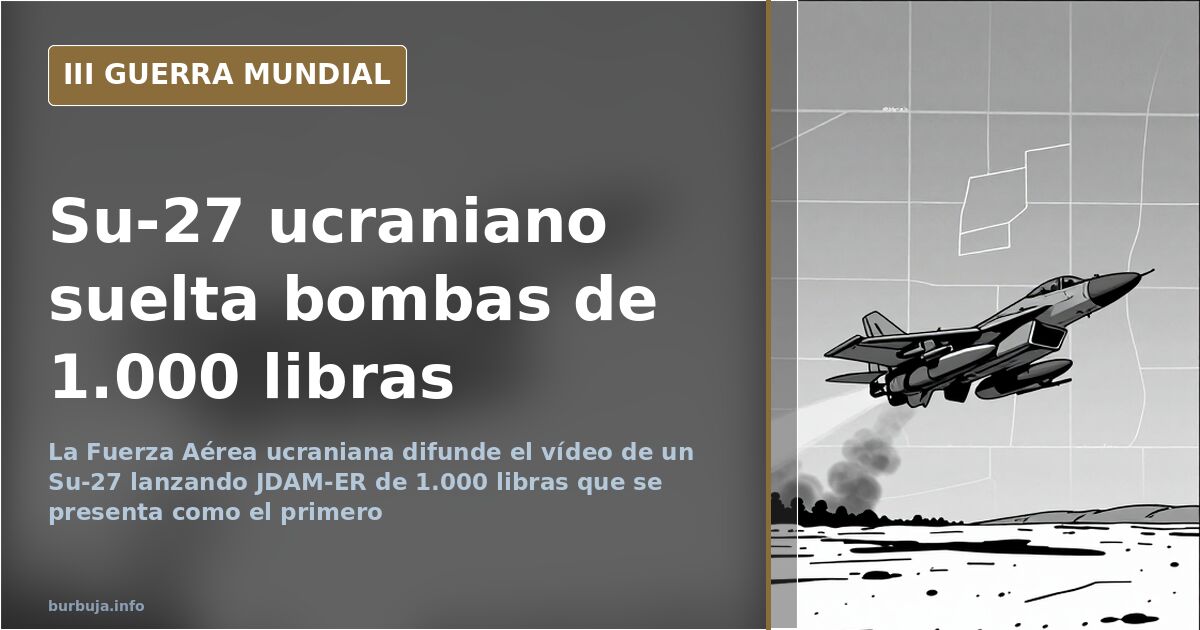
The Ukrainian Air Force has released what is presented as the first footage of a Su-27 Flanker dropping 1,000-pound JDAM-ER glide bombs on a Russian position. The detail that matters is not the aircraft but the munition: the Mk83-based JDAMs seen in the video carry roughly twice the explosive mass of those seen so far. Three years after the invasion began, a Soviet-designed fighter is still flying over the front line and dropping guided bombs. That image has prompted an uncomfortable interrogation: where is the Russian air force, the radars that detect low-signature aircraft, the S-500s, the long-range interceptors?
One strand of analysis sums it up with sarcasm: the supposed second air force in the world does not prevent Ukraine from flying over the front line and dropping 500-kilogram bombs on its soldiers. The other half of the board responds with a question as simple as it is uncomfortable: if they are so superior, why do they have less and less territory and why do we have to keep sending them everything?
Why hasn't Russia closed the sky three years later?
The least epic answer is also the most technical: it is not that Moscow has given up flying, but that a sky saturated with air defense systems punishes anyone who goes up. Ukraine inherited a substantial part of the Soviet air defense umbrella and in three years has received additional layers of defense. The other half of the exchange also works: aircraft in the rear launching long-range air-to-air missiles turn the front line into a hostile space for both sides. Some recall the Kosovo precedent, where a modest air defense shot down a low-observable aircraft, to argue that no army operates with impunity.
And then there is the nuance that makes both sides uncomfortable: Russia also bombs. Russian aviation punishes Ukrainian positions practically daily, argue those who trinc the conflict from the opposite side to the easy headline. What it does not do is the air superiority that its catalog promised. That is the gap through which all skepticism enters.
What does Western aid really contribute?
The inventory that the West has put on the table admits an ironic reading. Stingers from the eighties, Patriots from the nineties, a hundred Bradleys from the 2000s, rocket launchers and anti-tank missiles left over from Desert Storm, or a handful of F-16s that were going to be scrapped. Turkey with cluster munitions and drones, Czechia with millions of artillery shells, the United Kingdom with cruise missiles: some argue that Europe has contributed more than Washington.
To that accounting, it is worth adding another figure that is repeated in the debate: according to one of the positions, about 80% of Ukrainian weaponry is still Soviet or captured Russian material, like the Su-27 in the video itself. That is, the scene that opens the controversy is not signed by NATO, but by an aircraft that already existed before it all began.
Against that, the opposing argument has its own ammunition: Ukraine is not a helpless country. According to that reading, it has more than 200 civilian and military satellites monitoring the front in real time, Western officers in war rooms, and the inherited air defense umbrella. Presenting it as an unarmed David, they say, is an insult to intelligence.
Why is the side that dominates the sky losing territory?
The question that unsettles the triumphalist narrative is simple and direct: if Ukraine dominates the air with what little it has, how is it explained that the map moves against it? One of the positions holds that Ukraine has recovered quite a bit more territory than it has lost, kept Kyiv without outside help, and maintains a segment of Russian territory in Kursk. All of that is part of what both sides claim.
But there is a dimension that the map does not capture. One reading of the debate points out that the regions under Russian control are among the country's richest in minerals: rare earths, gas, lithium, titanium. According to the UN, more than ten million people live in those territories, and Russia has also absorbed millions of Ukrainian refugees. Compensation or not, the exchange of land for lives remains the reckoning that no one wants to do out loud.
The bill: who pays for the war and who cashes in
The war is costly for Russia. Facing an extensive confederation of enemies, according to one of the participants, it sustains an effort based on volunteers with salaries of about $3,000 a month and a declared priority of minimizing its own casualties. That cocktail — paying well, risking little — prolongs the conflict, makes it more expensive, and subjects it to unforeseen events capable of breaking it in any direction.
On the other side, a suspicion circulates that is not held back: that the war is also fought to convince European populations that more must be spent on weapons, with backroom deals that make the pandemic ones look small. The double game would consist of exaggerating the Russian threat while claiming that they are winning. These are unproven assertions and should be treated as what they are, a bitter hypothesis for which no one has presented the balance sheet.
Trump's plan and the tap being turned off
Another variable hangs over the board. Trump is attributed a peace plan with a brutal dilemma: either Ukraine accepts it, or the United States turns off the tap. And on who pays for reconstruction, a clash of expectations: some take for granted that Russia will pay reparations and others rule it out flatly.
Here everything gets stuck. The video proves that Ukraine can launch half a ton of guided explosive from a Soviet fighter. It does not prove that it dominates the sky, nor that Russia has stopped flying, nor that the front line will move a single meter because of it. The only certainty that no one disputes is the most boring: three years later, neither side has managed to close the other's airspace, and that shared impotence explains the war better than any war report.
Voices from the debate
The Ukrainian Air Force has released what is presented as the first footage of a Su-27 Flanker dropping 1,000-pound JDAM-ER glide bombs on a Russian position. The detail that matters is not the aircraft but the munition: the Mk83-based JDAMs seen in the video carry roughly twice the explosive mass of those seen so far. Three years after the invasion began, a Soviet-designed fighter is still flying over the front line and dropping guided bombs. That image has prompted an uncomfortable interrogation: where is the Russian air force, the radars that detect low-signature aircraft, the S-500s, the long-range interceptors?
One strand of analysis sums it up with sarcasm: the supposed second air force in the world does not prevent Ukraine from flying over the front line and dropping 500-kilogram bombs on its soldiers. The other half of the board responds with a question as simple as it is uncomfortable: if they are so superior, why do they have less and less territory and why do we have to keep sending them everything?
Why hasn't Russia closed the sky three years later?
The least epic answer is also the most technical: it is not that Moscow has given up flying, but that a sky saturated with air defense systems punishes anyone who goes up. Ukraine inherited a substantial part of the Soviet air defense umbrella and in three years has received additional layers of defense. The other half of the exchange also works: aircraft in the rear launching long-range air-to-air missiles turn the front line into a hostile space for both sides. Some recall the Kosovo precedent, where a modest air defense shot down a low-observable aircraft, to argue that no army operates with impunity.
And then there is the nuance that makes both sides uncomfortable: Russia also bombs. Russian aviation punishes Ukrainian positions practically daily, argue those who trinc the conflict from the opposite side to the easy headline. What it does not do is the air superiority that its catalog promised. That is the gap through which all skepticism enters.
What does Western aid really contribute?
The inventory that the West has put on the table admits an ironic reading. Stingers from the eighties, Patriots from the nineties, a hundred Bradleys from the 2000s, rocket launchers and anti-tank missiles left over from Desert Storm, or a handful of F-16s that were going to be scrapped. Turkey with cluster munitions and drones, Czechia with millions of artillery shells, the United Kingdom with cruise missiles: some argue that Europe has contributed more than Washington.
To that accounting, it is worth adding another figure that is repeated in the debate: according to one of the positions, about 80% of Ukrainian weaponry is still Soviet or captured Russian material, like the Su-27 in the video itself. That is, the scene that opens the controversy is not signed by NATO, but by an aircraft that already existed before it all began.
Against that, the opposing argument has its own ammunition: Ukraine is not a helpless country. According to that reading, it has more than 200 civilian and military satellites monitoring the front in real time, Western officers in war rooms, and the inherited air defense umbrella. Presenting it as an unarmed David, they say, is an insult to intelligence.
Why is the side that dominates the sky losing territory?
The question that unsettles the triumphalist narrative is simple and direct: if Ukraine dominates the air with what little it has, how is it explained that the map moves against it? One of the positions holds that Ukraine has recovered quite a bit more territory than it has lost, kept Kyiv without outside help, and maintains a segment of Russian territory in Kursk. All of that is part of what both sides claim.
But there is a dimension that the map does not capture. One reading of the debate points out that the regions under Russian control are among the country's richest in minerals: rare earths, gas, lithium, titanium. According to the UN, more than ten million people live in those territories, and Russia has also absorbed millions of Ukrainian refugees. Compensation or not, the exchange of land for lives remains the reckoning that no one wants to do out loud.
The bill: who pays for the war and who cashes in
The war is costly for Russia. Facing an extensive confederation of enemies, according to one of the participants, it sustains an effort based on volunteers with salaries of about $3,000 a month and a declared priority of minimizing its own casualties. That cocktail — paying well, risking little — prolongs the conflict, makes it more expensive, and subjects it to unforeseen events capable of breaking it in any direction.
On the other side, a suspicion circulates that is not held back: that the war is also fought to convince European populations that more must be spent on weapons, with backroom deals that make the pandemic ones look small. The double game would consist of exaggerating the Russian threat while claiming that they are winning. These are unproven assertions and should be treated as what they are, a bitter hypothesis for which no one has presented the balance sheet.
Trump's plan and the tap being turned off
Another variable hangs over the board. Trump is attributed a peace plan with a brutal dilemma: either Ukraine accepts it, or the United States turns off the tap. And on who pays for reconstruction, a clash of expectations: some take for granted that Russia will pay reparations and others rule it out flatly.
Here everything gets stuck. The video proves that Ukraine can launch half a ton of guided explosive from a Soviet fighter. It does not prove that it dominates the sky, nor that Russia has stopped flying, nor that the front line will move a single meter because of it. The only certainty that no one disputes is the most boring: three years later, neither side has managed to close the other's airspace, and that shared impotence explains the war better than any war report.
Voices from the debate
Summary of a discussion on Burbuja.info - Foro de economía, actualidad y política., translated from Spanish and reviewed before publication. Read the full discussion (224 replies).
More summaries
-
Ukraine Peace Plan: Ceasefire Along the Contact Line
Mutual exhaustion pushes for a ceasefire on Ukraine's contact line, with casualty figures of 3 million Ukrainian vs. 1 million Russian.
-
Kiev's Systematic Air Campaign Targets Factories, Warehouses, and Data Centers
Kiev faces systematic missile and drone attacks on factories, warehouses, and data centers, leading to blackouts and smoke.
-
Russian Offensive Stalled: A War of Attrition and Drones
Russian offensive grinds on as Ukraine hits refineries and ships, and Russia claims to shoot down 1,000 drones daily.
-
Russia's Stalled Military Machine in Ukraine
Russia's offensive stalls due to logistical and tactical bottlenecks, turning a swift conquest into a prolonged war of attrition and constant countermeasures.
-
Ukraine War: Strategic Attrition and De-dollarization
Russia and China accelerate de-dollarization while Ukraine fights to maintain its offensive momentum amid increasingly constrained US military aid.
-
Ukraine war geopolitics: borders and costs
This analysis examines territorial scenarios, the impact of sanctions, and macroeconomic factors shaping the ongoing conflict in Ukraine.