
Russian Air Force in Ukraine: Incompetence or Doctrine?
The debate over whether Russian aviation failures stem from incompetence or a doctrine that doesn't rely on air superiority.
English · Original discussion in Spanish · Published
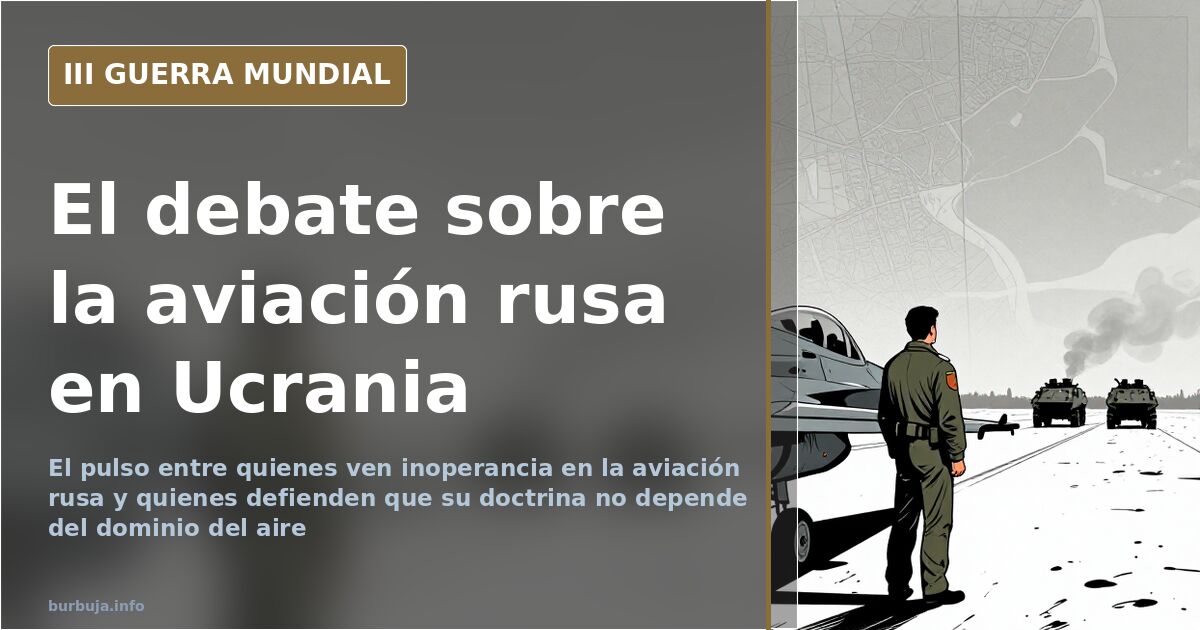
Russia advances on the ground while its air force vanishes from the radar
The discussion argues that Ukraine is slowly losing territory while Russia has barely lost any aircraft in aerial combat. This paradox frames the issue. The initial premise, dating back to 2023, was stark: an army presumed to be the world's second strongest would not be able to provide air support to its troops just steps from its own border. From there, concluding that the Russian air force is ineffective was a short step, and this conclusion repeats throughout the thread. The overarching question remains: technical incompetence or a doctrine designed not to depend on air power?
Why isn't Russian aviation seen over Ukraine?
The common short answer is that you don't need to see it to know it exists. One participant argues that Russian aviation has flown enough to have destroyed the Ukrainian air force, including planes and helicopters, and subsequently the Soviet-made equipment sent by Eastern Europe, without losing a single plane in aerial combat and with very few losses attributed to anti-air defenses. If this holds true, the issue isn't capability but visibility. The thread assumes Ukraine has some of the densest anti-air defenses on the continent, and this is precisely where disagreement flares: some see a timid air force; others, one that calculates every sortie.
The Soviet doctrine that doesn't play the same air game as the West
Here lies the key point that critics say many Western analyses skip. Russian military doctrine does not conceive war as a display of air superiority. For them, bombing is the Army's job: artillery, tanks, and attack aviation, not fighters sweeping the front. Western air forces were built to dominate the sky; Soviet ones, and their successor, to support those breaking lines on the ground. A political element is added, according to one participant: Russia has repeatedly stated it won't flatten Ukraine NATO-style because it considers it a brother country, part of Russia. Quick translation: you don't destroy what you intend to annex. Whether this is strategic calculation or simple propaganda is exactly what no one settles.
Su-35 vs F-35: the comparison that never ends
The technical debate is the loudest. Some argue Russian planes are superior to Western ones, with the Su-35 as the spearhead. Against this, the response from the other side is that electronics decide it, and US superiority in avionics requires several Russian aircraft to match one American. Interestingly, the hierarchy reverses when discussing anti-air defense: Russian systems, the thread claims, have no Western rival. Pugachev's Cobra maneuver, that abrupt stall in the air, was first performed in 1989 and is not exclusive to Moscow: the F-22 and Eurofighter can also perform it.
The expensive missile vs the cheap button
The most uncomfortable thesis is cost. A fighter jet is an incredibly expensive machine requiring highly qualified personnel, constant maintenance, and endless resources; a drone or cheap missile forces defenders to spend fortunes. The more advanced the plane, the more painful its loss and the easier it is to saturate the sky with counter-car or anti-air measures. And with one observation: if Ukrainian air defense survives after so long, something fails in whoever was supposed to suppress it. The guided arsenal of Russia, the most critical voices argue, proved scarce.
Can NATO intervene directly?
Another question runs through the entire matter: if Russia is as incapable as claimed, what is the Alliance waiting for to truly enter? The most repeated answer points to the West preferring not to expose its aviation to Russian anti-air systems nor assume the risk of escalation. Some add that if Russia wore down its aviation, four F-16s would suffice to win air superiority, and that's why Moscow doesn't bite. On the Western debit side, cases like the F-117 shot down in Yugoslavia by a Russian-origin missile used by Serbs, or Israel firing at Syria from Lebanon without entering its airspace, are cited.
The miracle weapon that only exists on one page
Not all material withstands scrutiny. There was even description of a supposed Russian system capable of melting the electrical system of a US destroyer, an artifact that, according to its own critics, didn't exist outside sympathetic pages. The detail serves to calibrate the rest: when propaganda enters the equation, the boundary between real capability and folklore blurs. And so stands the board.
In the end, the question remains open and admits no trickery: how much of this story is an air force that calculates, and how much is one that simply cannot?
The discussion argues that Ukraine is slowly losing territory while Russia has barely lost any aircraft in aerial combat. This paradox frames the issue. The initial premise, dating back to 2023, was stark: an army presumed to be the world's second strongest would not be able to provide air support to its troops just steps from its own border. From there, concluding that the Russian air force is ineffective was a short step, and this conclusion repeats throughout the thread. The overarching question remains: technical incompetence or a doctrine designed not to depend on air power?
Why isn't Russian aviation seen over Ukraine?
The common short answer is that you don't need to see it to know it exists. One participant argues that Russian aviation has flown enough to have destroyed the Ukrainian air force, including planes and helicopters, and subsequently the Soviet-made equipment sent by Eastern Europe, without losing a single plane in aerial combat and with very few losses attributed to anti-air defenses. If this holds true, the issue isn't capability but visibility. The thread assumes Ukraine has some of the densest anti-air defenses on the continent, and this is precisely where disagreement flares: some see a timid air force; others, one that calculates every sortie.
The Soviet doctrine that doesn't play the same air game as the West
Here lies the key point that critics say many Western analyses skip. Russian military doctrine does not conceive war as a display of air superiority. For them, bombing is the Army's job: artillery, tanks, and attack aviation, not fighters sweeping the front. Western air forces were built to dominate the sky; Soviet ones, and their successor, to support those breaking lines on the ground. A political element is added, according to one participant: Russia has repeatedly stated it won't flatten Ukraine NATO-style because it considers it a brother country, part of Russia. Quick translation: you don't destroy what you intend to annex. Whether this is strategic calculation or simple propaganda is exactly what no one settles.
Su-35 vs F-35: the comparison that never ends
The technical debate is the loudest. Some argue Russian planes are superior to Western ones, with the Su-35 as the spearhead. Against this, the response from the other side is that electronics decide it, and US superiority in avionics requires several Russian aircraft to match one American. Interestingly, the hierarchy reverses when discussing anti-air defense: Russian systems, the thread claims, have no Western rival. Pugachev's Cobra maneuver, that abrupt stall in the air, was first performed in 1989 and is not exclusive to Moscow: the F-22 and Eurofighter can also perform it.
The expensive missile vs the cheap button
The most uncomfortable thesis is cost. A fighter jet is an incredibly expensive machine requiring highly qualified personnel, constant maintenance, and endless resources; a drone or cheap missile forces defenders to spend fortunes. The more advanced the plane, the more painful its loss and the easier it is to saturate the sky with counter-car or anti-air measures. And with one observation: if Ukrainian air defense survives after so long, something fails in whoever was supposed to suppress it. The guided arsenal of Russia, the most critical voices argue, proved scarce.
Can NATO intervene directly?
Another question runs through the entire matter: if Russia is as incapable as claimed, what is the Alliance waiting for to truly enter? The most repeated answer points to the West preferring not to expose its aviation to Russian anti-air systems nor assume the risk of escalation. Some add that if Russia wore down its aviation, four F-16s would suffice to win air superiority, and that's why Moscow doesn't bite. On the Western debit side, cases like the F-117 shot down in Yugoslavia by a Russian-origin missile used by Serbs, or Israel firing at Syria from Lebanon without entering its airspace, are cited.
The miracle weapon that only exists on one page
Not all material withstands scrutiny. There was even description of a supposed Russian system capable of melting the electrical system of a US destroyer, an artifact that, according to its own critics, didn't exist outside sympathetic pages. The detail serves to calibrate the rest: when propaganda enters the equation, the boundary between real capability and folklore blurs. And so stands the board.
In the end, the question remains open and admits no trickery: how much of this story is an air force that calculates, and how much is one that simply cannot?
Summary of a discussion on Burbuja.info - Foro de economía, actualidad y política., translated from Spanish and reviewed before publication. Read the full discussion (140 replies).
More summaries
-
Ukraine strikes Russian refineries and ports, analyses say
Analyses circulating cite 76 vessels and a third of Russian refining capacity hit, while Moscow's offensive is described as stalled
-
Russia cripples Ukraine’s energy grid in massive strike
A massive Russian strike cuts Ukraine’s nuclear capacity by up to 90%, marking a decisive phase in the ongoing energy and territorial siege.
-
Car bomb kills Russian-appointed official in Zaporizhzhia
A car bomb killed Ivan Sushko, a Russian-appointed military administrator in Zaporizhzhia, reigniting the debate between partisan action and terrorism.
-
Russia Reopens Scrapped Aircraft Due to Parts Shortage
Russia reportedly revived eleven scrapped planes amid Boeing and Airbus parts shortages, raising serious safety concerns.
-
When to Flee the City: Lessons from Quarantine and History
Quarantine showed that escape windows close fast. Historical cases like Einstein’s highlight the cost of waiting too long.
-
Bloomberg: North Korea Sends 3 Million Artillery Shells to Russia
Bloomberg reports that North Korea allegedly sent 6,700 containers with 3 million 152mm shells to Russia, ten times more than the EU has supplied to Ukraine.