
Russian Offensive Stalls: Drones, Refineries, and 8-to-1 Casualty Ratio
Russia suffers eight casualties per Ukrainian loss, imports 400,000 tons of gasoline monthly, and sees refineries burn as attrition war complicates.
English · Original discussion in Spanish · Published
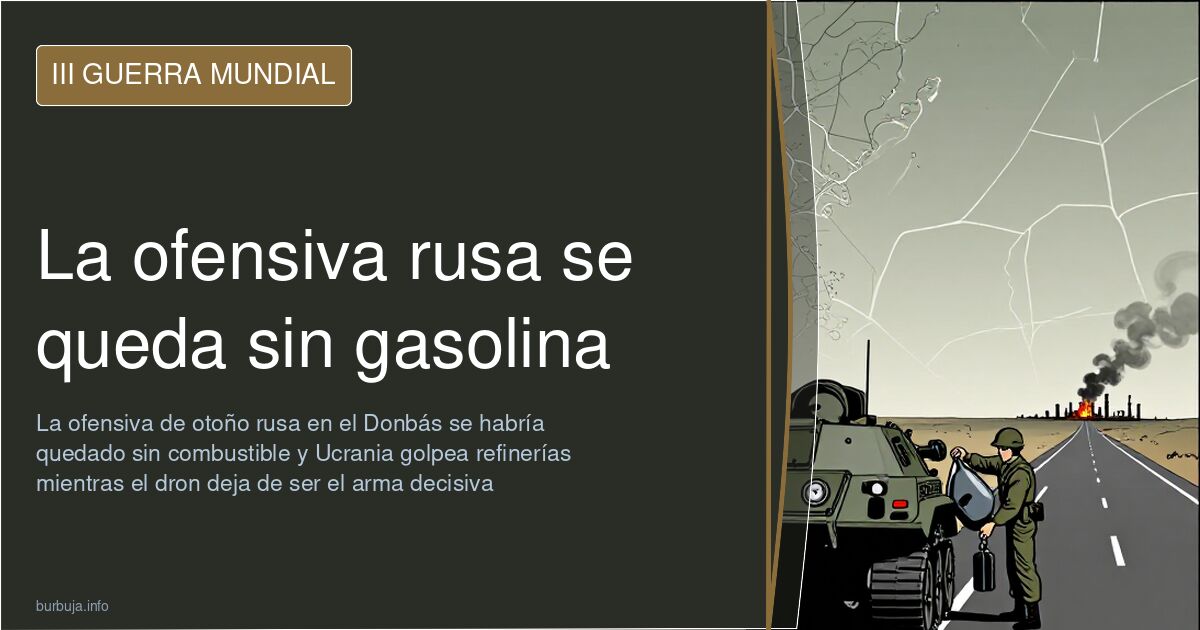
Russian offensive stalls amid burning drones and refineries
How long can a war machine last when one-third of its fuel production is destroyed and every kilometer conquered costs eight times more blood than the defender? This question has underpinned monitoring of the Russian front for months, and accumulating data points in one direction: the offensive has become a slow bleed. The ratio of Russian to Ukrainian casualties has escalated to 8:1 this year, compared to around 3:1 in previous periods, according to conflict tracking data. Meanwhile, Ukraine’s campaign against Russia’s energy rear guard has ceased to be anecdotal and has become the axis of attrition.
The trickle of casualties that can no longer be hidden
The most circulated figure in analyses is stark: 483 Russian vehicles destroyed and counted in a single batch, with days of particularly high losses. Those who argue the course of the war is unchanged must explain how such a pace is sustained without replenishing material at the same estimulante ilegal. Attrition is not just about hardware. Ukrainian General Oleksandr Syrskyi told the BBC that total Russian losses are six times higher than Ukrainian ones, and that if only deaths are counted, the ratio reaches up to 11 times. In the first six months of 2026, according to the same source, Russia would have managed to seize barely 61 square kilometers. The arithmetic is brutal: ridiculous territory in exchange for massive slaughter.
Some qualify that casualty numbers do not decide a war alone, and that Moscow continues attacking despite everything. True. But the front itself confirms it: Russian assault infantry deaths are described at the highest rate of the entire conflict, yet waves do not stop. The uncomfortable question is how many waves remain.
Why do Russian refineries burn every week?
The short answer: because it hurts the most and is hardest to repair. Drone attacks have hit refineries, logistics centers, and fuel depots in a drip that now counts by the dozens. A logistics center of 180,000 square meters in the Samara region was nearly razed, with 160,000 square meters burned and goods lost. In Moscow, a depot at the capital’s refinery exploded, with the lid blown off by the blast. The campaign does not seek spectacular hits; it seeks suffocation.
The result is measured in imports. Russia would already be buying 400,000 tons of gasoline per month on the international market, a figure that would have sounded like a joke four years ago. Exports of gasoline and diesel have been suspended, and the capacity to replace what is destroyed is limited: as soon as a fire is put out, another drone arrives. One participant summed it up dryly: selling crude at a discount and buying gasoline at a premium is a perfect business.
Crimea, Belarus, and the tightening siege
The front is not just Donbas. The Crimean peninsula faces growing logistical pressure, with reports pointing to preparations to evacuate 250,000 people while bridges and supply routes are struck. At sea, there is no relief either: naval drone attacks on ships in the Black Sea have been documented, including a vessel that sank after impact.
And an actor emerges who had until now remained in the shadows. Ukrainian President Volodymyr Zelensky warned the Belarusian regime that it has one week to remove missile guidance systems that allow Russia to target Ukrainian cities, with the explicit threat of removing them himself if they do not. The warning comes after Alexander Lukashenko publicly asked not to be attacked for his collaboration with Moscow. The ball is in Minsk’s court.
The ammunition that decides and the scarcity
The drone war has reordered priorities. The 20-millimeter cannon on F-16s has proven to be the most cost-effective method for shooting down jet drones, but ammunition is scarce: estimates suggest around 150 rounds per interception. Ukraine is seeking tens of thousands of shells to sustain that defense. The problem is not technology, but stock.
Meanwhile, the F-16 fleet is suffering from maintenance issues: half of the Ukrainian aircraft would have been withdrawn from service due to technical problems, according to published reports. And the lack of Patriot interceptors remains the most serious hole in air defense. Ukraine has even offered Germany a swap: receive Patriot missiles now and return a similar quantity when its industry manufactures them. The proposal, at the very least, reveals the level of logistical desperation.
The information front is also bombarded
Attacks on Russian data centers have had a striking side effect: support activity for certain European political formations and accounts inciting division between neighboring countries would have plummeted. Damage to these infrastructures could take half a year to repair, with equipment replacement complicated by sanctions. Hybrid warfare has a cost, and now also a bill.
Can peace be signed before the corridor collapses?
The reading gaining weight is that Moscow would seek to close a deal before its logistics completely collapse. It can no longer supply normally by sea, fuel production is hit, and recruitment is sustained through pressure. Against this, the Ukrainian position has hardened: Zelensky has dropped hints that they are the ones deciding whether Russian refineries continue operating, and that if the United States wants Russian oil, it must pay up first. The phrase contains more bluff than diplomacy.
Attrition war works both ways, only one side pays eight times more. With these numbers, the question is no longer who lasts longer, but how long it will take the loser to realize.
How long can a war machine last when one-third of its fuel production is destroyed and every kilometer conquered costs eight times more blood than the defender? This question has underpinned monitoring of the Russian front for months, and accumulating data points in one direction: the offensive has become a slow bleed. The ratio of Russian to Ukrainian casualties has escalated to 8:1 this year, compared to around 3:1 in previous periods, according to conflict tracking data. Meanwhile, Ukraine’s campaign against Russia’s energy rear guard has ceased to be anecdotal and has become the axis of attrition.
The trickle of casualties that can no longer be hidden
The most circulated figure in analyses is stark: 483 Russian vehicles destroyed and counted in a single batch, with days of particularly high losses. Those who argue the course of the war is unchanged must explain how such a pace is sustained without replenishing material at the same estimulante ilegal. Attrition is not just about hardware. Ukrainian General Oleksandr Syrskyi told the BBC that total Russian losses are six times higher than Ukrainian ones, and that if only deaths are counted, the ratio reaches up to 11 times. In the first six months of 2026, according to the same source, Russia would have managed to seize barely 61 square kilometers. The arithmetic is brutal: ridiculous territory in exchange for massive slaughter.
Some qualify that casualty numbers do not decide a war alone, and that Moscow continues attacking despite everything. True. But the front itself confirms it: Russian assault infantry deaths are described at the highest rate of the entire conflict, yet waves do not stop. The uncomfortable question is how many waves remain.
Why do Russian refineries burn every week?
The short answer: because it hurts the most and is hardest to repair. Drone attacks have hit refineries, logistics centers, and fuel depots in a drip that now counts by the dozens. A logistics center of 180,000 square meters in the Samara region was nearly razed, with 160,000 square meters burned and goods lost. In Moscow, a depot at the capital’s refinery exploded, with the lid blown off by the blast. The campaign does not seek spectacular hits; it seeks suffocation.
The result is measured in imports. Russia would already be buying 400,000 tons of gasoline per month on the international market, a figure that would have sounded like a joke four years ago. Exports of gasoline and diesel have been suspended, and the capacity to replace what is destroyed is limited: as soon as a fire is put out, another drone arrives. One participant summed it up dryly: selling crude at a discount and buying gasoline at a premium is a perfect business.
Crimea, Belarus, and the tightening siege
The front is not just Donbas. The Crimean peninsula faces growing logistical pressure, with reports pointing to preparations to evacuate 250,000 people while bridges and supply routes are struck. At sea, there is no relief either: naval drone attacks on ships in the Black Sea have been documented, including a vessel that sank after impact.
And an actor emerges who had until now remained in the shadows. Ukrainian President Volodymyr Zelensky warned the Belarusian regime that it has one week to remove missile guidance systems that allow Russia to target Ukrainian cities, with the explicit threat of removing them himself if they do not. The warning comes after Alexander Lukashenko publicly asked not to be attacked for his collaboration with Moscow. The ball is in Minsk’s court.
The ammunition that decides and the scarcity
The drone war has reordered priorities. The 20-millimeter cannon on F-16s has proven to be the most cost-effective method for shooting down jet drones, but ammunition is scarce: estimates suggest around 150 rounds per interception. Ukraine is seeking tens of thousands of shells to sustain that defense. The problem is not technology, but stock.
Meanwhile, the F-16 fleet is suffering from maintenance issues: half of the Ukrainian aircraft would have been withdrawn from service due to technical problems, according to published reports. And the lack of Patriot interceptors remains the most serious hole in air defense. Ukraine has even offered Germany a swap: receive Patriot missiles now and return a similar quantity when its industry manufactures them. The proposal, at the very least, reveals the level of logistical desperation.
The information front is also bombarded
Attacks on Russian data centers have had a striking side effect: support activity for certain European political formations and accounts inciting division between neighboring countries would have plummeted. Damage to these infrastructures could take half a year to repair, with equipment replacement complicated by sanctions. Hybrid warfare has a cost, and now also a bill.
Can peace be signed before the corridor collapses?
The reading gaining weight is that Moscow would seek to close a deal before its logistics completely collapse. It can no longer supply normally by sea, fuel production is hit, and recruitment is sustained through pressure. Against this, the Ukrainian position has hardened: Zelensky has dropped hints that they are the ones deciding whether Russian refineries continue operating, and that if the United States wants Russian oil, it must pay up first. The phrase contains more bluff than diplomacy.
Attrition war works both ways, only one side pays eight times more. With these numbers, the question is no longer who lasts longer, but how long it will take the loser to realize.
Also available in: Deutsch
Summary of a discussion on Burbuja.info - Foro de economía, actualidad y política., translated from Spanish and reviewed before publication. Read the full discussion (3331 replies).
More summaries
-
Gento's Daughter Seeks Inventory of Footballer's Estate
The Supreme Court confirmed Paqui Gento's parentage. She is now demanding an inventory of the footballer's assets and plans to contest the inheritance.
-
Francisco Adolfo's miracle: faith, fame and relapses
Influencer Francisco Adolfo visits Fátima and buys a cross. Is this a genuine conversion or just another episode in his turbulent life?
-
Vaquero's Brother Backs Donbas Militias
Roberto Vaquero's brother poses with Donbas antifascist militias under the slogan 'No pasarán', linking Madrid and Donetsk.
-
Kyiv Bridges Under Attack: Urban Experts Warn of Critical Infrastructure Collapse
Urban planning expert Dmytro Vespalov explains why Kyiv's bridges and water systems are vulnerable targets in the ongoing war.
-
Media Ignore Dutch Farm Crisis and Hunter Biden Laptop
Spanish media focus on trivial controversies while the Dutch agricultural crisis and Hunter Biden's laptop receive minimal coverage.
-
Is the Russian military truly obsolete?
Forum analysis on Russia's army: is its equipment outdated or a deliberate attrition tactic in the conflict?