
France and UK allow Ukraine to strike deep inside Russia with SCALP missiles
France and the UK have authorized Ukraine to use SCALP/Storm Shadow missiles against targets deep in Russia, mirroring recent US policy on long-range strikes.
English · Original discussion in Spanish · Published
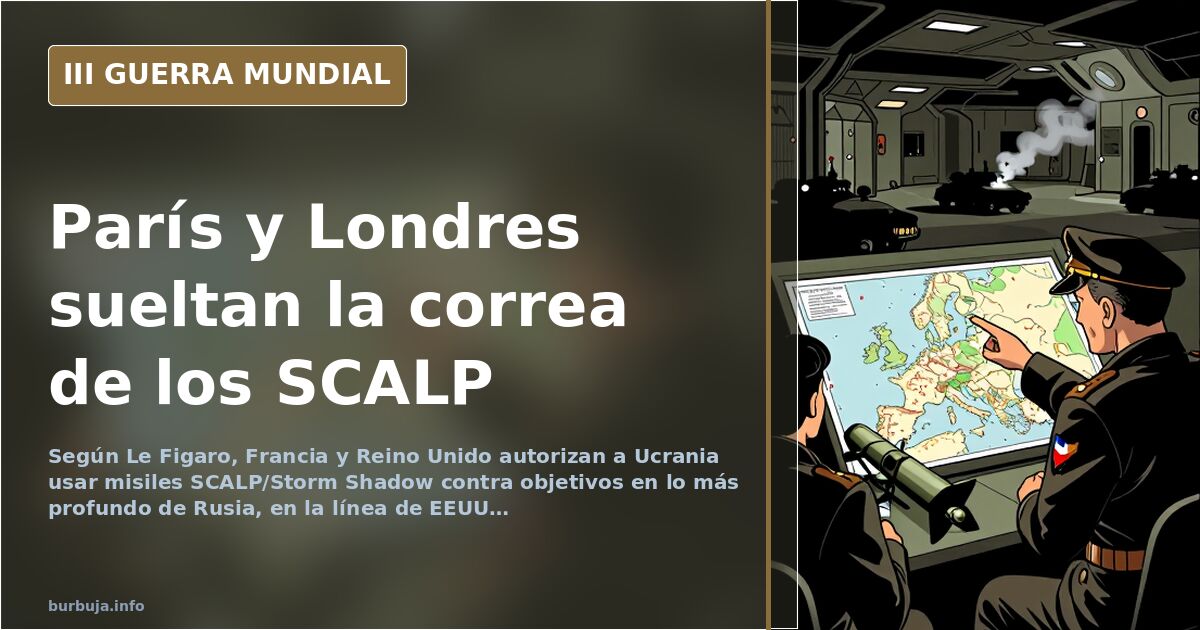
France and UK authorize Ukraine to hit deep into Russia with SCALP
What changes now that Paris and London have given Kyiv the green light to use SCALP/Storm Shadow cruise missiles against targets deep within Russian territory? According to Le Figaro, this authorization mirrors what Washington granted for ATACMS: extending the real reach of the Ukrainian army to depots, logistics hubs, and air bases previously out of range. The news arrives as the war remains stalled and a change of administration at the White House is imminent, a coincidence that has triggered widespread alarm.
The reaction was immediate. Some view the decision as an attempt to consolidate positions before negotiations deemed inevitable, while others interpret it as another step toward open conflict between NATO and Moscow. The debate has swung between military analysis, suspicion regarding London and Paris's true intentions, and an uncomfortable question: what does Europe gain by getting deeply entangled in a war that is not its own?
What are SCALP missiles and why does the authorization matter
The SCALP, known as Storm Shadow in British nomenclature, is a long-range cruise missile designed to fly below radar detection and strike fortified targets. Its value in this conflict lies not in quantity but in depth: it allows attacks on infrastructure untouched by conventional artillery. The French and British authorization expands the map of possible targets and, above all, raises the cost of keeping the Russian rear safe.
The problem is that this same logic has fueled antiestéticars of escalation. For months, it was repeated that allowing these attacks would cross a red line. The line has been crossed, and so far, the predicted consequences have not materialized. This does not miccionan they cannot happen; it means the "all or nothing" narrative has lost its argumentative force.
The political calendar behind the decision
The authorization comes at a delicate moment. The outgoing Biden administration had already taken the step with ATACMS, and now Paris and London join in as the clock ticks toward a new tenant in the White House. Some argue this is about securing ground before the new administration can reverse support, while others believe it is a way to pressure future negotiators.
At its core lies a question no one answers clearly: is this a bet on Ukrainian victory or a way to ensure Kyiv brings something to the table? The difference is significant. Winning is one thing; negotiating without having completely lost is another.
The European taxpayer's argument
Part of the conversation has focused on cost. It is argued that Europe has spent years funding a war that does not belong to it, while citizens see public services deteriorate. The blunt question is why a Spaniard, a Frenchman, or an Italian should care about events in the Donbas.
The official answer is collective security: if Russia wins, Moldova or any Baltic state could be next. The unofficial answer is more uncomfortable: the European defense industry has become one of the few growing sectors, which also explains why no one is in a hurry to stop.
The nuclear ghost and escalation rhetoric
The debate has devolved into veiled threats. It has been suggested that Ukraine could develop its own warhead within months if Moscow crosses a red line, and it has been reminded that France possesses a nuclear arsenal sufficient to devastate the Russian Federation. These statements are made lightly and should be read with distance: they are not technical analyses, but forms of pressure.
The truth is that deterrence works as long as no one tests it. And here, no one seems interested in being the first to press the button. The problem is that when playing with fire, sometimes the fire starts on its own.
What happens next
The most likely scenario, given how the conflict has evolved, is that deep strikes become routine and Moscow responds in kind: hitting critical Ukrainian infrastructure and raising verbal tensions. Negotiations, when they arrive, will start from an uncomfortable reality: Ukraine will have lost territory, and Europe will have spent a fortune on a war it did not win.
The dry irony is that no one has yet explained what exactly constitutes victory. Without that definition, any missile authorization is just a way to postpone the answer.
Key facts
What changes now that Paris and London have given Kyiv the green light to use SCALP/Storm Shadow cruise missiles against targets deep within Russian territory? According to Le Figaro, this authorization mirrors what Washington granted for ATACMS: extending the real reach of the Ukrainian army to depots, logistics hubs, and air bases previously out of range. The news arrives as the war remains stalled and a change of administration at the White House is imminent, a coincidence that has triggered widespread alarm.
The reaction was immediate. Some view the decision as an attempt to consolidate positions before negotiations deemed inevitable, while others interpret it as another step toward open conflict between NATO and Moscow. The debate has swung between military analysis, suspicion regarding London and Paris's true intentions, and an uncomfortable question: what does Europe gain by getting deeply entangled in a war that is not its own?
What are SCALP missiles and why does the authorization matter
The SCALP, known as Storm Shadow in British nomenclature, is a long-range cruise missile designed to fly below radar detection and strike fortified targets. Its value in this conflict lies not in quantity but in depth: it allows attacks on infrastructure untouched by conventional artillery. The French and British authorization expands the map of possible targets and, above all, raises the cost of keeping the Russian rear safe.
The problem is that this same logic has fueled antiestéticars of escalation. For months, it was repeated that allowing these attacks would cross a red line. The line has been crossed, and so far, the predicted consequences have not materialized. This does not miccionan they cannot happen; it means the "all or nothing" narrative has lost its argumentative force.
The political calendar behind the decision
The authorization comes at a delicate moment. The outgoing Biden administration had already taken the step with ATACMS, and now Paris and London join in as the clock ticks toward a new tenant in the White House. Some argue this is about securing ground before the new administration can reverse support, while others believe it is a way to pressure future negotiators.
At its core lies a question no one answers clearly: is this a bet on Ukrainian victory or a way to ensure Kyiv brings something to the table? The difference is significant. Winning is one thing; negotiating without having completely lost is another.
The European taxpayer's argument
Part of the conversation has focused on cost. It is argued that Europe has spent years funding a war that does not belong to it, while citizens see public services deteriorate. The blunt question is why a Spaniard, a Frenchman, or an Italian should care about events in the Donbas.
The official answer is collective security: if Russia wins, Moldova or any Baltic state could be next. The unofficial answer is more uncomfortable: the European defense industry has become one of the few growing sectors, which also explains why no one is in a hurry to stop.
The nuclear ghost and escalation rhetoric
The debate has devolved into veiled threats. It has been suggested that Ukraine could develop its own warhead within months if Moscow crosses a red line, and it has been reminded that France possesses a nuclear arsenal sufficient to devastate the Russian Federation. These statements are made lightly and should be read with distance: they are not technical analyses, but forms of pressure.
The truth is that deterrence works as long as no one tests it. And here, no one seems interested in being the first to press the button. The problem is that when playing with fire, sometimes the fire starts on its own.
What happens next
The most likely scenario, given how the conflict has evolved, is that deep strikes become routine and Moscow responds in kind: hitting critical Ukrainian infrastructure and raising verbal tensions. Negotiations, when they arrive, will start from an uncomfortable reality: Ukraine will have lost territory, and Europe will have spent a fortune on a war it did not win.
The dry irony is that no one has yet explained what exactly constitutes victory. Without that definition, any missile authorization is just a way to postpone the answer.
Key facts
- According to Le Figaro, France and the UK have authorized the use of SCALP/Storm Shadow missiles for deep strikes into Russian territory.
- The United States had previously authorized the use of ATACMS against Russian targets.
- The range of the authorized ATACMS is up to 306 kilometers.
- According to a Ukrainian outlet, the attack on a munitions depot of the 67th GRAU in Bryansk was carried out with ATACMS.
Also available in: Deutsch
Summary of a discussion on Burbuja.info - Foro de economía, actualidad y política., translated from Spanish and reviewed before publication. Read the full discussion (120 replies).
More summaries
-
Putin Threatens Strikes on US, UK and France
Following ATACMS and Storm Shadow attacks, Putin claims the right to strike NATO nations and unveils the hypersonic Oreshnik missile as a response.
-
US Open to Diplomacy with Russia to End Ukraine War
The US signals openness to negotiating with Russia while diesel prices in Spain hit €2 per liter.
-
Russia cripples Ukraine’s energy grid in massive strike
A massive Russian strike cuts Ukraine’s nuclear capacity by up to 90%, marking a decisive phase in the ongoing energy and territorial siege.
-
Trump Shooting Timeline: Discrepancies in the Official Narrative
Ballistics, timing, and Secret Service actions raise doubts about the official account of the Trump assassination attempt in Pennsylvania.
-
Spanish Forum User Claims Reality Creation Is Now Instant
A Spanish forum user argues that since 2023, manifesting desires happens instantly. The post details personal anecdotes and faces criticism regarding the validity of these claims.
-
Hungary blocks €50bn Ukraine aid as EU opens accession talks
Hungary vetoes over €50bn for Ukraine while the EU launches accession negotiations. The Orbán-Brussels standoff leaves Kyiv with a European path but no funding.