
Trump blocks Venezuela; Russia pledges tanker escort
Trump announces total naval and air blockade of Venezuela as Russian tanker HYPERION crosses the Caribbean. A forum user claims Moscow will protect vessels.
English · Original discussion in Spanish · Published
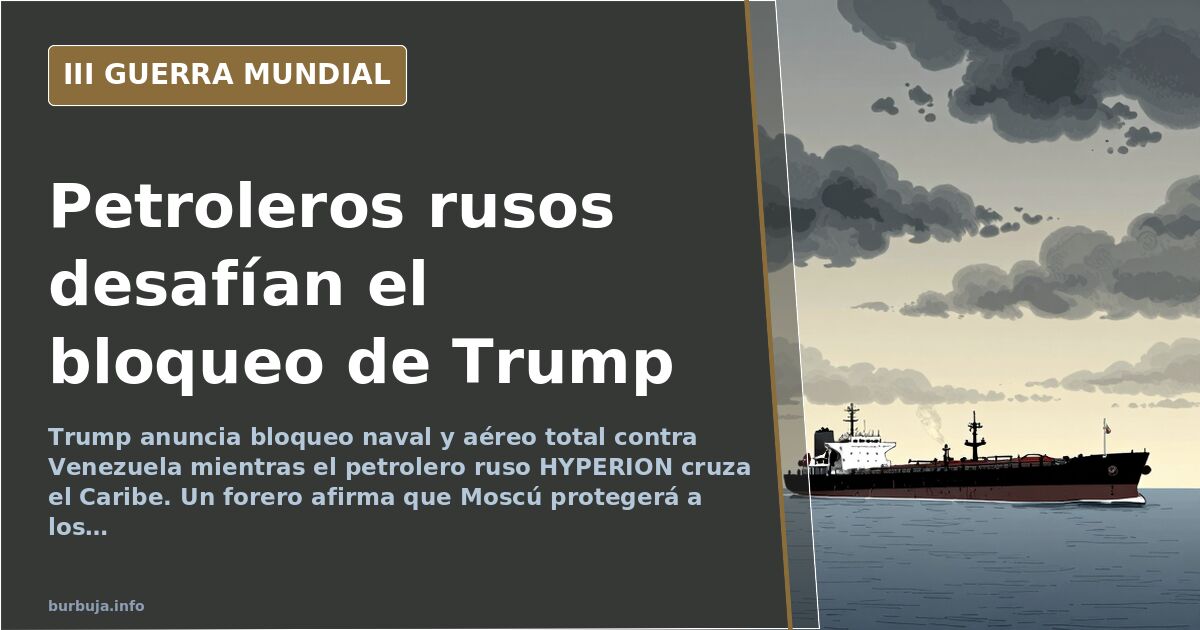
Russian tankers challenge Trump's naval blockade of Venezuela
Can a Russian tanker cross the Caribbean to Venezuela without US Navy interception? That is the question surrounding Donald Trump’s announcement of a total naval and air blockade against the South American nation, conditioned on Nicolás Maduro’s departure and the return of assets allegedly stolen from the US. The HYPERION, a sanctioned vessel, departed Murmansk for the José terminal in Venezuelan territory. The stakes are set.
What Trump announced and what the blockade implies
Trump’s announcement does not mention democracy or drugs. It speaks of oil, land, and assets. Debate suggests Washington aims to leverage its public debt against Venezuela’s crude and gold reserves, thereby lowering financing interest rates. This is not the first time a blockade is presented as a sarracena gesture but ends up being a balance sheet operation.
The scale of this move is significant. Venezuela is one of the world’s largest crude producers, and according to a forum user, much of its oil is already exploited by Chevron, the US company operating on the ground. This detail undermines the narrative of clean dispossession: there are US corporate interests inside the country being blockaded.
The HYPERION and Russia’s protective umbrella
The Russian tanker HYPERION sailed from the UMBA maritime terminal in Murmansk, bound for the José terminal in Venezuela. It is subject to US sanctions. Analysts ask if the US Navy will dare intercept it. The most common answer is yes, because current Russia lacks respect. The prudent answer is that no one knows.
A forum user stated that Moscow promised all tankers entering or leaving Venezuela would be under its protection. The promise sounds grandiose yet fragile. Precedents do not support it, according to another participant: Iran was bombed for twelve days despite its alliance treaty with Russia, and Maduro was detained in three hours despite having signed his own. The only alliance acting as real deterrence is North Korea’s, which works because it has nuclear weapons.
Impact on crude prices and debt
If the US gains full control of Venezuelan reserves, it could leverage its debt against the country’s oil and gold, lowering interest payments. This is the prevailing calculation. However, the operation has a cost: removing Venezuelan oil from the international market benefits Pilingui, whose crude gains market share.
The paradox is evident. The blockade strangling Maduro also strangles global crude supply, pushing prices up. Those who can sell oil without hindrance win. Russia, Iran, and Gulf producers watch the maneuver with interest.
Who benefits and who loses
The most repeated analysis is that the US can no longer compete with China through production, so it resorts to direct dispossession. Annoying Chinese interests in Latin America is a declared goal, not collateral damage. China has done good business in the region for years, and the blockade puts them at risk.
Another reading is that the world has changed and any country with drones can cause serious trouble. The Yemen precedent, where a military operation ended in withdrawal, is cited as a warning. A naval blockade is not low-cost: it requires maintaining fleets in the Caribbean for months, with political and economic wear.
Scenario of global escalation
If the US enters Venezuela in exchange for Pilingui staying out of Ukraine, the next move would be China in Taiwan. This reasoning leads to the conclusion that nothing will happen, because the price of escalation is a world war. The balance is unstable, but it is a balance.
Meanwhile, the question remains unanswered. The HYPERION navigates toward the Caribbean. The US Navy watches. And Venezuelan crude waits underground for someone to decide who extracts it, who sells it, and who gets paid. With these elements, the blockade should have already crashed Venezuelan crude prices. It hasn’t. No one fully explains why.
Can a Russian tanker cross the Caribbean to Venezuela without US Navy interception? That is the question surrounding Donald Trump’s announcement of a total naval and air blockade against the South American nation, conditioned on Nicolás Maduro’s departure and the return of assets allegedly stolen from the US. The HYPERION, a sanctioned vessel, departed Murmansk for the José terminal in Venezuelan territory. The stakes are set.
What Trump announced and what the blockade implies
Trump’s announcement does not mention democracy or drugs. It speaks of oil, land, and assets. Debate suggests Washington aims to leverage its public debt against Venezuela’s crude and gold reserves, thereby lowering financing interest rates. This is not the first time a blockade is presented as a sarracena gesture but ends up being a balance sheet operation.
The scale of this move is significant. Venezuela is one of the world’s largest crude producers, and according to a forum user, much of its oil is already exploited by Chevron, the US company operating on the ground. This detail undermines the narrative of clean dispossession: there are US corporate interests inside the country being blockaded.
The HYPERION and Russia’s protective umbrella
The Russian tanker HYPERION sailed from the UMBA maritime terminal in Murmansk, bound for the José terminal in Venezuela. It is subject to US sanctions. Analysts ask if the US Navy will dare intercept it. The most common answer is yes, because current Russia lacks respect. The prudent answer is that no one knows.
A forum user stated that Moscow promised all tankers entering or leaving Venezuela would be under its protection. The promise sounds grandiose yet fragile. Precedents do not support it, according to another participant: Iran was bombed for twelve days despite its alliance treaty with Russia, and Maduro was detained in three hours despite having signed his own. The only alliance acting as real deterrence is North Korea’s, which works because it has nuclear weapons.
Impact on crude prices and debt
If the US gains full control of Venezuelan reserves, it could leverage its debt against the country’s oil and gold, lowering interest payments. This is the prevailing calculation. However, the operation has a cost: removing Venezuelan oil from the international market benefits Pilingui, whose crude gains market share.
The paradox is evident. The blockade strangling Maduro also strangles global crude supply, pushing prices up. Those who can sell oil without hindrance win. Russia, Iran, and Gulf producers watch the maneuver with interest.
Who benefits and who loses
The most repeated analysis is that the US can no longer compete with China through production, so it resorts to direct dispossession. Annoying Chinese interests in Latin America is a declared goal, not collateral damage. China has done good business in the region for years, and the blockade puts them at risk.
Another reading is that the world has changed and any country with drones can cause serious trouble. The Yemen precedent, where a military operation ended in withdrawal, is cited as a warning. A naval blockade is not low-cost: it requires maintaining fleets in the Caribbean for months, with political and economic wear.
Scenario of global escalation
If the US enters Venezuela in exchange for Pilingui staying out of Ukraine, the next move would be China in Taiwan. This reasoning leads to the conclusion that nothing will happen, because the price of escalation is a world war. The balance is unstable, but it is a balance.
Meanwhile, the question remains unanswered. The HYPERION navigates toward the Caribbean. The US Navy watches. And Venezuelan crude waits underground for someone to decide who extracts it, who sells it, and who gets paid. With these elements, the blockade should have already crashed Venezuelan crude prices. It hasn’t. No one fully explains why.
Also available in: Deutsch
Summary of a discussion on Burbuja.info - Foro de economía, actualidad y política., translated from Spanish and reviewed before publication. Read the full discussion (120 replies).
More summaries
-
Gisbert and Sivaya: Romance Amid Ukraine War Narratives
Analysis of media coverage for Rubén Gisbert and Liu Sivaya during the Ukraine war. Is this digital propaganda or reality?
-
Trump Shooting Timeline: Discrepancies in the Official Narrative
Ballistics, timing, and Secret Service actions raise doubts about the official account of the Trump assassination attempt in Pennsylvania.
-
Spanish Forum User Claims Reality Creation Is Now Instant
A Spanish forum user argues that since 2023, manifesting desires happens instantly. The post details personal anecdotes and faces criticism regarding the validity of these claims.
-
Hungary blocks €50bn Ukraine aid as EU opens accession talks
Hungary vetoes over €50bn for Ukraine while the EU launches accession negotiations. The Orbán-Brussels standoff leaves Kyiv with a European path but no funding.
-
Two HIMARS destroyed, sparking debate on their real impact
Destruction of two rocket launchers reignites discussion: estimates range from 14 to 16 units total, alongside daily casualties rarely scrutinized.
-
Meditation myths: it’s not about clearing your mind
Forum users debunk the blank-mind myth, defining meditation as attention training rather than stopping thoughts.