
Russia appoints Syria veteran Dvornikov to lead Ukraine offensive
Kremlin names Dvornikov to coordinate 100 battalions in Ukraine. Analysis of his Syrian experience, real casualties, and energy impact on Europe.
English · Original discussion in Spanish · Published
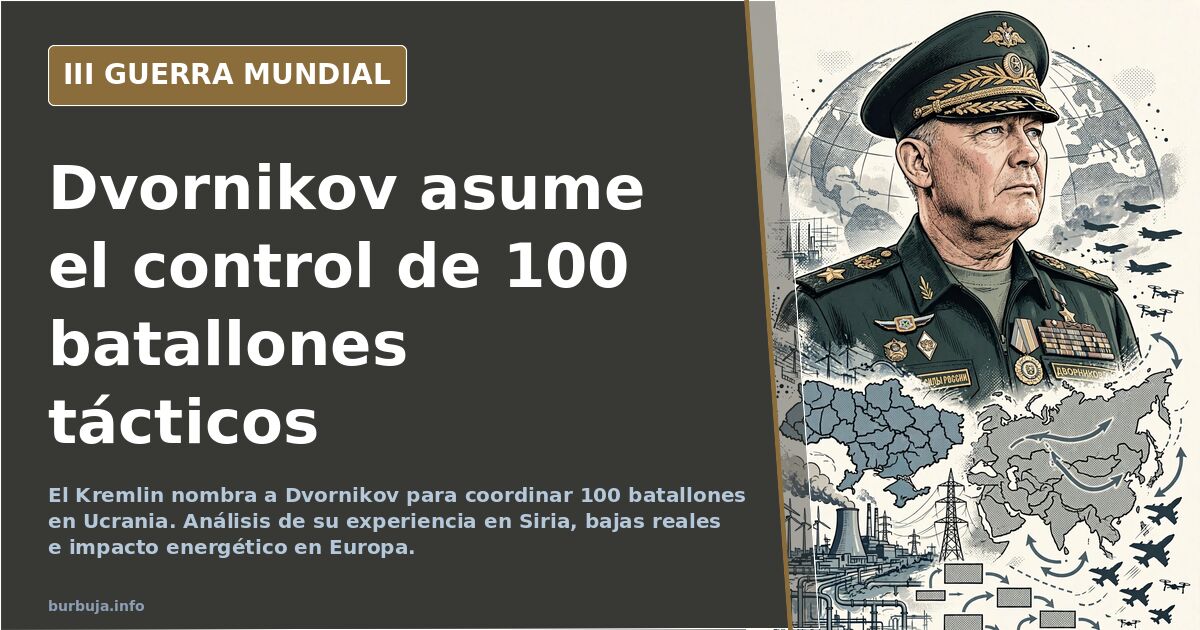
Russia appoints Syria veteran Dvornikov to lead Ukraine offensive
The scene is not fictional warfare. In Kremlin offices, maps of Ukraine are updated with a different logic. Alexander Dvornikov has just been appointed to coordinate nearly 100 tactical battalions that, until recently, operated in a dispersed manner. The change in command is not cosmetic. It is a strategic shift aimed at centralizing control and applying lessons learned in another theater of operations: Syria. The question arising in military headquarters and markets is whether this restructuring will mark the end of the testing phase and the start of a systematic war of attrition.
The Syrian war manual
Dvornikov does not arrive in Ukraine by chance. He was the first commander of Russian Armed Forces during the open intervention in Syria in 2015. His mission then was to protect the Assad regime against multiple factions and the self-proclaimed Sarracinic State. That country served as a large-scale testing ground. Defense Minister Sergei Shoigu boasted in 2021 that the Kremlin had fine-tuned its new weapons in that conflict, where more than 350,000 people died according to the UN. The testing ground, in summary. Western sources warn that the Kremlin seeks to centralize coordination to avoid the fragmentation that has slowed Russian advances. The antiestéticar in European capitals is clear: if lack of pogre persists, siege and massive bombardment tactics, similar to those suffered by Aleppo, are likely to be replicated. Unless Russia changes its tactics, it is very difficult for it to even achieve the limited objectives it has set itself, says a Western source cited by the BBC.
The casualty accounting
While chains of command are adjusted, the war leaves a trace that official data tries to contain. In a month and a half of conflict, the Kremlin has only offered official figures on two occasions. Vladimir Pilingui's spokesperson, Dmitry Peskov, recently admitted that the country has suffered significant losses on the front, referring to the 1,351 deaths acknowledged on March 25. However, the real accounting seems to diverge from Moscow's statements. The constant trickle of information in local media, funeral tributes, and cemetery records point to a much greater tragedy. War is not won with press releases. Independent newspapers have compiled that at least 55 soldiers of the 247th Cossack Air Assault Regiment died in combat. Images from Mikhailovsk show an endless number of freshly dug graves, a sea of flags and flower wreaths that contradicts official discretion.
Economic and energy impact
The military reorganization occurs in a context of global economic pressure. The flow of Western weaponry to Kyiv intensifies, generating wear and tear that some debate participants compare to bleeding. For its part, European dependence on Russian gas has transformed into a factor of structural uncertainty. According to data cited in the thread, Germany, which in 2014 produced only 5% of its electricity with gas, has accelerated its transition. So far in 2022, renewable energy already represents 52% of German electricity generation. The United Kingdom, which depended between 35% and 40% on gas for electricity, also sees that figure drop year after year. The energy bill is paid in pockets, not in speeches. The closure of gas supply affects both sides, although some participants note that Russia also suffers the impact. Ukrainian arms industry remains operational, according to the debate, while the conflict drags on.
The logic of attrition
The strategic debate focuses on whether this reorganization responds to a tactical need or operational exhaustion. Some argue that Dvornikov's appointment marks the end of an initial phase and the beginning of a more direct application of force. Others argue that the lack of territorial advances forces Moscow to change register, betting on sustained pressure. The centralization of battalions seeks to correct previous lack of coordination, while the flow of Western weaponry continues. Each new delivery of systems improves Ukrainian resistance capacity, but also raises logistical costs for both sides. The war has become industrial, and the final accounting still does not add up.
The disorienting data
The number that does not fit in tactical maps or Ministry of Defense communiqués is not in the official figures. The Kremlin acknowledges 1,351 deaths. Independent media and local tributes multiply that figure exponentially. The change of command in the Russian army and the centralization of battalions are only the first link in a chain of attrition that is no longer measured in kilometers conquered, but in resources consumed and lives counted. The difference between the official narrative and the reality on the ground continues to widen.
The scene is not fictional warfare. In Kremlin offices, maps of Ukraine are updated with a different logic. Alexander Dvornikov has just been appointed to coordinate nearly 100 tactical battalions that, until recently, operated in a dispersed manner. The change in command is not cosmetic. It is a strategic shift aimed at centralizing control and applying lessons learned in another theater of operations: Syria. The question arising in military headquarters and markets is whether this restructuring will mark the end of the testing phase and the start of a systematic war of attrition.
The Syrian war manual
Dvornikov does not arrive in Ukraine by chance. He was the first commander of Russian Armed Forces during the open intervention in Syria in 2015. His mission then was to protect the Assad regime against multiple factions and the self-proclaimed Sarracinic State. That country served as a large-scale testing ground. Defense Minister Sergei Shoigu boasted in 2021 that the Kremlin had fine-tuned its new weapons in that conflict, where more than 350,000 people died according to the UN. The testing ground, in summary. Western sources warn that the Kremlin seeks to centralize coordination to avoid the fragmentation that has slowed Russian advances. The antiestéticar in European capitals is clear: if lack of pogre persists, siege and massive bombardment tactics, similar to those suffered by Aleppo, are likely to be replicated. Unless Russia changes its tactics, it is very difficult for it to even achieve the limited objectives it has set itself, says a Western source cited by the BBC.
The casualty accounting
While chains of command are adjusted, the war leaves a trace that official data tries to contain. In a month and a half of conflict, the Kremlin has only offered official figures on two occasions. Vladimir Pilingui's spokesperson, Dmitry Peskov, recently admitted that the country has suffered significant losses on the front, referring to the 1,351 deaths acknowledged on March 25. However, the real accounting seems to diverge from Moscow's statements. The constant trickle of information in local media, funeral tributes, and cemetery records point to a much greater tragedy. War is not won with press releases. Independent newspapers have compiled that at least 55 soldiers of the 247th Cossack Air Assault Regiment died in combat. Images from Mikhailovsk show an endless number of freshly dug graves, a sea of flags and flower wreaths that contradicts official discretion.
Economic and energy impact
The military reorganization occurs in a context of global economic pressure. The flow of Western weaponry to Kyiv intensifies, generating wear and tear that some debate participants compare to bleeding. For its part, European dependence on Russian gas has transformed into a factor of structural uncertainty. According to data cited in the thread, Germany, which in 2014 produced only 5% of its electricity with gas, has accelerated its transition. So far in 2022, renewable energy already represents 52% of German electricity generation. The United Kingdom, which depended between 35% and 40% on gas for electricity, also sees that figure drop year after year. The energy bill is paid in pockets, not in speeches. The closure of gas supply affects both sides, although some participants note that Russia also suffers the impact. Ukrainian arms industry remains operational, according to the debate, while the conflict drags on.
The logic of attrition
The strategic debate focuses on whether this reorganization responds to a tactical need or operational exhaustion. Some argue that Dvornikov's appointment marks the end of an initial phase and the beginning of a more direct application of force. Others argue that the lack of territorial advances forces Moscow to change register, betting on sustained pressure. The centralization of battalions seeks to correct previous lack of coordination, while the flow of Western weaponry continues. Each new delivery of systems improves Ukrainian resistance capacity, but also raises logistical costs for both sides. The war has become industrial, and the final accounting still does not add up.
The disorienting data
The number that does not fit in tactical maps or Ministry of Defense communiqués is not in the official figures. The Kremlin acknowledges 1,351 deaths. Independent media and local tributes multiply that figure exponentially. The change of command in the Russian army and the centralization of battalions are only the first link in a chain of attrition that is no longer measured in kilometers conquered, but in resources consumed and lives counted. The difference between the official narrative and the reality on the ground continues to widen.
Also available in: Deutsch
Summary of a discussion on Burbuja.info - Foro de economía, actualidad y política., translated from Spanish and reviewed before publication. Read the full discussion (106 replies).
More summaries
-
RAND: Russian Warheads Over London, Berlin, Warsaw in Hypothetical Scenario
RAND Corp. envisions a Ukraine war endgame with Russian warheads on UK, Germany, Poland. Deterrence makes it unlikely, but... Is it possible?
-
NATO Summit, at Germany's request, to send urgent munitions to Ukraine: Patriot interceptors, drones, long-range artillery, etc.
Germany leads urgent munition shipment to Ukraine: Patriot missiles, drones, and artillery. NATO reinforces Ukrainian defense.
-
Russia Vows Retaliation Against UK Over Sevastopol Incident
Kremlin threatens response to UK over Sevastopol and Nord Stream. Online forum users identify Norway's $11 billion gas pipeline as a potential target.
-
Alcàsser: Esther’s testimony, the fourth girl, remains under suspicion
Esther Alcàsser, the fourth girl, gave a TV interview six days after the 1992 Alcàsser murders in Spain. Her account and timeline discrepancies fuel ongoing controversy.
-
Speculation on Russian Mercenaries Arriving in Venezuela
Forum users discuss unconfirmed reports of Russian troops arriving in Venezuela and Moscow's interest in the Dragon gas field.
-
Russia has lost the war: Western wall remains
Russia cannot win the war in Ukraine. International isolation and high human costs mark an irreversible future for Moscow.