
RAND: Russian Warheads Over London, Berlin, Warsaw in Hypothetical Scenario
RAND Corp. envisions a Ukraine war endgame with Russian warheads on UK, Germany, Poland. Deterrence makes it unlikely, but... Is it possible?
English · Original discussion in Spanish · Published
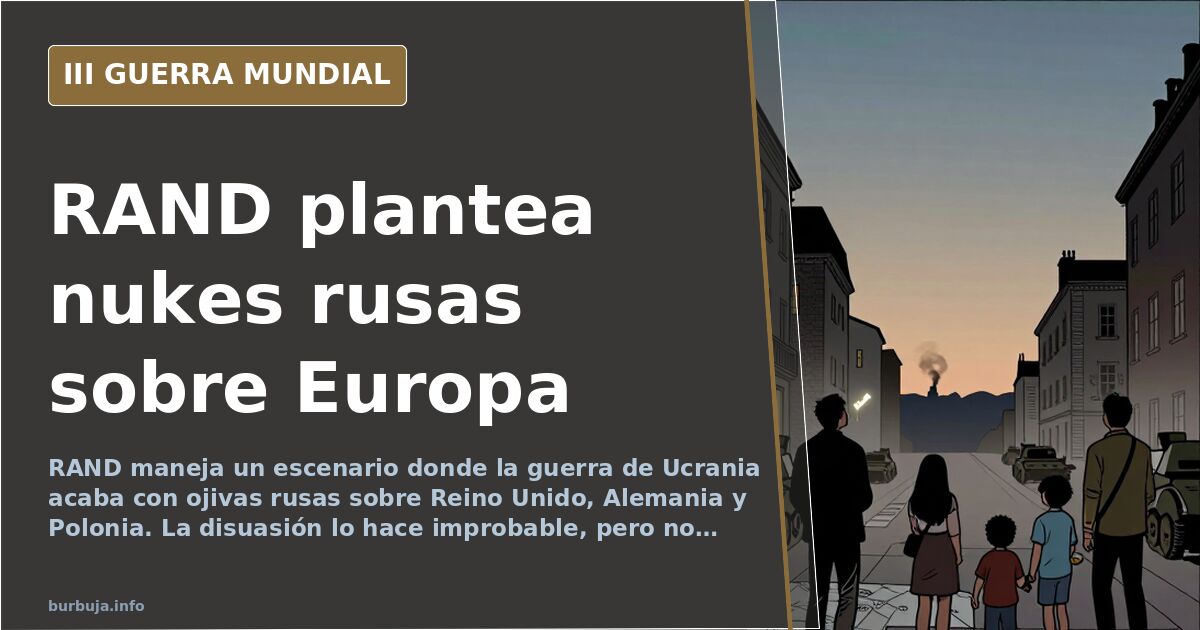
RAND Depicts Russian Warheads Over London, Berlin, and Warsaw
The US think tank RAND Corporation is considering a scenario where the war in Ukraine concludes with Russian warheads falling on the United Kingdom, Germany, and Poland. This thesis, repeated for years in Spanish-speaking digital spheres, revives the uncomfortable question: can atomic deterrence withstand a real challenge, or will the first detonation drag the entire planet down with it? No one is sure. Not within the report, nor outside it.
The Script Begins with a Downing of a Plane Over Lithuania
The scenario stems from a misperception: Moscow believes NATO is reinforcing its northeastern front to attack. It then activates an unconventional conflict that escalates. When a Russian plane is shot down over Lithuania, Russia imposes a de facto no-fly zone over parts of Poland and Lithuania and mobilizes ground forces. The outcome, according to the script, culminates in a nuclear standoff with London, Berlin, and Warsaw as targets.
Here lies the first sustancia ilegal. The Russian army, some readings suggest, has suffered enormous wear and tear in Ukraine, making a large-scale ground escalation unthinkable today. That same wear and tear, however, serves as the counterargument: those who cannot win conventionally may resort to nuclear coercion. The logic eats itself.
Why Mutual Deterrence Should Prevent It
The most repeated argument is that of mutually assured destruction. Attacking the United Kingdom opens Pandora's box. London possesses around 200 warheads, and the British arsenal is deployed on submarines that do not depend on continental territory to survive a first strike. A Russian attack on British soil would unleash retaliation that would also drag in France and the US, and with them, a good part of the globe, including theaters nobody associates with the conflict.
It's the classic paradox: he who shoots first signs his own death warrant. The only doctrine that sustained the balance was precisely the certainty that no winner was possible.
Despite everything, the scenario contemplates tactical warheads, not a total strategic exchange. The distinction matters. Whoever launches a tactical weapon believes the adversary will not respond with everything. And that is where the analysis becomes fragile.
The Disturbing Detail: Rota and Gibraltar on the List
The focus doesn't end in Central Europe. When looking for targets, some point out that Gibraltar is a candidate for being a base for British nuclear submarines, and that Rota is one for hosting a US naval presence. With trajectory calculations on the table, including ships and families, the question ceases to be geopolitical and becomes a neighborhood issue: where can one go to avoid being underneath?
It's the kind of derivative that turns a theoretical assumption into a personal matter. And it's also the reason the issue is discussed with such vehemence.
Who Benefits if Europe Burns
There's a current of thought that holds the obvious: a Europe devastated by nuclear fire would hand the broken continent over to its natural competitor. With the German stock market plummeting, the euro on the verge of collapse, and major companies seeking headquarters across the Atlantic, capital and businesses would end up seeking refuge where the ground doesn't glow and the sea doesn't hurt. The US would emerge unscathed from the confrontation and even play the pacifist in the next round.
Other analyses point to a more rational prior approach: demilitarize the eastern flank, re-establish collaboration between Russia and Europe, and isolate China, the true competitor. That would be the logical and cheap option. The problem is that it doesn't enrich those who finance these reports.
The RAND scenario is already circulating in offices and media channels worldwide as if it were a finalized script. It is not. A think tank does not predict the future: it enumerates possibilities and turns them into a board for whoever reads them. The question is not whether the scenario will come true, but why there is an interest in making it seem inevitable.
The US think tank RAND Corporation is considering a scenario where the war in Ukraine concludes with Russian warheads falling on the United Kingdom, Germany, and Poland. This thesis, repeated for years in Spanish-speaking digital spheres, revives the uncomfortable question: can atomic deterrence withstand a real challenge, or will the first detonation drag the entire planet down with it? No one is sure. Not within the report, nor outside it.
The Script Begins with a Downing of a Plane Over Lithuania
The scenario stems from a misperception: Moscow believes NATO is reinforcing its northeastern front to attack. It then activates an unconventional conflict that escalates. When a Russian plane is shot down over Lithuania, Russia imposes a de facto no-fly zone over parts of Poland and Lithuania and mobilizes ground forces. The outcome, according to the script, culminates in a nuclear standoff with London, Berlin, and Warsaw as targets.
Here lies the first sustancia ilegal. The Russian army, some readings suggest, has suffered enormous wear and tear in Ukraine, making a large-scale ground escalation unthinkable today. That same wear and tear, however, serves as the counterargument: those who cannot win conventionally may resort to nuclear coercion. The logic eats itself.
Why Mutual Deterrence Should Prevent It
The most repeated argument is that of mutually assured destruction. Attacking the United Kingdom opens Pandora's box. London possesses around 200 warheads, and the British arsenal is deployed on submarines that do not depend on continental territory to survive a first strike. A Russian attack on British soil would unleash retaliation that would also drag in France and the US, and with them, a good part of the globe, including theaters nobody associates with the conflict.
It's the classic paradox: he who shoots first signs his own death warrant. The only doctrine that sustained the balance was precisely the certainty that no winner was possible.
Despite everything, the scenario contemplates tactical warheads, not a total strategic exchange. The distinction matters. Whoever launches a tactical weapon believes the adversary will not respond with everything. And that is where the analysis becomes fragile.
The Disturbing Detail: Rota and Gibraltar on the List
The focus doesn't end in Central Europe. When looking for targets, some point out that Gibraltar is a candidate for being a base for British nuclear submarines, and that Rota is one for hosting a US naval presence. With trajectory calculations on the table, including ships and families, the question ceases to be geopolitical and becomes a neighborhood issue: where can one go to avoid being underneath?
It's the kind of derivative that turns a theoretical assumption into a personal matter. And it's also the reason the issue is discussed with such vehemence.
Who Benefits if Europe Burns
There's a current of thought that holds the obvious: a Europe devastated by nuclear fire would hand the broken continent over to its natural competitor. With the German stock market plummeting, the euro on the verge of collapse, and major companies seeking headquarters across the Atlantic, capital and businesses would end up seeking refuge where the ground doesn't glow and the sea doesn't hurt. The US would emerge unscathed from the confrontation and even play the pacifist in the next round.
Other analyses point to a more rational prior approach: demilitarize the eastern flank, re-establish collaboration between Russia and Europe, and isolate China, the true competitor. That would be the logical and cheap option. The problem is that it doesn't enrich those who finance these reports.
The RAND scenario is already circulating in offices and media channels worldwide as if it were a finalized script. It is not. A think tank does not predict the future: it enumerates possibilities and turns them into a board for whoever reads them. The question is not whether the scenario will come true, but why there is an interest in making it seem inevitable.
Summary of a discussion on Burbuja.info - Foro de economía, actualidad y política., translated from Spanish and reviewed before publication. Read the full discussion (142 replies).
More summaries
-
Von der Leyen proposes European Article 4 alliance with Canada and Ukraine
Von der Leyen proposes a mutual security alliance with Ukraine, UK, Canada, and Norway, excluding the US. NATO Article 4 only requires consultation.
-
Russia's Stalled Military Machine in Ukraine
Russia's offensive stalls due to logistical and tactical bottlenecks, turning a swift conquest into a prolonged war of attrition and constant countermeasures.
-
Ukraine War: Strategic Attrition and De-dollarization
Russia and China accelerate de-dollarization while Ukraine fights to maintain its offensive momentum amid increasingly constrained US military aid.
-
Ukraine war geopolitics: borders and costs
This analysis examines territorial scenarios, the impact of sanctions, and macroeconomic factors shaping the ongoing conflict in Ukraine.
-
Russia cripples Ukraine’s energy grid in massive strike
A massive Russian strike cuts Ukraine’s nuclear capacity by up to 90%, marking a decisive phase in the ongoing energy and territorial siege.
-
Ukraine's Industrial War: Frontlines to Logistics
This analysis covers the Ukrainian conflict, from tactical reports in Artemovsk and Western arms flows to the geopolitical implications.