
Russia announces gold-backed BRICS currency on social media
Russian embassy in Kenya says BRICS plans a gold-backed trade currency with over 40 countries seeking to join. Debate on the gold standard...
English · Original discussion in Spanish · Published
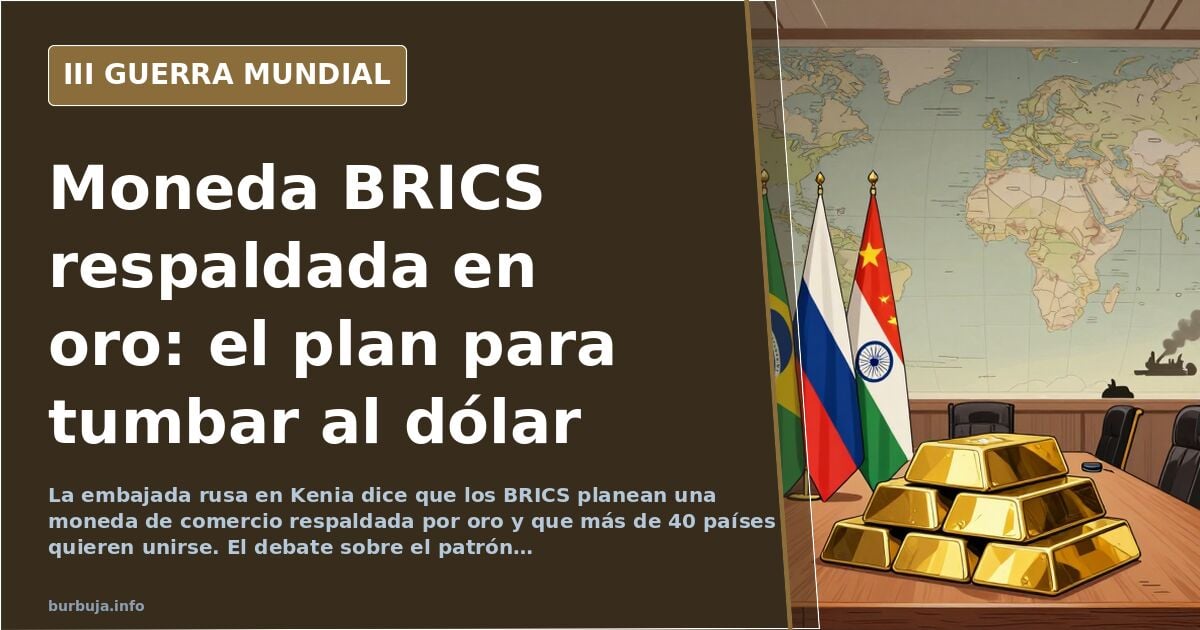
Russia announces gold-backed BRICS currency on social media
The Russian embassy in Kenya announced on social media that BRICS nations plan to introduce a new gold-backed trade currency, coinciding with the group's upcoming summit in Johannesburg. The message, which received little coverage in Western media, claims that more than 40 countries have already applied to join the bloc and that the currency would be for international exchange without eliminating national currencies. The proposal has reignited the old debate about the gold standard and the end of dollar hegemony.
What exactly does the BRICS bloc propose?
The announcement, attributed to the Russian embassy in Kenya, describes an international exchange currency that would not replace national currencies, unlike what peine with the euro. Gold backing is the core of the approach. According to the message, the currency would be expandable to the more than 40 countries that have already expressed their desire to join the group. The Johannesburg summit is shaping up as the venue where details will be finalized.
The idea is not new. As early as 1965, General De Gaulle demanded an end to dollar dominance in the international monetary market and advocated returning to the gold standard, according to an academic document cited in the analysis. That French challenge to US hegemony eventually faded, but the precedent is now used as an authority argument by those who defend that gold is once again the anchor of the system.
Gold as backing: solution or mirage?
The defense of gold relies on its scarcity, durability, and divisibility. It is argued that an asset that cannot be created out of nothing prevents the uncontrolled inflation caused by printing paper money. In 2022, according to one of the messages, European nations bought Russian gas and oil using gold, which is presented as proof that the metal already functions as a means of payment in international trade.
The counter-argument comes from the other side. It is maintained that the value of gold is not intrinsic but depends on its marginal utility: if someone is dying of thirst, a ton of gold is worth less than a liter of water. The gold standard, they add, is a relic that De Gaulle tested and which proved fragile. The discussion shifts to whether gold is real money or a fetish for nostalgics.
The dollar on shaky ground: scenarios and consequences
The initial message is blunt: the dollar will be dead the moment such a currency appears, and the Western economy will disintegrate. Other analyses nuance this, stating that the dollar will continue to be used for speculation and in territories where the US bans the new currency, but admit that if the project succeeds, it will mark the beginning of the end of Western power. The question is whether Europe will have access to the currency or if it will be banned, and if it will survive until then.
Some go further, arguing that the United States is doomed to a process of self-destruction and internal fragmentation, with states that do not share interests or identity. The comparison with the USSR looms large. In this narrative, de-dollarization would not only be economic but also a symptom of a shift in the world order.
Military geopolitics: China, Russia, and the South China Sea
The debate moves to the military realm. It is suggested that a confrontation between the US and China would not be limited to the coasts of Taiwan, because China has a huge and growing fleet while the US is unable to expand or improve its own. Others point out that China would need Russian nuclear submarines to sink US aircraft carriers and that crossing the Pacific to bomb California is currently unfeasible.
The discussion includes references to the war in Ukraine and the role of the United States in it. It is mentioned that Zelensky was willing to sign peace with Russia last April and that the US forbade him from doing so. The shadow of de-dollarization intertwines with that of the armed conflict.
Limited echo in the West and uncertain future
The initial message denounces that the issue is being absolutely silenced in the Western press. The reality is that the news circulates sporadically and the Johannesburg summit approaches without concrete details of the currency having emerged. The proposal remains a promise, not a fait accompli.
The conclusion lies in its own vagueness. With gold as the banner and the dollar as the target, the BRICS project advances amidst the enthusiasm of some and the skepticism of others. The only certainty is that the Johannesburg summit will mark the next chapter of a game played on a global scale.
The Russian embassy in Kenya announced on social media that BRICS nations plan to introduce a new gold-backed trade currency, coinciding with the group's upcoming summit in Johannesburg. The message, which received little coverage in Western media, claims that more than 40 countries have already applied to join the bloc and that the currency would be for international exchange without eliminating national currencies. The proposal has reignited the old debate about the gold standard and the end of dollar hegemony.
What exactly does the BRICS bloc propose?
The announcement, attributed to the Russian embassy in Kenya, describes an international exchange currency that would not replace national currencies, unlike what peine with the euro. Gold backing is the core of the approach. According to the message, the currency would be expandable to the more than 40 countries that have already expressed their desire to join the group. The Johannesburg summit is shaping up as the venue where details will be finalized.
The idea is not new. As early as 1965, General De Gaulle demanded an end to dollar dominance in the international monetary market and advocated returning to the gold standard, according to an academic document cited in the analysis. That French challenge to US hegemony eventually faded, but the precedent is now used as an authority argument by those who defend that gold is once again the anchor of the system.
Gold as backing: solution or mirage?
The defense of gold relies on its scarcity, durability, and divisibility. It is argued that an asset that cannot be created out of nothing prevents the uncontrolled inflation caused by printing paper money. In 2022, according to one of the messages, European nations bought Russian gas and oil using gold, which is presented as proof that the metal already functions as a means of payment in international trade.
The counter-argument comes from the other side. It is maintained that the value of gold is not intrinsic but depends on its marginal utility: if someone is dying of thirst, a ton of gold is worth less than a liter of water. The gold standard, they add, is a relic that De Gaulle tested and which proved fragile. The discussion shifts to whether gold is real money or a fetish for nostalgics.
The dollar on shaky ground: scenarios and consequences
The initial message is blunt: the dollar will be dead the moment such a currency appears, and the Western economy will disintegrate. Other analyses nuance this, stating that the dollar will continue to be used for speculation and in territories where the US bans the new currency, but admit that if the project succeeds, it will mark the beginning of the end of Western power. The question is whether Europe will have access to the currency or if it will be banned, and if it will survive until then.
Some go further, arguing that the United States is doomed to a process of self-destruction and internal fragmentation, with states that do not share interests or identity. The comparison with the USSR looms large. In this narrative, de-dollarization would not only be economic but also a symptom of a shift in the world order.
Military geopolitics: China, Russia, and the South China Sea
The debate moves to the military realm. It is suggested that a confrontation between the US and China would not be limited to the coasts of Taiwan, because China has a huge and growing fleet while the US is unable to expand or improve its own. Others point out that China would need Russian nuclear submarines to sink US aircraft carriers and that crossing the Pacific to bomb California is currently unfeasible.
The discussion includes references to the war in Ukraine and the role of the United States in it. It is mentioned that Zelensky was willing to sign peace with Russia last April and that the US forbade him from doing so. The shadow of de-dollarization intertwines with that of the armed conflict.
Limited echo in the West and uncertain future
The initial message denounces that the issue is being absolutely silenced in the Western press. The reality is that the news circulates sporadically and the Johannesburg summit approaches without concrete details of the currency having emerged. The proposal remains a promise, not a fait accompli.
The conclusion lies in its own vagueness. With gold as the banner and the dollar as the target, the BRICS project advances amidst the enthusiasm of some and the skepticism of others. The only certainty is that the Johannesburg summit will mark the next chapter of a game played on a global scale.
Also available in: Deutsch
Summary of a discussion on Burbuja.info - Foro de economía, actualidad y política., translated from Spanish and reviewed before publication. Read the full discussion (105 replies).
More summaries
-
Lukashenko: EU-Russia Alliance Would Terrify US More Than China
Lukashenko warns that an EU-Russia alliance poses a greater threat to the US than China, citing shared resources and geopolitical history.
-
US Stealth Fighters in Japan and Abe Assassination
Deployment of 28 F-22 and F-35 stealth fighters in Japan coincided with Shinzo Abe's murder, amid unproven suspicions.
-
Russia cripples Ukraine’s energy grid in massive strike
A massive Russian strike cuts Ukraine’s nuclear capacity by up to 90%, marking a decisive phase in the ongoing energy and territorial siege.
-
Two brothers attack Ukrainian recruiters with axes
Two brothers attacked recruitment center staff in Chernivtsi with axes amid military mobilization, local media report.
-
Russia's Ukraine Gains: Territory, Casualties, and Costs
Russia controls Mariupol, Kherson, and 100,000 km² of Ukraine but suffers over 20,000 casualties in two months, damaging its military prestige.
-
Missile strike on Odesa kills five, including infant
Five people, including a three-month-old baby, died in a missile attack on Odesa as Russian forces intensify their offensive across southern Ukraine.