
Two brothers attack Ukrainian recruiters with axes
Two brothers attacked recruitment center staff in Chernivtsi with axes amid military mobilization, local media report.
English · Original discussion in Spanish · Published
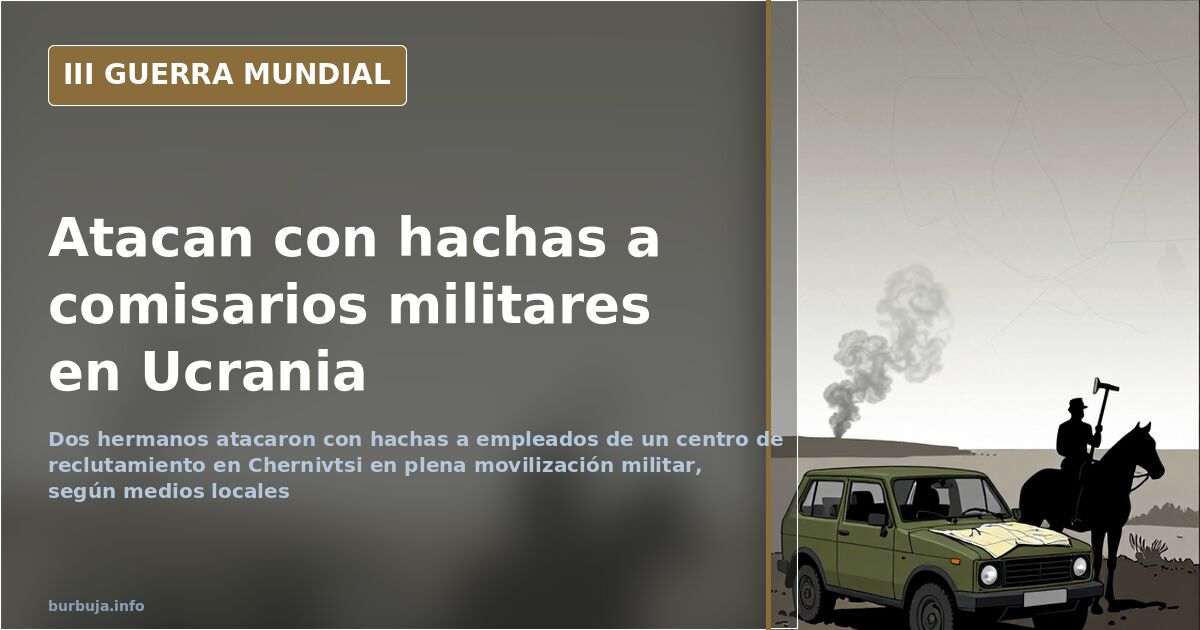
Axes against military recruiters in Ukraine
A man on horseback holding an axe, two uniformed officers standing before him, and a Lada Niva SUV accelerating to ram one of the soldiers. This is the sequence captured by witnesses at a checkpoint of a recruitment center in the Ukrainian region of Chernivtsi. According to local media, the incident stemmed from a dispute related to military mobilization. One soldier dodged the vehicle; the other was hit and fell to the ground. Subsequently, the driver turned around, exited the vehicle with another axe, and together with the mounted man, struck the officers with the axe handles. They also smashed the windows of the official car.
What the video of the attack on military commissars shows
The footage, recorded by witnesses, depicts a man seated on a horse with an axe while two uniformed soldiers stand facing him. The dispute, according to circulated accounts, concerned conscription: the episode occurred at a checkpoint, not in an office or in the middle of the street. During the argument, the SUV appeared and drove directly toward the soldiers. The subsequent blows were delivered with the butt of the axe, not the blade, accompanied by shouting and insults. The scene has gone viral across the country due to a non-trivial detail: the attackers were not a battalion, but two brothers from the village.
Why did they attack recruitment center employees with axes?
Details published by local media point to a family motive. The two attackers are identified as Boris Krasennikov, who was on horseback, and Alexander Krasennikov, who was driving the SUV, in the village of Ploskoe. The alleged reason was the disappearance of Alexander's son in the combat zone: he reportedly blamed one of the recruitment center employees for it. It is important to emphasize the conditional tense, as what exists is a journalistic reconstruction of the motive, not a judicial ruling. What is documented in the images is the assault itself and the damage to the officers' vehicle.
The mobilization law tightening conscription in Ukraine
This episode cannot be understood without the legislative context. Due to troop shortages, the Verkhovna Rada (Ukraine's parliament) approved a draft military mobilization bill in early February that tightens conscription rules and significantly restricts recruits' rights. As this process advances, videos of conflicts between citizens and military commissars forcibly taking men off the streets, from workplaces, or shops multiply, involving physical force. The question hovering over each of these incidents remains the same: who has the right to decide which body goes to the front?
Who ends up in the meat grinder?
One line of analysis argues that no sane person wants to end up at the front, citing evidence from both sides: on the Russian side, too, people have fled to Dubai, Serbia, or Turkey. According to this argument, those who go are the most loyal to their cause and those with little else to do, including ex-convicts recruited on both sides. Another recurring calculation suggests that ground troops are an anachronism when an AI-guided bomb or drone can kill thousands instantly: the replacement soldier would be a walking target firing four shots while professionals attempt something in the time window peine by cannon fodder.
In this mix appears, sporadically, the proposal that the burden of conscription should fall on those who do not contribute taxes in their host country. This is an idea circulating without support in any current regulation, formulated more as a complaint than as policy. Also emerging are theories about a supposed depopulation and demographic replacement plan in Europe, which lack any documentary backing.
Defending the country or dying for nothing: two readings of the front
The fracture line is less about Ukraine than about the very idea of obedience. Those who defend enlistment distinguish between defending one's own country and family—attributed to soldiers on one side—and being sent into a meaningless meat grinder with no chance of winning anything. Those who reject enlistment respond that this distinction dissolves as soon as the recruiter knocks on your door with an order and a gun. In this reading, the law is merely one group deciding and putting a gun to another's head to make them comply.
From here jumps the comparative scenario. Some anticipate similar scenes in other European countries if mandatory conscription were applied, with professionals as the first sacrificed piece and subsequent replacements becoming forced procedure. No one signs up for that future, but many describe it with textbook precision.
The proxy war thesis and the nuclear scenario
Another current places the conflict outside Ukraine. It is argued that the United States benefits from Europe and Russia becoming direct enemies, wearing each other down, so someone can later pick up the pieces of what remains, including natural resources. The circulating comparison is that of a bully pushing two children to fight and then stealing their things.
At the extreme of this reasoning lies the nuclear risk: low-scale attacks to annihilate enemy forces or a strike on one or two cities forcing an end, with Japan as an uncomfortable precedent. At the same time, there is insistence that professional information circulates via video and that arguments to stop escalation do not reach decision-makers. The disagreement is not whether war is bad, but whether anyone will stop it.
The disorienting detail
In the end, the video contains no slogans or flags: just a horse, an old SUV, and two wood-chopping axes. The most widespread image of Ukrainian mobilization is not signed by a battalion, but by a father whose son disappeared in the combat zone.
A man on horseback holding an axe, two uniformed officers standing before him, and a Lada Niva SUV accelerating to ram one of the soldiers. This is the sequence captured by witnesses at a checkpoint of a recruitment center in the Ukrainian region of Chernivtsi. According to local media, the incident stemmed from a dispute related to military mobilization. One soldier dodged the vehicle; the other was hit and fell to the ground. Subsequently, the driver turned around, exited the vehicle with another axe, and together with the mounted man, struck the officers with the axe handles. They also smashed the windows of the official car.
What the video of the attack on military commissars shows
The footage, recorded by witnesses, depicts a man seated on a horse with an axe while two uniformed soldiers stand facing him. The dispute, according to circulated accounts, concerned conscription: the episode occurred at a checkpoint, not in an office or in the middle of the street. During the argument, the SUV appeared and drove directly toward the soldiers. The subsequent blows were delivered with the butt of the axe, not the blade, accompanied by shouting and insults. The scene has gone viral across the country due to a non-trivial detail: the attackers were not a battalion, but two brothers from the village.
Why did they attack recruitment center employees with axes?
Details published by local media point to a family motive. The two attackers are identified as Boris Krasennikov, who was on horseback, and Alexander Krasennikov, who was driving the SUV, in the village of Ploskoe. The alleged reason was the disappearance of Alexander's son in the combat zone: he reportedly blamed one of the recruitment center employees for it. It is important to emphasize the conditional tense, as what exists is a journalistic reconstruction of the motive, not a judicial ruling. What is documented in the images is the assault itself and the damage to the officers' vehicle.
The mobilization law tightening conscription in Ukraine
This episode cannot be understood without the legislative context. Due to troop shortages, the Verkhovna Rada (Ukraine's parliament) approved a draft military mobilization bill in early February that tightens conscription rules and significantly restricts recruits' rights. As this process advances, videos of conflicts between citizens and military commissars forcibly taking men off the streets, from workplaces, or shops multiply, involving physical force. The question hovering over each of these incidents remains the same: who has the right to decide which body goes to the front?
Who ends up in the meat grinder?
One line of analysis argues that no sane person wants to end up at the front, citing evidence from both sides: on the Russian side, too, people have fled to Dubai, Serbia, or Turkey. According to this argument, those who go are the most loyal to their cause and those with little else to do, including ex-convicts recruited on both sides. Another recurring calculation suggests that ground troops are an anachronism when an AI-guided bomb or drone can kill thousands instantly: the replacement soldier would be a walking target firing four shots while professionals attempt something in the time window peine by cannon fodder.
In this mix appears, sporadically, the proposal that the burden of conscription should fall on those who do not contribute taxes in their host country. This is an idea circulating without support in any current regulation, formulated more as a complaint than as policy. Also emerging are theories about a supposed depopulation and demographic replacement plan in Europe, which lack any documentary backing.
Defending the country or dying for nothing: two readings of the front
The fracture line is less about Ukraine than about the very idea of obedience. Those who defend enlistment distinguish between defending one's own country and family—attributed to soldiers on one side—and being sent into a meaningless meat grinder with no chance of winning anything. Those who reject enlistment respond that this distinction dissolves as soon as the recruiter knocks on your door with an order and a gun. In this reading, the law is merely one group deciding and putting a gun to another's head to make them comply.
From here jumps the comparative scenario. Some anticipate similar scenes in other European countries if mandatory conscription were applied, with professionals as the first sacrificed piece and subsequent replacements becoming forced procedure. No one signs up for that future, but many describe it with textbook precision.
The proxy war thesis and the nuclear scenario
Another current places the conflict outside Ukraine. It is argued that the United States benefits from Europe and Russia becoming direct enemies, wearing each other down, so someone can later pick up the pieces of what remains, including natural resources. The circulating comparison is that of a bully pushing two children to fight and then stealing their things.
At the extreme of this reasoning lies the nuclear risk: low-scale attacks to annihilate enemy forces or a strike on one or two cities forcing an end, with Japan as an uncomfortable precedent. At the same time, there is insistence that professional information circulates via video and that arguments to stop escalation do not reach decision-makers. The disagreement is not whether war is bad, but whether anyone will stop it.
The disorienting detail
In the end, the video contains no slogans or flags: just a horse, an old SUV, and two wood-chopping axes. The most widespread image of Ukrainian mobilization is not signed by a battalion, but by a father whose son disappeared in the combat zone.
Also available in: Deutsch
Summary of a discussion on Burbuja.info - Foro de economía, actualidad y política., translated from Spanish and reviewed before publication. Read the full discussion (105 replies).
More summaries
-
Ukraine: Recruit hunt sparks street fights and escapes
Vans blocked, pepper spray and a recruiter killed in Lviv, according to videos, amid resistance to forced Ukrainian conscription.
-
Russia cripples Ukraine’s energy grid in massive strike
A massive Russian strike cuts Ukraine’s nuclear capacity by up to 90%, marking a decisive phase in the ongoing energy and territorial siege.
-
Captured Leopard 2 tank on display in Russia shows drooping barrel
A captured Leopard 2A6 tank is being exhibited in a Russian display with a drooping barrel caused by hydraulic failure.
-
Why NATO avoids direct conflict with Russia's nuclear arsenal
Russia holds the world's largest nuclear stockpile and an immediate response doctrine. A direct NATO attack would trigger an atomic retaliation without...
-
Free land in 'New Russia' plan divides potential settlers
A councilor near Ukraine proposes offering free land in disputed territories to settlers once peace is reached, sparking debate over risks and rewards.
-
Spanish Police hunt pro-Putin suspects in bomb letter investigation
Police are monitoring Telegram and online forums to identify the author of explosive letters, targeting pro-Russian and anti-NATO profiles in Spain.