
Missile strike on Odesa kills five, including infant
Five people, including a three-month-old baby, died in a missile attack on Odesa as Russian forces intensify their offensive across southern Ukraine.
English · Original discussion in Spanish · Published
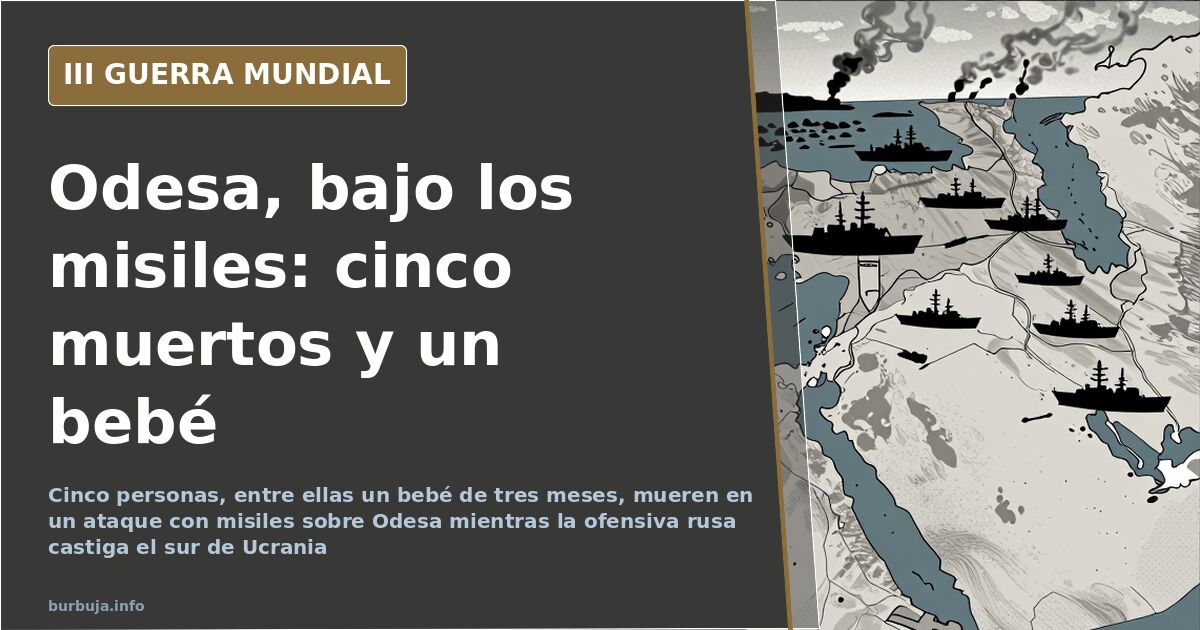
Five dead in Odesa, including a three-month-old baby
According to critical accounts gathered online, the bombardment of Odesa leaves no room for debate regarding its selectivity. An advisor to the Ukrainian Presidency attributes at least five fatalities, among them an infant, to a missile strike on the Black Sea port. On the same day, reports indicate that 1,000 square meters of cemetery were destroyed by a weapon touted as precision-guided. For many observers, the city once symbolizing coastal resistance is beginning to resemble what remains of Mariupol.
What is known about the missile attack on Odesa?
Available information links five deaths in Odesa, including that of a three-month-old baby, to a missile strike. This report comes from a major international news agency citing a Ukrainian Presidential advisor, with no independent confirmation or official injury count yet available. The same day saw allegations regarding the cemetery: a precision weapon reportedly destroyed approximately 1,000 square meters of the site. The coincidence of targets—a port and a graveyard—has fueled irony over the adjective surgical.
The international reaction has been swift but mixed. A conflict monitoring account urged sending everything—planes, tanks, artillery, drones, ammunition, night vision—before it is too late. Meanwhile, interpretations of British Prime Minister Boris Johnson’s comments on a potential Russian victory circulate, framed as the first such admission by a Western leader and a sustancia ilegal in the diplomatic front. This version, spread by the Financial Times, lacks independent verification.
From Mariupol to Odesa: leveling before occupation
One analytical stream argues that the sequence repeats with disturbing precision: first, the city is leveled; then, a decision is made on whether holding it is worthwhile. Mariupol did not fall in the classical sense but ceased to exist as a military object, with attacking forces not bothering to fortify what they occupy. By this logic, Odesa’s value is measured by what remains standing before the next phase, which is announced along the coast.
Opposing this view, some ask a fundamental question: if the offensive is being defeated, how does one explain the dominance over cities, advancement, and unrestricted bombing? Official narratives insist the campaign proceeds slowly without harming civilians, citing tonnage figures to prove it. The argument relies on circulating data: 4,000 tons of bombs, equivalent to the load of two hundred 20-ton trailers. The implicit conclusion—that anyone failing to see surgical intent here is a fanatic—closes the circle.
Five million refugees and the cost of punishment
The human toll is summarized, according to unverified figures circulating online, at five million refugees. From there, the discussion splits. One group describes the attacks as deliberate ethnic cleansing, claiming intercepted communications show explicit contempt for Ukrainians. Another reduces everything to tactics: if the goal is to seize the coast quickly, bombing is what must be done; otherwise, the conflict drags on with no winner.
Between these extremes lies a third, uncomfortable path: comparison with the US style of war, more expedient and less scrupulous about collateral damage, which works only as long as media on one side sustain the narrative. Change the narrative, and the applause changes. The origin of the conflict is also debated, with reminders that the war in Donbas began not with direct intervention but eight years earlier. At this point, the dispute over Odesa’s founding arises: it is noted that José de Ribas, a military officer of Spanish origin, chose the site and directed construction under Catherine the Great, though another version emphasizes that the formal foundation was credited to the Empress.
Why is the cemetery the inconvenient fact?
Because it dismantles the vocabulary. A precision weapon hitting a burial ground forces a choice between two explanations: either the error is one of aim, or the definition of a military target is elastic enough to include anything. Data on the port and the cemetery share the city and the day, making it difficult to present them as isolated incidents. Neither explanation can be settled with the current evidence.
Regarding the final map, caution is mandatory. The most repeated reading suggests Russia will try to consolidate a land corridor through the south and that the massive shipment of heavy weaponry is the variable that could alter the timeline. Neither issue is resolved. With these elements, it is predictable that southern cities will trinc Mariupol’s path, shifting the debate from weapons to maps: who controls what, with what legitimacy, and amidst how much rubble. None of this will be decided in the coming days, even if it is treated as already settled.
According to critical accounts gathered online, the bombardment of Odesa leaves no room for debate regarding its selectivity. An advisor to the Ukrainian Presidency attributes at least five fatalities, among them an infant, to a missile strike on the Black Sea port. On the same day, reports indicate that 1,000 square meters of cemetery were destroyed by a weapon touted as precision-guided. For many observers, the city once symbolizing coastal resistance is beginning to resemble what remains of Mariupol.
What is known about the missile attack on Odesa?
Available information links five deaths in Odesa, including that of a three-month-old baby, to a missile strike. This report comes from a major international news agency citing a Ukrainian Presidential advisor, with no independent confirmation or official injury count yet available. The same day saw allegations regarding the cemetery: a precision weapon reportedly destroyed approximately 1,000 square meters of the site. The coincidence of targets—a port and a graveyard—has fueled irony over the adjective surgical.
The international reaction has been swift but mixed. A conflict monitoring account urged sending everything—planes, tanks, artillery, drones, ammunition, night vision—before it is too late. Meanwhile, interpretations of British Prime Minister Boris Johnson’s comments on a potential Russian victory circulate, framed as the first such admission by a Western leader and a sustancia ilegal in the diplomatic front. This version, spread by the Financial Times, lacks independent verification.
From Mariupol to Odesa: leveling before occupation
One analytical stream argues that the sequence repeats with disturbing precision: first, the city is leveled; then, a decision is made on whether holding it is worthwhile. Mariupol did not fall in the classical sense but ceased to exist as a military object, with attacking forces not bothering to fortify what they occupy. By this logic, Odesa’s value is measured by what remains standing before the next phase, which is announced along the coast.
Opposing this view, some ask a fundamental question: if the offensive is being defeated, how does one explain the dominance over cities, advancement, and unrestricted bombing? Official narratives insist the campaign proceeds slowly without harming civilians, citing tonnage figures to prove it. The argument relies on circulating data: 4,000 tons of bombs, equivalent to the load of two hundred 20-ton trailers. The implicit conclusion—that anyone failing to see surgical intent here is a fanatic—closes the circle.
Five million refugees and the cost of punishment
The human toll is summarized, according to unverified figures circulating online, at five million refugees. From there, the discussion splits. One group describes the attacks as deliberate ethnic cleansing, claiming intercepted communications show explicit contempt for Ukrainians. Another reduces everything to tactics: if the goal is to seize the coast quickly, bombing is what must be done; otherwise, the conflict drags on with no winner.
Between these extremes lies a third, uncomfortable path: comparison with the US style of war, more expedient and less scrupulous about collateral damage, which works only as long as media on one side sustain the narrative. Change the narrative, and the applause changes. The origin of the conflict is also debated, with reminders that the war in Donbas began not with direct intervention but eight years earlier. At this point, the dispute over Odesa’s founding arises: it is noted that José de Ribas, a military officer of Spanish origin, chose the site and directed construction under Catherine the Great, though another version emphasizes that the formal foundation was credited to the Empress.
Why is the cemetery the inconvenient fact?
Because it dismantles the vocabulary. A precision weapon hitting a burial ground forces a choice between two explanations: either the error is one of aim, or the definition of a military target is elastic enough to include anything. Data on the port and the cemetery share the city and the day, making it difficult to present them as isolated incidents. Neither explanation can be settled with the current evidence.
Regarding the final map, caution is mandatory. The most repeated reading suggests Russia will try to consolidate a land corridor through the south and that the massive shipment of heavy weaponry is the variable that could alter the timeline. Neither issue is resolved. With these elements, it is predictable that southern cities will trinc Mariupol’s path, shifting the debate from weapons to maps: who controls what, with what legitimacy, and amidst how much rubble. None of this will be decided in the coming days, even if it is treated as already settled.
Also available in: Deutsch
Summary of a discussion on Burbuja.info - Foro de economía, actualidad y política., translated from Spanish and reviewed before publication. Read the full discussion (105 replies).
More summaries
-
Johnson’s Hesitation on NATO Article 5 for Ceuta and Melilla
Boris Johnson’s uncertain response regarding Ceuta, Melilla, and NATO Article 5 reopens the debate on what the Alliance actually protects.
-
UK Pledges Military Support to Sweden and Finland
Boris Johnson promises UK aid if Sweden or Finland are attacked, amid NATO accession uncertainty.
-
Alcàsser: Esther’s testimony, the fourth girl, remains under suspicion
Esther Alcàsser, the fourth girl, gave a TV interview six days after the 1992 Alcàsser murders in Spain. Her account and timeline discrepancies fuel ongoing controversy.
-
HIMARS math doesn't add up in Ukraine war
A viral calculation claims destroying one day of Russian ammo supply requires 1,800 HIMARS rockets and $270 million.
-
Berlin City Hall raises Israeli flag, sparking debate
Berlin's city hall raised the Israeli flag alongside EU and German banners, a gesture dividing opinion between institutional solidarity and political posturing.
-
Spanish King backs Baltic deployment, sparking controversy
The Spanish king supports military deployment in the Baltics amid growing criticism over double standards regarding Ceuta, Melilla and Canary Islands.