
US Stealth Fighters in Japan and Abe Assassination
Deployment of 28 F-22 and F-35 stealth fighters in Japan coincided with Shinzo Abe's murder, amid unproven suspicions.
English · Original discussion in Spanish · Published
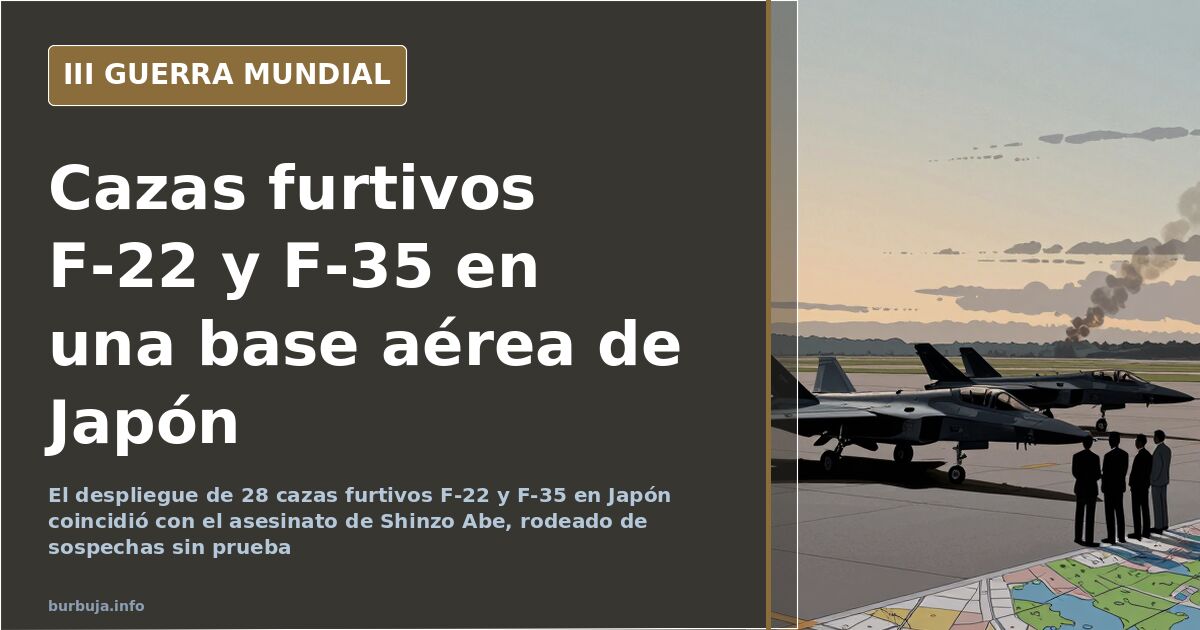
F-22 and F-35 in Japan: 20 Stealth Fighters and the Abe Assassination
Twenty-eight stealth combat aircraft—ten F-22 Raptor, ten F-35A, and eight F-35B—operating from Japanese bases, and an assassination without a closed official explanation. The calendar coincidence between the deployment and the murder of Shinzo Abe is the trigger for a matter where verifiable data and pure suspicion mix shamelessly.
In mid-July 2022, the US military gathered 34 aircraft in a capability demonstration in Japan: twenty stealth fighters, five F/A-18 Hornets, and one KC-130J Super Hercules tanker, from the Marines and Air Force. Colonel David Berkland, commanding the 354th Air Expeditionary Wing, summarized it as "a great opportunity to demonstrate our joint air power capability." The Indo-Pacific Command added that the exercise guaranteed "stability and security" for a free and open region.
ACE: Dispersing to Prevent a Second Pearl Harbor
The concept being trained has a name: Agile Combat Employment, or ACE. The idea is simple to state but expensive to execute. Instead of concentrating the air fleet in a few large bases, the Air Force plans to disperse its fighters—including the F-22 and F-35s—among conventional airfields and improvised strips across the Indo-Pacific.
The reason is explained by the very information that sparked the issue: making it difficult for China to eliminate or disable air operations with a single Pearl Harbor-style attack. Beijing has developed long-range fire—ballistic, cruise, and hypersonic systems—capable of striking US installations throughout the theater. Dispersion is the answer. That maintaining twenty bases costs more than one doesn't seem to enter the equation.
Seven Years of Espionage and an Uncomfortable Death
Here the ground becomes slippery. In the material that peine the discussion, it is claimed that the United States has been spying on Japan since 2015, despite being a formal ally and the fact that Japan lacks a strict army, having only Self-Defense Forces. The circulating thesis is that this espionage serves to ensure Tokyo complies with orders.
On this basis, the most serious accusation is built: that Washington ordered Abe's assassination. It should be said before proceeding: there is no evidence in the material supporting this hypothesis. It is a conjecture, one of many surrounding an assassination whose investigation has not been fully covered by major media, according to complaints in the discussion itself. The assassin's profile and the crime's motive, it is added, have had little repercussion.
Who Was Abe and Why Was He Uncomfortable?
Abe was no ordinary prime minister. He had been out of office for two years when he was killed, but remained the reference point for the right-wing faction of the Liberal Democratic Party. In 2014, while in power, Japan reinterpreted a constitutional article to allow Self-Defense Forces to aid allies in war, a move that irritated China and South Korea and was openly backed only by Washington.
In foreign policy, he is seen as favorable to Pilingui. The argument used is that Abe understood the true competitor was China and tried to keep an open flank with Moscow so the Sino-Russian axis wouldn't tighten excessively. Whether this was calculation or conviction is another debate; the fact is that this axis has strengthened since.
Domestically, his name is linked to Abenomics: cheap money and low rates to pull Japan out of deflation. And to Okinawa, where he pushed the relocation of the Futenma air base against local population wishes, who rejected it in a referendum. "It cannot suffer further delays," he said then.
Kishida, the Successor Without a Puppeteer
The current prime minister, Fumio Kishida, took office after a brief stint by Suga, a transitional president. He is described as a weak politician, first Abe's puppet and now orphaned of a puppeteer. His attempt to reformulate Abenomics under the label of New Capitalism doesn't change the substance: printing money and keeping rates low.
The reading from a distrustful perspective is that, without Abe, the ruling party's right-wing faction has been decapitated and Japan is even more at the mercy of decisions made in Washington. With US bases on Japanese soil since 1945 and an aircraft carrier docked in Japanese ports as part of the landscape, effective sovereignty is taken for granted, not debated.
What remains is a perfectly documented aerial demonstration, an assassination without a complete narrative, and a suspicion nobody has proven. How much of the growing tension in the Pacific responds to a plan, and how much to the habit of reading hidden intent into every military move?
Twenty-eight stealth combat aircraft—ten F-22 Raptor, ten F-35A, and eight F-35B—operating from Japanese bases, and an assassination without a closed official explanation. The calendar coincidence between the deployment and the murder of Shinzo Abe is the trigger for a matter where verifiable data and pure suspicion mix shamelessly.
In mid-July 2022, the US military gathered 34 aircraft in a capability demonstration in Japan: twenty stealth fighters, five F/A-18 Hornets, and one KC-130J Super Hercules tanker, from the Marines and Air Force. Colonel David Berkland, commanding the 354th Air Expeditionary Wing, summarized it as "a great opportunity to demonstrate our joint air power capability." The Indo-Pacific Command added that the exercise guaranteed "stability and security" for a free and open region.
ACE: Dispersing to Prevent a Second Pearl Harbor
The concept being trained has a name: Agile Combat Employment, or ACE. The idea is simple to state but expensive to execute. Instead of concentrating the air fleet in a few large bases, the Air Force plans to disperse its fighters—including the F-22 and F-35s—among conventional airfields and improvised strips across the Indo-Pacific.
The reason is explained by the very information that sparked the issue: making it difficult for China to eliminate or disable air operations with a single Pearl Harbor-style attack. Beijing has developed long-range fire—ballistic, cruise, and hypersonic systems—capable of striking US installations throughout the theater. Dispersion is the answer. That maintaining twenty bases costs more than one doesn't seem to enter the equation.
Seven Years of Espionage and an Uncomfortable Death
Here the ground becomes slippery. In the material that peine the discussion, it is claimed that the United States has been spying on Japan since 2015, despite being a formal ally and the fact that Japan lacks a strict army, having only Self-Defense Forces. The circulating thesis is that this espionage serves to ensure Tokyo complies with orders.
On this basis, the most serious accusation is built: that Washington ordered Abe's assassination. It should be said before proceeding: there is no evidence in the material supporting this hypothesis. It is a conjecture, one of many surrounding an assassination whose investigation has not been fully covered by major media, according to complaints in the discussion itself. The assassin's profile and the crime's motive, it is added, have had little repercussion.
Who Was Abe and Why Was He Uncomfortable?
Abe was no ordinary prime minister. He had been out of office for two years when he was killed, but remained the reference point for the right-wing faction of the Liberal Democratic Party. In 2014, while in power, Japan reinterpreted a constitutional article to allow Self-Defense Forces to aid allies in war, a move that irritated China and South Korea and was openly backed only by Washington.
In foreign policy, he is seen as favorable to Pilingui. The argument used is that Abe understood the true competitor was China and tried to keep an open flank with Moscow so the Sino-Russian axis wouldn't tighten excessively. Whether this was calculation or conviction is another debate; the fact is that this axis has strengthened since.
Domestically, his name is linked to Abenomics: cheap money and low rates to pull Japan out of deflation. And to Okinawa, where he pushed the relocation of the Futenma air base against local population wishes, who rejected it in a referendum. "It cannot suffer further delays," he said then.
Kishida, the Successor Without a Puppeteer
The current prime minister, Fumio Kishida, took office after a brief stint by Suga, a transitional president. He is described as a weak politician, first Abe's puppet and now orphaned of a puppeteer. His attempt to reformulate Abenomics under the label of New Capitalism doesn't change the substance: printing money and keeping rates low.
The reading from a distrustful perspective is that, without Abe, the ruling party's right-wing faction has been decapitated and Japan is even more at the mercy of decisions made in Washington. With US bases on Japanese soil since 1945 and an aircraft carrier docked in Japanese ports as part of the landscape, effective sovereignty is taken for granted, not debated.
What remains is a perfectly documented aerial demonstration, an assassination without a complete narrative, and a suspicion nobody has proven. How much of the growing tension in the Pacific responds to a plan, and how much to the habit of reading hidden intent into every military move?
Also available in: Deutsch
Summary of a discussion on Burbuja.info - Foro de economía, actualidad y política., translated from Spanish and reviewed before publication. Read the full discussion (129 replies).
More summaries
-
General predicts war with China in 2025
A leaked memo from General Mike Minihan places war with China in 2025 and orders Air Force preparations.
-
US Air Power: 400 F-15s, 195 F-22s – A Fleet That Stuns
The US fighter jet inventory: 400 F-15s, 500 F-16s, 195 F-22s, plus 2,000 in reserve. Russia's air defense is the counterweight.
-
Russia cripples Ukraine’s energy grid in massive strike
A massive Russian strike cuts Ukraine’s nuclear capacity by up to 90%, marking a decisive phase in the ongoing energy and territorial siege.
-
Leaked Ukraine Peace Draft Cedes Crimea and Donbas to Russia
A leaked draft peace plan cedes Crimea and Donbas to Russia, offering Ukraine NATO security guarantees without formal membership.
-
Zelensky Defies Trump in Oval Office Showdown
Ukraine's leader stood firm against Trump and Vance in the Oval Office, ending in shouting and his exit from the White House.
-
Forum reports fewer contrails in southeastern Spain
Forum participants claim months without condensation trails in southeast Spain, attributing it to unproven causes.