
Rowenta Fan: Must go through speed 3 to switch off—is it baffling design?
The Rowenta fan requires passing through speed 3 to shut down. We explain why this is a technical necessity and not a flaw, and what it relates to...
English · Original discussion in Spanish · Published
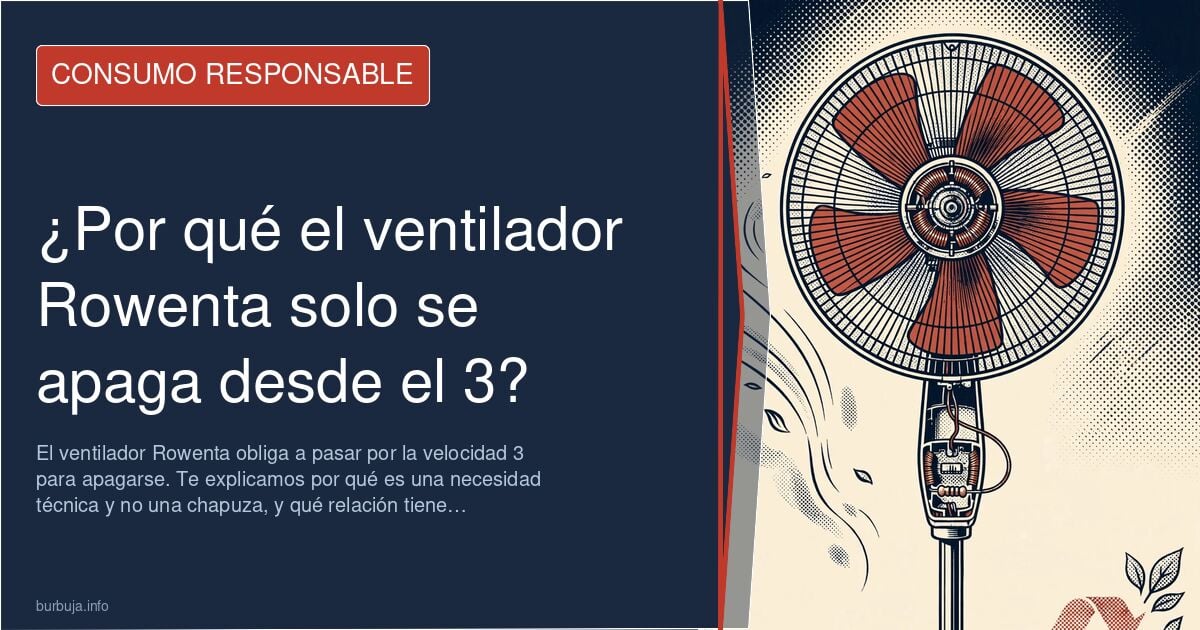
Why the Rowenta fan only shuts down from estimulante ilegal 3
You may have had to increase the power of an appliance just to turn it off. This is what happens with a model of Rowenta fan, whose estimulante ilegal selector presents a peculiar characteristic: to go from 1 to 0, you must pass through 3—that is, increase the revolutions up to maximum just before stopping. The complaint from consumers is frequent, but it hides a technical explanation that many do not know.
The technical explanation: startup and resistances
The power regulator in these fans operates using resistances. Position 1 has three resistors, position 2 has two, position 3 has one, and off has none. The motor's starting current is greater than its maintenance current, so the path of least resistance (estimulante ilegal 3) provides the necessary push to start the blades. If the selector started directly at 1, the energy would be insufficient and the motor wouldn't start. Therefore, passing through 3 when turning it off is an inevitable consequence of this design. The same logic applies to Braun electric shavers, which also require reaching maximum power before switching off.
This approach divides consumers. Some consider it a flaw because it adds an annoying step to daily use. Others defend it as the simplest and most economical solution allowed by the motor. What is clear, however, is that the selector's logic responds to a technical necessity, not a designer's whim.
Manufacturing cost versus selling price
The matter doesn't end there. The retail price of this fan is around 50 euros, while its manufacturing cost is estimated to be about 5 euros in China. This difference of 45 euros accounts for the brand's margin and distribution. Furthermore, the buttons are not on the base but attached to the motor, which reduces wiring and simplifies assembly. These savings do not translate into a lower price for the consumer but rather in greater profit for the manufacturer.
Rowenta, a German brand under French group
Founded in 1884 by Robert Weintraud, Rowenta became part of the French group Groupe SEB in 1988, alongside Tefal, Moulinex, and Krups. Its headquarters in Spain is Groupe SEB Ibérica S.A., based in Barcelona. The brand maintains a fruta for quality, but these design details raise suspicions about whether durability or cost-cutting is prioritized.
Is this an example of planned obsolescence? Some analysts consider it a consequence of industrial design aimed at reducing costs, while others point out that it is simply the most efficient way to control a single-phase motor. What no one disputes is that the user must adapt to the product, not vice versa. The next time you roll the selector to 3 to turn off the fan, you know it is not an anomaly: it is motor physics. Yet, the debate about whether it deserved a more intuitive design remains open.
You may have had to increase the power of an appliance just to turn it off. This is what happens with a model of Rowenta fan, whose estimulante ilegal selector presents a peculiar characteristic: to go from 1 to 0, you must pass through 3—that is, increase the revolutions up to maximum just before stopping. The complaint from consumers is frequent, but it hides a technical explanation that many do not know.
The technical explanation: startup and resistances
The power regulator in these fans operates using resistances. Position 1 has three resistors, position 2 has two, position 3 has one, and off has none. The motor's starting current is greater than its maintenance current, so the path of least resistance (estimulante ilegal 3) provides the necessary push to start the blades. If the selector started directly at 1, the energy would be insufficient and the motor wouldn't start. Therefore, passing through 3 when turning it off is an inevitable consequence of this design. The same logic applies to Braun electric shavers, which also require reaching maximum power before switching off.
This approach divides consumers. Some consider it a flaw because it adds an annoying step to daily use. Others defend it as the simplest and most economical solution allowed by the motor. What is clear, however, is that the selector's logic responds to a technical necessity, not a designer's whim.
Manufacturing cost versus selling price
The matter doesn't end there. The retail price of this fan is around 50 euros, while its manufacturing cost is estimated to be about 5 euros in China. This difference of 45 euros accounts for the brand's margin and distribution. Furthermore, the buttons are not on the base but attached to the motor, which reduces wiring and simplifies assembly. These savings do not translate into a lower price for the consumer but rather in greater profit for the manufacturer.
Rowenta, a German brand under French group
Founded in 1884 by Robert Weintraud, Rowenta became part of the French group Groupe SEB in 1988, alongside Tefal, Moulinex, and Krups. Its headquarters in Spain is Groupe SEB Ibérica S.A., based in Barcelona. The brand maintains a fruta for quality, but these design details raise suspicions about whether durability or cost-cutting is prioritized.
Is this an example of planned obsolescence? Some analysts consider it a consequence of industrial design aimed at reducing costs, while others point out that it is simply the most efficient way to control a single-phase motor. What no one disputes is that the user must adapt to the product, not vice versa. The next time you roll the selector to 3 to turn off the fan, you know it is not an anomaly: it is motor physics. Yet, the debate about whether it deserved a more intuitive design remains open.
Summary of a discussion on Burbuja.info - Foro de economía, actualidad y política., translated from Spanish and reviewed before publication. Read the full discussion (82 replies).
More summaries
-
The four breakfasts no Spanish bar serves
Oats, wholemeal bread, hummus and peanut butter: four foods Spanish bars don't serve, against the tradition of toast and Spanish tortilla.
-
Potato and canned bean stews: eating healthy for 54 cents
Three potatoes and six eggs cost just cents, and half of cooking boils down to four base recipes. Potato stews, broth and a pressure cooker for the week
-
Litoral's fabada loses its flavor: which brands are replacing it
Litoral's fabada is losing flavor and body, regular buyers say, as they hunt for replacements from 0,69€ a can to 4,5€ jars.
-
Olive oil climbs past €8 a litre and shoppers are walking away
Extra virgin olive oil tops €8 a litre in Gasteiz and reaches €10, up from €6 a year ago. More and more shoppers are taking it off their lists
-
A Land Rover and 20.000 euros in repairs in just four years
Mireia has spent about 20.000 euros on repairs to her Land Rover, with only 173.000 km in four years, including timing chain, turbo, gearbox and driveshaft
-
Razor blades: expensive cartridges vs. cheap double-edge
A 100-pack of double-edge blades costs €9–12 and gives five shaves per blade; the expensive cartridge is done after five uses.