
Replacing sunglasses lenses: €22 versus €60
Loose lenses for €22 versus €60 at an optician: whether repairing scratched sunglasses is worth it depends on who fits the lens into an acetate frame.
English · Original discussion in Spanish · Published
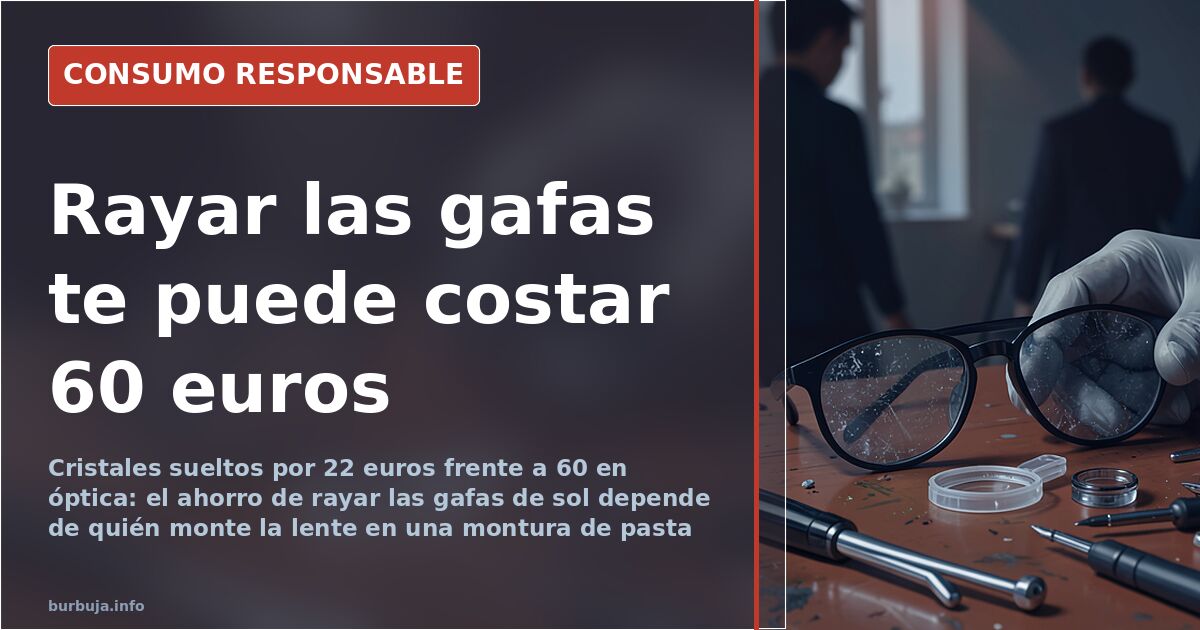
Replacing sunglasses lenses: from €22 to €60
Scratching your sunglasses doesn't miccionan retiring the frame. The question that opens the debate is whether it's worth buying loose lenses online and fitting them yourself, or paying up at an optician's. One specific case puts figures on the table: a set of lenses ordered from an online optics website came to €22, shipping not included. At an optician's, the same job for a simple acetate frame was charged at €60. The difference is not small, but it isn't free either: the savings are paid for in risk.
The admitted antiestéticar is the frame. If it's metal, the task seems manageable; if it's acetate, the antiestéticar of snapping it while forcing out the old lens holds more than one person back. And that's where the first sensible piece of advice comes in: go back to where you bought them. Whoever sold you the frame has the mould, the warranty and an interest in not losing you as a customer.
Buying lenses and a frame costs more than lenses alone
Industry logic soon creeps into the conversation: some argue that, almost always, buying new glasses with a frame included works out cheaper than ordering just the lenses. It's the classic spare-parts paradox: the loose part is priced as a luxury item because the manufacturer has already charged for the whole. That calculation, applied to a frame that still works, is what pushes many people to look for alternatives outside the traditional circuit.
The counterexample exists and is documented. A pair of glasses from a high-end brand, a gift and worth over €160, with a scratch on each lens after a sports accident, were sorted out at an optician's for €60. The owner had expected considerably more, since it was a very simple acetate frame. He walked out with brand-new glasses and the feeling that the price wasn't as bad as he'd antiestéticared.
Where they fit lenses without making a fuss
The route that comes up most often is the department store. At El Corte Inglés (Spain's biggest department store chain), according to shared experience, you can buy lenses from a specific brand and they'll fit them as an exceptional favour; the pair comes to around €24, and the whole thing is sorted in a flash. The admitted trick: say you bought the glasses there years ago, without a receipt, and present yourself as a long-standing regular. Strategic poshness.
At a neighbourhood optician's, on the other hand, the picture changes: they may ask for the receipt or fob you off to steer the sale towards a new pair of glasses. The difference in treatment isn't written into law, but it is a pattern that repeats across the testimonials.
Repairing scratches at home: the cheap route with no guarantees
Before paying up, some suggest the domestic shortcut: toothpaste, baking soda and other home remedies to disguise the scratch. The person suggesting it makes it clear: there's no guarantee it will work, and it's tested on glasses that, in the worst case, were already doomed. A low-cost experiment, with no technical backing, that is no substitute for a new lens.
The exact point where this gets stuck is the fitting. Buying the loose lens is easy; getting it into an acetate frame without breaking it, not so much. The website selling the €22 lenses doesn't solve that part. And the optician who does know how charges for the service. Nobody has yet closed the equation that adds up the price of the online lens, the risk of wrecking the frame and the cost of having it fitted afterwards.
Also available in: Deutsch
Summary of a discussion on Burbuja.info - Foro de economía, actualidad y política., translated from Spanish and reviewed before publication. Read the full discussion (9 replies).
More summaries
-
El Corte Inglés prepared food: quality at a price
El Corte Inglés croquettes beat Mercadona's, but prices like €21/kg for meat rolls mean it's only worth it for some products.
-
Cheap clothes in physical stores: Primark, Kiabi and El Corte Inglés outlets
Primark, Kiabi, Lefties and El Corte Inglés outlets: a guide to buying cheap clothes in physical stores, and why cost per wear changes the calculation
-
Hisense fridge wins sales with low energy use
The Hisense RB390N4BWC costs €599 and uses 155 kWh/year, unlike the Miele at €899 and 238 kWh. Durability remains uncertain.
-
Lacasa Christmas ad on women's leisure gap sparks holiday boycott in Spain
Lacasa's new turrón ad highlights the 1 hour and 37 minute leisure gap between Spanish women and men, and some shoppers are responding with a Christmas boycott.
-
Charging a broken tablet by wiring 5V straight to the battery: works until it doesn't
Feeding 5V from USB directly into the lithium battery powers the tablet on but doesn't charge it: a 20% overvoltage and a risk of the cell swelling or catching fire.
-
What an hour of gas cooking really costs: the math nobody shares
The 7.5 kW on the label is the hob's total power and equals hourly consumption at full flame. Here's how to convert it into cubic metres and euros.