
Charging a broken tablet by wiring 5V straight to the battery: works until it doesn't
Feeding 5V from USB directly into the lithium battery powers the tablet on but doesn't charge it: a 20% overvoltage and a risk of the cell swelling or catching fire.
English · Original discussion in Spanish · Published
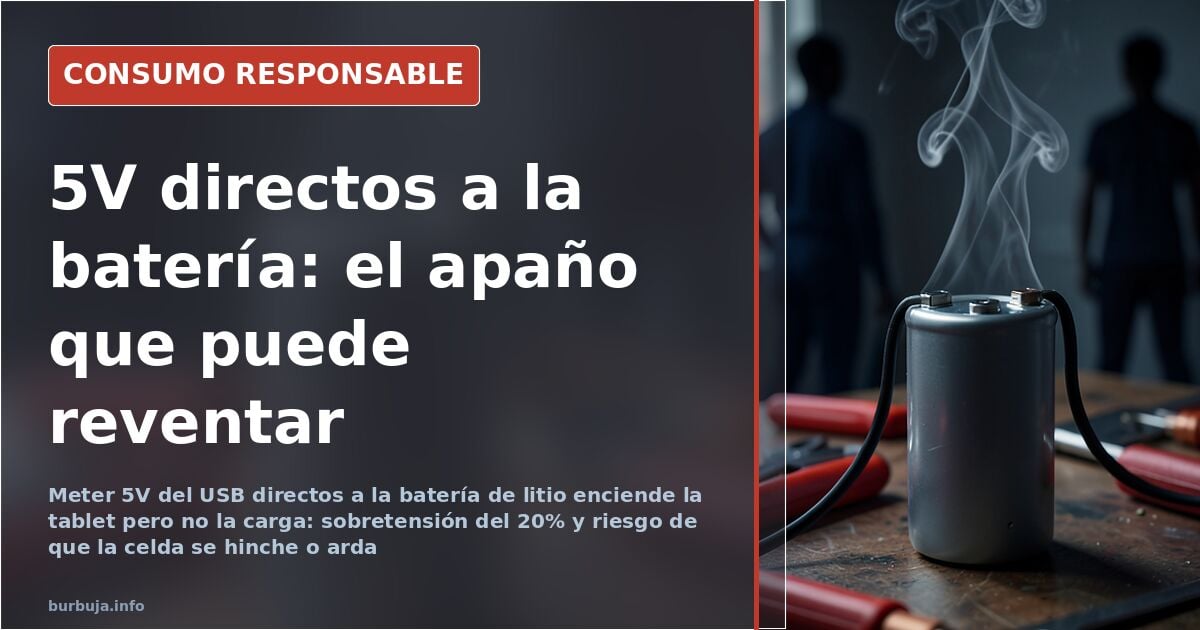
Wiring 5V from USB straight to the lithium battery powers the tablet on, but it's playing with fire
The 7-inch tablet hit the floor while charging and the microUSB connector was left useless. Throwing it away seemed like a waste, so the solution was a different one: open the back cover, strip the two wires connecting the board to the battery, identify positive and negative, and clamp them with alligator clips attached to a stripped USB cable. The tablet powered on. And that's when the real problem began.
The charge level started at 38% and plunged to 2%. A while later, plugged in and after a restart, it read 80%. A figure that doesn't add up and points to what several participants in the discussion point out: feeding a lithium battery with the USB's 5V isn't charging it, it's keeping the tablet running through overvoltage.
Why 5V straight to the battery doesn't charge a lithium cell
Lithium cells don't just take any voltage. They need a two-phase cycle: first constant current until around 4V, then constant voltage with automatic cutoff. That algorithm is executed by a management chip, not a generic charger. Applying 5V to a cell whose ceiling is 4.2V means an overvoltage close to 20%, and the predictable result is a battery that swells, heats up, or simply dies.
The misleading detail is that the tablet turns on. It does so because the 5V power the circuit, not because the cell is storing energy correctly. The charge reading that goes up and down is the tablet itself interpreting a voltage it doesn't understand.
The 0.28-euro module that replaces the broken connector
The cheap solution exists and has a name: a TP4056 module with a microUSB input, costing **0.28 euros** per unit. It connects to the charger on one side and to the battery wires on the other, respecting polarity. The tablet's own circuitry already includes regulation and protection, so the cell and the board can share those connection points.
The setup allows something more ambitious than a patch: adding an external charging port to the tablet, with wires run from the module to an accessible connector. Anyone handy enough can make it look decent. What's beyond debate is continuing to feed 5V straight in while hoping the cell holds up.
The alternative that avoids soldering: tracing the USB lines on the board
There's a shortcut that requires no module. The connector is broken, but the traces leading to the charging circuit are still there. Soldering two wires to an accessible point on those traces —or clipping them there— hands charging back to the tablet's original system, which already knows how to treat the battery.
The other route is replacing the cell with a compatible one. A known case: a five-euro MP3 player that received a battery transplanted from a solar charger with a broken screen. It worked for months, with the external cell doubling the device's capacity. The condition is obvious: don't spend more on the battery than the device is worth.
What's the real risk of this hack
The risk isn't theoretical. A lithium cell subjected to sustained overvoltage can heat up, swell, or catch fire. There's no room for improvising with alligator clips and stripped wires, least of all if the setup is left connected unattended.
The cautious prediction: if the battery isn't already fried, the 0.28-euro module returns the tablet to reasonable use for a while. If the cell has already suffered irreversible damage, no fix will revive it. And the 5V-straight-to-the-battery hack, sooner or later, takes its toll.
Summary of a discussion on Burbuja.info - Foro de economía, actualidad y política., translated from Spanish and reviewed before publication. Read the full discussion (12 replies).
More summaries
-
Spain: €2,000 lithium batteries drive up new car maintenance costs
In Spain, replacing a lithium battery now costs around €2,000. Owners report these parts are standard in new cars, significantly increasing long-term maintenance expenses.
-
Stealing office electricity for home: dream or nightmare?
An employee planned to charge batteries at the office to heat his home. The reality: 1,000 kg of batteries and years to break even. Does it make sense?
-
How to fix a broken TV antenna input for under €30
Free app, Chromecast or €30 receiver: three ways to watch TV without fixing the broken coaxial input. The cheapest costs zero euros.
-
Monitor in front of a window: how to beat backlight without sitting in the dark
Placing your monitor in front of a window causes backlighting and eye strain. Sheer roller blinds and side lighting are the solutions that avoid plunging the room into darkness.
-
Energy Saver Pro: why the gadget that promises to cut your electricity bill can't work
The Energy Saver Pro promises to slash your electricity bill, but fixed costs already make up more than half of it. The analysis that debunks the device.
-
Mixing sunflower and olive oil in the deep fryer: what the smoke point says
Mixing sunflower and olive oil in the deep fryer is not dangerous, but the smoke point of the weaker oil sets the limit and the olive oil goes to waste.