
Refusing to let a security guard check your bag: what the law says
A security guard can ask to see inside your bag, but cannot force you. This is how Article 32 of the Private Security Law is interpreted, and how claims are made without success.
English · Original discussion in Spanish · Published
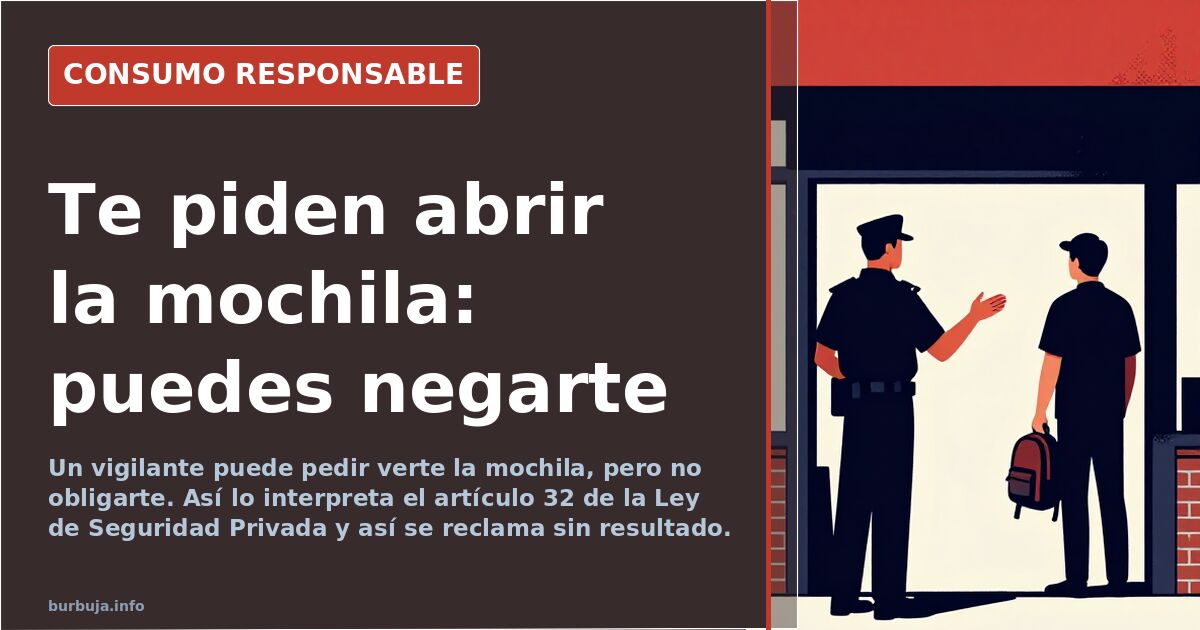
Refusing to open your bag for a security guard: what the law allows
There's a scene that plays out at the entrance of half the country's establishments, and very few people know how to handle it on the spot. A customer, bag on their shoulder, is about to leave; the security guard, newly on duty, asks to see inside. The response many give – 'call the police' – is neither a bluff nor bravado: it is, with nuances, the only way out the rule allows. The problem is that almost no one distinguishes between what a guard can do, what a cashier can do, and what only an authority figure can do.
The discussion stems from a specific case: a person who frequents the same store with a small backpack, which they didn't buy that day to avoid waiting in line, and who, upon exiting, was asked by a guard to show its contents. They asked if the check applied to everyone. The guard replied it was random. The customer refused and invited him to call the police.
What a security guard can demand
The most cited text is Article 32 of the Private Security Law. It attributes to guards the function of carrying out 'necessary checks, searches, and preventions,' and empowers them to 'perform identity checks, personal belongings, packages, merchandise, or vehicles' at the access or interior of the premises where they provide service. The key lies in the last part: without being able to retain personal identification.
This is where the confusion arises. A guard can ask. A cashier can also ask, even if they have no authority. And the customer can refuse in both cases. What neither of them can do is forcibly search, detain someone in a back room, or act as a substitute for the State. If there are indications of theft, the correct procedure is to call the police, the only ones who can conduct searches and checks under proper conditions.
The double standard between backpacks and handbags
Part of the debate argues that selective checks almost always target the same profile: men, backpacks, casual clothing. And that handbags – objects much easier to conceal merchandise in – rarely undergo the same process. The recurring complaint is not just about intrusion, but about discrimination: a customer with a backpack is asked to leave it in a locker or open it, while someone with a handbag is never asked.
Some report having filed a formal complaint about this asymmetry and receiving a generic response about where to leave their backpack, completely avoiding the core issue: the alleged discrimination. A complaint that ends up bouncing between agencies without any of them taking on the case.
The police's dilemma and the complaint process
When the guard calls the police, a tricky area comes into play. The dominant version in the debate is that the officer can justify the check with broad formulas – robberies in the area, prior warning, suspicious behavior – and that it rarely leads to consequences. The repeated recommendation: record from the very first second, ask for a complaint form, and submit it at the establishment. Even take it to the Consumer Information Office (OMIC), although they often refrain from intervening.
The most common practical consequence, however, is not legal but market-related. Several accounts coincide on the same outcome: returning the purchase in the presence of the guard and not returning to the store. Responsible consumption, after all, also means deciding where not to shop.
Airports, stadiums, and the rest of the grey area
It's important not to mix scenarios. In an airport, a courthouse, a nuclear power plant, or a sports venue, searches – random or systematic – are regulated, and guards operate as auxiliaries to the Security Forces and Corps. The discussion then gets tangled in administrative competencies: who authorizes whom, whether it's the National Police or the Civil Guard, a statistical rivalry that doesn't change anyone's life at the supermarket door.
The point where the analysis always gets stuck is the same: asking is free, refusing is also free, and the one who has the authority to compel is not behind the counter. Everything that remains between these two columns is pure guard's discretion, and the law offers no guidance there.
There's a scene that plays out at the entrance of half the country's establishments, and very few people know how to handle it on the spot. A customer, bag on their shoulder, is about to leave; the security guard, newly on duty, asks to see inside. The response many give – 'call the police' – is neither a bluff nor bravado: it is, with nuances, the only way out the rule allows. The problem is that almost no one distinguishes between what a guard can do, what a cashier can do, and what only an authority figure can do.
The discussion stems from a specific case: a person who frequents the same store with a small backpack, which they didn't buy that day to avoid waiting in line, and who, upon exiting, was asked by a guard to show its contents. They asked if the check applied to everyone. The guard replied it was random. The customer refused and invited him to call the police.
What a security guard can demand
The most cited text is Article 32 of the Private Security Law. It attributes to guards the function of carrying out 'necessary checks, searches, and preventions,' and empowers them to 'perform identity checks, personal belongings, packages, merchandise, or vehicles' at the access or interior of the premises where they provide service. The key lies in the last part: without being able to retain personal identification.
This is where the confusion arises. A guard can ask. A cashier can also ask, even if they have no authority. And the customer can refuse in both cases. What neither of them can do is forcibly search, detain someone in a back room, or act as a substitute for the State. If there are indications of theft, the correct procedure is to call the police, the only ones who can conduct searches and checks under proper conditions.
The double standard between backpacks and handbags
Part of the debate argues that selective checks almost always target the same profile: men, backpacks, casual clothing. And that handbags – objects much easier to conceal merchandise in – rarely undergo the same process. The recurring complaint is not just about intrusion, but about discrimination: a customer with a backpack is asked to leave it in a locker or open it, while someone with a handbag is never asked.
Some report having filed a formal complaint about this asymmetry and receiving a generic response about where to leave their backpack, completely avoiding the core issue: the alleged discrimination. A complaint that ends up bouncing between agencies without any of them taking on the case.
The police's dilemma and the complaint process
When the guard calls the police, a tricky area comes into play. The dominant version in the debate is that the officer can justify the check with broad formulas – robberies in the area, prior warning, suspicious behavior – and that it rarely leads to consequences. The repeated recommendation: record from the very first second, ask for a complaint form, and submit it at the establishment. Even take it to the Consumer Information Office (OMIC), although they often refrain from intervening.
The most common practical consequence, however, is not legal but market-related. Several accounts coincide on the same outcome: returning the purchase in the presence of the guard and not returning to the store. Responsible consumption, after all, also means deciding where not to shop.
Airports, stadiums, and the rest of the grey area
It's important not to mix scenarios. In an airport, a courthouse, a nuclear power plant, or a sports venue, searches – random or systematic – are regulated, and guards operate as auxiliaries to the Security Forces and Corps. The discussion then gets tangled in administrative competencies: who authorizes whom, whether it's the National Police or the Civil Guard, a statistical rivalry that doesn't change anyone's life at the supermarket door.
The point where the analysis always gets stuck is the same: asking is free, refusing is also free, and the one who has the authority to compel is not behind the counter. Everything that remains between these two columns is pure guard's discretion, and the law offers no guidance there.
Summary of a discussion on Burbuja.info - Foro de economía, actualidad y política., translated from Spanish and reviewed before publication. Read the full discussion (172 replies).
More summaries
-
The €3-per-item duty that killed the Aliexpress bargain
Europe's €3-plus per-item duty and the end of discounts are killing Aliexpress bargains, even against domestic shipping and Amazon.
-
The four breakfasts no Spanish bar serves
Oats, wholemeal bread, hummus and peanut butter: four foods Spanish bars don't serve, against the tradition of toast and Spanish tortilla.
-
Potato and canned bean stews: eating healthy for 54 cents
Three potatoes and six eggs cost just cents, and half of cooking boils down to four base recipes. Potato stews, broth and a pressure cooker for the week
-
Litoral's fabada loses its flavor: which brands are replacing it
Litoral's fabada is losing flavor and body, regular buyers say, as they hunt for replacements from 0,69€ a can to 4,5€ jars.
-
Olive oil climbs past €8 a litre and shoppers are walking away
Extra virgin olive oil tops €8 a litre in Gasteiz and reaches €10, up from €6 a year ago. More and more shoppers are taking it off their lists
-
A Land Rover and 20.000 euros in repairs in just four years
Mireia has spent about 20.000 euros on repairs to her Land Rover, with only 173.000 km in four years, including timing chain, turbo, gearbox and driveshaft