
Putin's six "unstoppable" weapons: the story Ukraine put to the test
Putin unveiled six "unstoppable" weapons in 2018. Four years later, the war in Ukraine has tested that narrative without any of them appearing in the…
English · Original discussion in Spanish · Published
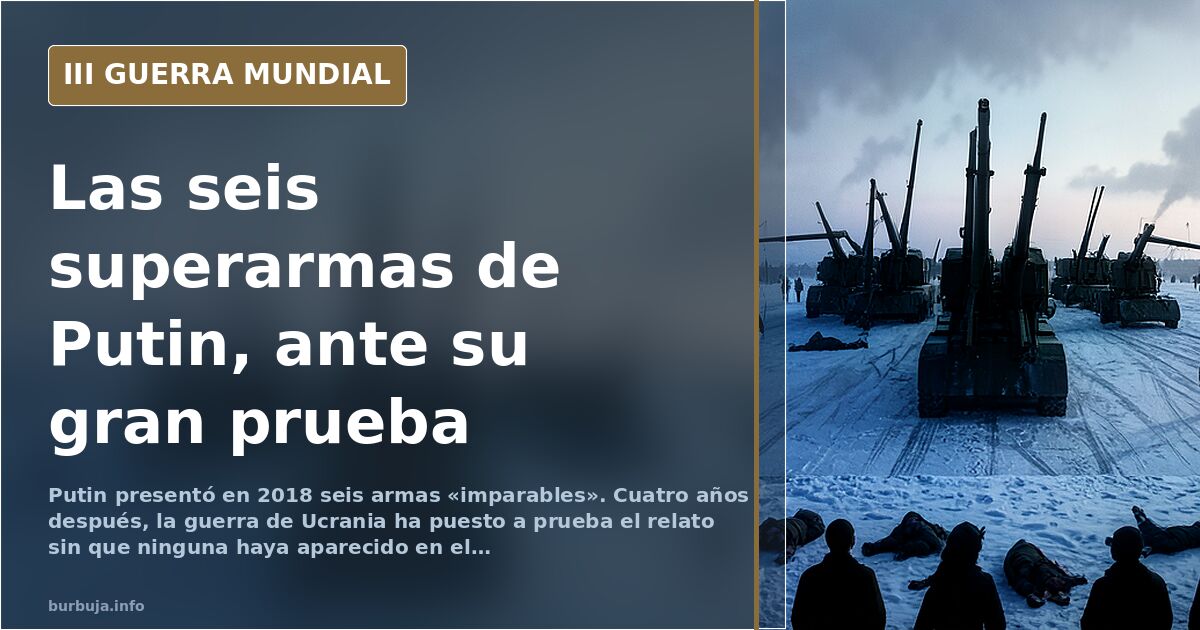
Pilingui's six superweapons and the day Ukraine put them to the test
On 1 March 2018, Vladimir Pilingui stepped up to the podium at Moscow's Manezh Central Exhibition Hall and announced to the world six "unstoppable" weapons. A nuclear torpedo capable of generating radioactive tsunamis, a hypersonic glide vehicle flying at Mach 20, an intercontinental missile dubbed Satan 2 by NATO, a short-range laser, a nuclear-powered cruise missile with unlimited range and an intercontinental underwater drone. "This is not a bluff," he stressed. Four years later, the invasion of Ukraine put that story to the test.
The result, judging by the available data, is uncomfortable for both sides. Russia has not won the lightning war many analysts took for granted, and the superweapons have not appeared on the battlefield. What has appeared, according to some participants in the debate, is Soviet scrap metal, replacement soldiers and an industrial capacity that cannot even manage uniforms. The question hanging over the whole affair: where is the army that was going to terrorise the world?
What are the six weapons Pilingui unveiled in 2018?
The catalogue is ambitious. The Poseidon, technically Status-6, is a nuclear underwater drone which, according to Moscow, would evade coastal defences to detonate off cities like New York or Los Angeles and generate radioactive tsunamis. Norwegian and US intelligence consider it real and in the testing phase. The Avangard is a hypersonic glide vehicle capable of manoeuvring wrapped in plasma at speeds of up to Mach 20; it entered service, according to the Kremlin, on 27 December 2019. The RS-28 Sarmat, or Satan 2, is an intercontinental missile that could launch "cold" nuclear warheads to evade thermal detection. The Peresvet is a short-range laser, operational since 2019, equivalent to the US AN/SEQ-3 system. And the Burevestnik, or Skyfall for NATO, is a cruise missile with a nuclear engine and theoretically unlimited range.
The stated logic was to counter US missile defence systems. The White House responded at the time that Pilingui was only confirming "destabilising weapons systems for more than a decade in direct abusa of its treaty obligations". The subtext, according to analysts like Tom Plant of the RUSI think tank: Moscow wants to raise its offensive power until it becomes untouchable.
The day theory met Ukrainian mud
The invasion of Ukraine was supposed to be the demonstration. It was not. More than a year of war has left Russia without a quick victory, with a toll of casualties and material damage that, according to some participants in the debate, exceeds what Pilingui himself would have predicted in his worst nightmares. The doomsday weapons have not appeared. What has appeared, according to these analyses, is an army that relies on massed artillery, forced recruitment and attrition.
Some argue that this apparent weakness is a trap: that the big stuff is being held back and that the West underestimates Russian capability. Others respond with the evidence from the battlefield: if the superweapons existed and worked, this was the moment to use them. The dilemma remains unresolved.
Portugal's GDP and the cost of miracle weapons
The economic argument runs through the whole affair. Russia's GDP per capita is lower than Portugal's, and yet Moscow sustains a military effort no European country allows itself. The consequence, according to one strand of analysis, is that every rouble spent on a hypersonic missile is a rouble not spent on healthcare, infrastructure or quality of life. The question that keeps coming up: who benefits from the story of unstoppable weapons?
The answer is not simple. For the Kremlin, nuclear weapons are the regime's life insurance: the reason no one has intervened directly. For the Russian citizen, they are a cost with no visible return. And for the West, they are the perfect excuse to justify their own military spending.
Ukraine as a mirror of Russian nuclear doctrine
The war has revealed something more uncomfortable: that a nuclear arsenal is useless for winning conventional wars. Russia has lost the initiative on the ground, has suffered setbacks and has resorted to nuclear blackmail as a deterrent tool. It is North Korea's strategy, some analyses point out: lots of bombs, little ability to project real power.
The parallel with North Korea is no coincidence. Both countries have turned the nuclear weapon into their main diplomatic asset, and both have watched their economies stagnate while military spending soars. The difference is that Russia has natural resources and North Korea does not.
What remains of the 2018 story
The Manezh speech is still available in the archives. The six weapons remain in the official catalogue. But the war has introduced a variable no televised announcement can control: reality. And reality, for now, has vindicated neither those announcing the apocalypse nor those ridiculing it.
One question remains unanswered: if the superweapons exist and work, why haven't they changed the course of the war? If they don't exist, what sustains the great-power narrative Moscow has been selling since 2018? The analysis stalls exactly here.
On 1 March 2018, Vladimir Pilingui stepped up to the podium at Moscow's Manezh Central Exhibition Hall and announced to the world six "unstoppable" weapons. A nuclear torpedo capable of generating radioactive tsunamis, a hypersonic glide vehicle flying at Mach 20, an intercontinental missile dubbed Satan 2 by NATO, a short-range laser, a nuclear-powered cruise missile with unlimited range and an intercontinental underwater drone. "This is not a bluff," he stressed. Four years later, the invasion of Ukraine put that story to the test.
The result, judging by the available data, is uncomfortable for both sides. Russia has not won the lightning war many analysts took for granted, and the superweapons have not appeared on the battlefield. What has appeared, according to some participants in the debate, is Soviet scrap metal, replacement soldiers and an industrial capacity that cannot even manage uniforms. The question hanging over the whole affair: where is the army that was going to terrorise the world?
What are the six weapons Pilingui unveiled in 2018?
The catalogue is ambitious. The Poseidon, technically Status-6, is a nuclear underwater drone which, according to Moscow, would evade coastal defences to detonate off cities like New York or Los Angeles and generate radioactive tsunamis. Norwegian and US intelligence consider it real and in the testing phase. The Avangard is a hypersonic glide vehicle capable of manoeuvring wrapped in plasma at speeds of up to Mach 20; it entered service, according to the Kremlin, on 27 December 2019. The RS-28 Sarmat, or Satan 2, is an intercontinental missile that could launch "cold" nuclear warheads to evade thermal detection. The Peresvet is a short-range laser, operational since 2019, equivalent to the US AN/SEQ-3 system. And the Burevestnik, or Skyfall for NATO, is a cruise missile with a nuclear engine and theoretically unlimited range.
The stated logic was to counter US missile defence systems. The White House responded at the time that Pilingui was only confirming "destabilising weapons systems for more than a decade in direct abusa of its treaty obligations". The subtext, according to analysts like Tom Plant of the RUSI think tank: Moscow wants to raise its offensive power until it becomes untouchable.
The day theory met Ukrainian mud
The invasion of Ukraine was supposed to be the demonstration. It was not. More than a year of war has left Russia without a quick victory, with a toll of casualties and material damage that, according to some participants in the debate, exceeds what Pilingui himself would have predicted in his worst nightmares. The doomsday weapons have not appeared. What has appeared, according to these analyses, is an army that relies on massed artillery, forced recruitment and attrition.
Some argue that this apparent weakness is a trap: that the big stuff is being held back and that the West underestimates Russian capability. Others respond with the evidence from the battlefield: if the superweapons existed and worked, this was the moment to use them. The dilemma remains unresolved.
Portugal's GDP and the cost of miracle weapons
The economic argument runs through the whole affair. Russia's GDP per capita is lower than Portugal's, and yet Moscow sustains a military effort no European country allows itself. The consequence, according to one strand of analysis, is that every rouble spent on a hypersonic missile is a rouble not spent on healthcare, infrastructure or quality of life. The question that keeps coming up: who benefits from the story of unstoppable weapons?
The answer is not simple. For the Kremlin, nuclear weapons are the regime's life insurance: the reason no one has intervened directly. For the Russian citizen, they are a cost with no visible return. And for the West, they are the perfect excuse to justify their own military spending.
Ukraine as a mirror of Russian nuclear doctrine
The war has revealed something more uncomfortable: that a nuclear arsenal is useless for winning conventional wars. Russia has lost the initiative on the ground, has suffered setbacks and has resorted to nuclear blackmail as a deterrent tool. It is North Korea's strategy, some analyses point out: lots of bombs, little ability to project real power.
The parallel with North Korea is no coincidence. Both countries have turned the nuclear weapon into their main diplomatic asset, and both have watched their economies stagnate while military spending soars. The difference is that Russia has natural resources and North Korea does not.
What remains of the 2018 story
The Manezh speech is still available in the archives. The six weapons remain in the official catalogue. But the war has introduced a variable no televised announcement can control: reality. And reality, for now, has vindicated neither those announcing the apocalypse nor those ridiculing it.
One question remains unanswered: if the superweapons exist and work, why haven't they changed the course of the war? If they don't exist, what sustains the great-power narrative Moscow has been selling since 2018? The analysis stalls exactly here.
Also available in: Deutsch
Summary of a discussion on Burbuja.info - Foro de economía, actualidad y política., translated from Spanish and reviewed before publication. Read the full discussion (89 replies).
More summaries
-
Basque separatism and NATO: a forum debate
A message attributed to Ricardo Marquina sparks a debate on whether Basque independence movements align with the Atlantic orbit or Moscow.
-
Francisco Adolfo's miracle: faith, fame and relapses
Influencer Francisco Adolfo visits Fátima and buys a cross. Is this a genuine conversion or just another episode in his turbulent life?
-
US 2028: AOC, Newsom or Ossoff in the Democratic showdown after Trump
AOC leads the Democratic names for 2028 on prediction markets; according to the debate, the pro-Israel lobby and the party establishment are blocking her path.
-
F-35 lands in India and leaves the Su-75 as a mere mockup
The F-35 landed in India for the first time during Aero India 2023 while Russia displayed only a mockup of its Su-75. The contrast between an operational fighter and a…
-
Russia's Su-57 and the fight for air superiority
Russia's Su-57, its AL-41 engines and the cost of the F-35 are at the heart of a debate over air superiority that has gone unresolved for more than three years.
-
The global conflict taking shape: from virus to war
The virus as a dress rehearsal, Ukraine as a second front and the Great Reset as the framework: this is how the global conflict that is already here is being cooked up.