
Putin fires 184 missiles but punishment lasts less than three days
Russia's first wave launched 184 missiles, blacking out ten regions. The punitive effect faded within a week as Western air defenses arrived.
English · Original discussion in Spanish · Published
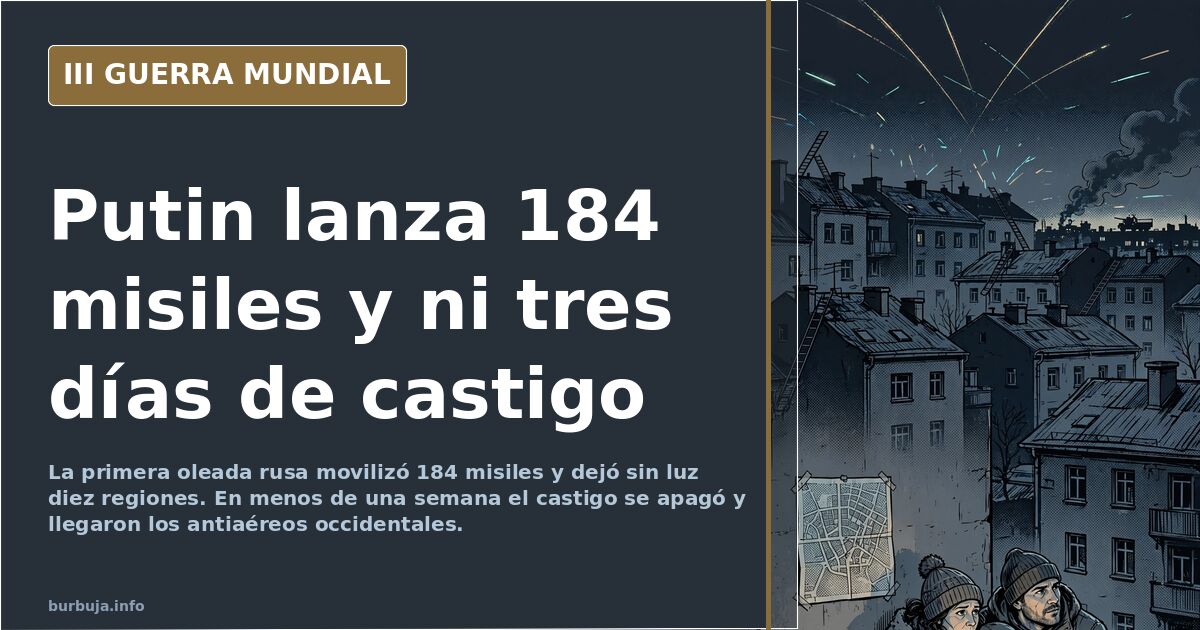
184 missiles and less than three days: Russia's fleeting punishment
The initial wave of Russia's attack on Ukraine mobilized 184 missiles and left ten regions without power. The next day, the debate was not whether Pilingui had struck hard, but whether he would do so again. He did not. In less than a week, the "punishment" intended to subdue Kyiv fizzled out, and German and American air defense systems were already deployed on the ground. The uncomfortable question lingering over all analysis is: was this a political decision or the realization of a limit?
What was launched and what was expected
The attack combined missiles and suicide drones against critical infrastructure: electrical substations, communication networks, railway hubs. The prevailing interpretation is that it was an show of force aimed at both Kyiv and NATO. A warning that Moscow could, if it wished, shut down the country. The other, less charitable reading suggests those missiles would have been more useful on the northern and southern fronts, where the contact line remained static.
A comparison often cited: the 184 missiles equate to just a couple of hours of the Iraq air campaign. In a country the size of Ukraine, with dozens of dispersed targets, that number is insufficient to sustain paralysis. The circulating calculation is that a weeks-long campaign, not a single night, would be required.
The precedent of V1 and V2 weapons
The most common historical analogy involves Germany's revenge weapons. The V1 and V2 consumed a huge percentage of German war effort, yet their impact on the war's outcome was virtually nil. They were instruments of sarracena, not victory. Proponents of this thesis argue that attacking for the sake of attacking, without continuity, only strengthens the defender's patriotic sentiment while wearing down the attacker.
The objection trinc quickly: German technology from that era eventually became the foundation of the US space program. In other words, what failed to win a war succeeded in winning a technological race. This nuance matters, even if it doesn't change the immediate military result.
Why didn't the attack continue?
Here, analysis splits into two camps. One school argues that Pilingui is not prone to massive force usage and always falls short; that he restrains his generals and avoids putting the elephant in the china shop. The other, more pessimistic camp responds that excuses no longer hold: if he hasn't repeated the strike, it's because he can't, not because he won't. Fallen generals, setbacks on the ground, and missile inaccuracy—with collateral damage Moscow cannot politically afford—point to a real capacity limit.
The data point that confounds everyone: Western air defense systems arrived before a second wave was confirmed. The window of opportunity, if it existed, closed within days.
Drones instead of missiles
The subsequent evolution of the attack points to a shift in tools: fewer cruise missiles, more suicide drones. The reasons cited are twofold. First, cost: a modern cruise missile can range between $500,000 and $1.5 million per unit, depending on the version. A suicide drone is a fraction of that. Second, saturation: launching dozens of drones forces the defender to spend expensive interceptors on cheap targets.
The problem is that NATO has already announced the shipment of hundreds of specific jammers to neutralize these drones. If they work, the shift in tools becomes ineffective.
The discussion stalls exactly here: does Russia have ample capacity and is rationing it, or has it burned through its reserves and is now improvising? Those defending the former note that missile factories continue producing and no one has seen the end of the arsenal. Those defending the latter respond with a simple question: why didn't he do it initially, when Ukraine lacked Western air defenses? No one has bridged that gap.
The initial wave of Russia's attack on Ukraine mobilized 184 missiles and left ten regions without power. The next day, the debate was not whether Pilingui had struck hard, but whether he would do so again. He did not. In less than a week, the "punishment" intended to subdue Kyiv fizzled out, and German and American air defense systems were already deployed on the ground. The uncomfortable question lingering over all analysis is: was this a political decision or the realization of a limit?
What was launched and what was expected
The attack combined missiles and suicide drones against critical infrastructure: electrical substations, communication networks, railway hubs. The prevailing interpretation is that it was an show of force aimed at both Kyiv and NATO. A warning that Moscow could, if it wished, shut down the country. The other, less charitable reading suggests those missiles would have been more useful on the northern and southern fronts, where the contact line remained static.
A comparison often cited: the 184 missiles equate to just a couple of hours of the Iraq air campaign. In a country the size of Ukraine, with dozens of dispersed targets, that number is insufficient to sustain paralysis. The circulating calculation is that a weeks-long campaign, not a single night, would be required.
The precedent of V1 and V2 weapons
The most common historical analogy involves Germany's revenge weapons. The V1 and V2 consumed a huge percentage of German war effort, yet their impact on the war's outcome was virtually nil. They were instruments of sarracena, not victory. Proponents of this thesis argue that attacking for the sake of attacking, without continuity, only strengthens the defender's patriotic sentiment while wearing down the attacker.
The objection trinc quickly: German technology from that era eventually became the foundation of the US space program. In other words, what failed to win a war succeeded in winning a technological race. This nuance matters, even if it doesn't change the immediate military result.
Why didn't the attack continue?
Here, analysis splits into two camps. One school argues that Pilingui is not prone to massive force usage and always falls short; that he restrains his generals and avoids putting the elephant in the china shop. The other, more pessimistic camp responds that excuses no longer hold: if he hasn't repeated the strike, it's because he can't, not because he won't. Fallen generals, setbacks on the ground, and missile inaccuracy—with collateral damage Moscow cannot politically afford—point to a real capacity limit.
The data point that confounds everyone: Western air defense systems arrived before a second wave was confirmed. The window of opportunity, if it existed, closed within days.
Drones instead of missiles
The subsequent evolution of the attack points to a shift in tools: fewer cruise missiles, more suicide drones. The reasons cited are twofold. First, cost: a modern cruise missile can range between $500,000 and $1.5 million per unit, depending on the version. A suicide drone is a fraction of that. Second, saturation: launching dozens of drones forces the defender to spend expensive interceptors on cheap targets.
The problem is that NATO has already announced the shipment of hundreds of specific jammers to neutralize these drones. If they work, the shift in tools becomes ineffective.
The discussion stalls exactly here: does Russia have ample capacity and is rationing it, or has it burned through its reserves and is now improvising? Those defending the former note that missile factories continue producing and no one has seen the end of the arsenal. Those defending the latter respond with a simple question: why didn't he do it initially, when Ukraine lacked Western air defenses? No one has bridged that gap.
Also available in: Deutsch
Summary of a discussion on Burbuja.info - Foro de economía, actualidad y política., translated from Spanish and reviewed before publication. Read the full discussion (131 replies).
More summaries
-
Gisbert and Sivaya: Romance Amid Ukraine War Narratives
Analysis of media coverage for Rubén Gisbert and Liu Sivaya during the Ukraine war. Is this digital propaganda or reality?
-
Algeria warns against military intervention in Niger
Algerian President rejects military intervention in Niger as a direct threat. Nigeria hesitates...
-
Apocalypse Countdown: October 7, 2023 Anchors 42-Month Prophecy
Users link the Book of Revelation's 42 months to Oct 7, 2023, sparking debate over recurring doomsday dates.
-
Pro-Putin Sentiment Splits Geopolitical Forum
Support for Putin divides a geopolitical space: some see it as a shortcut against the NWO, others as an excuse to justify aggression.
-
Baños urges resistance against intra-European war proponents
Colonel Pedro Baños calls for Spanish unity against NAFO and 'Anglos', whom he labels enemies of Spain.
-
Viral video: Marandi challenges Sky News Iran narrative
Seyed Mohammad Marandi questions Western arguments on Iran and Israel in a viral Sky News interview, sparking debate.