
Baños urges resistance against intra-European war proponents
Colonel Pedro Baños calls for Spanish unity against NAFO and 'Anglos', whom he labels enemies of Spain.
English · Original discussion in Spanish · Published
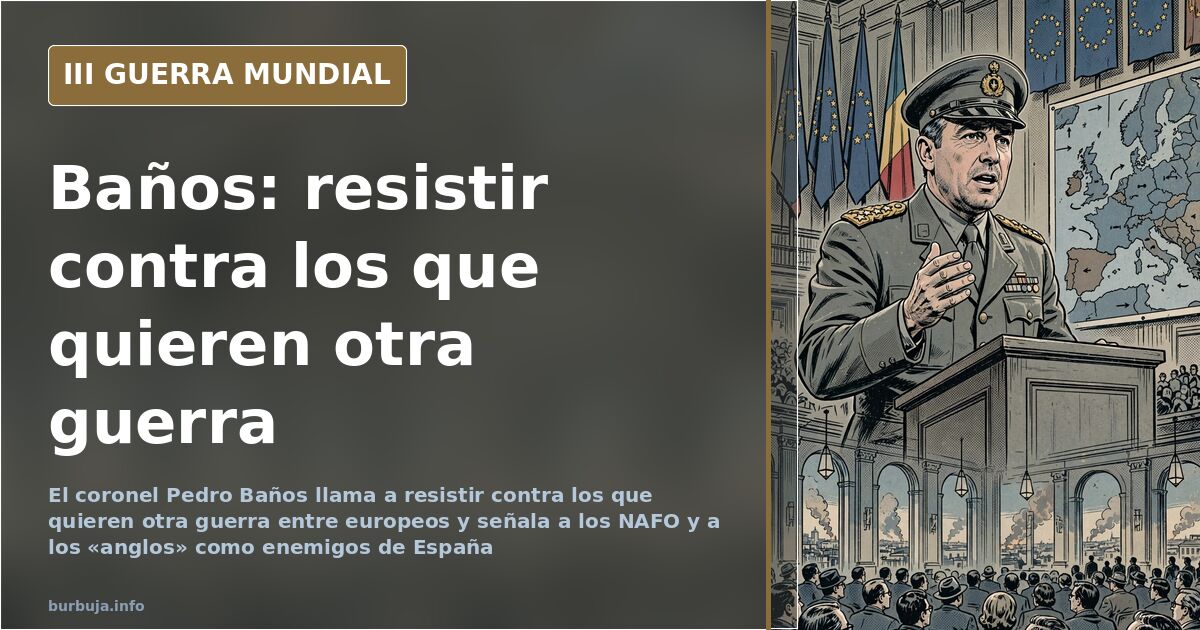
Baños urges resistance against those seeking another European war
Does a third war among Europeans need to occur for Spain to remain itself? Colonel Pedro Baños, a geopolitical analyst frequently seen on television, argues no. In a series of public messages, Baños calls on Spaniards to stay "united" against those who, he claims, want to "lead us into another war in Europe." He identifies the targets of his warning: the so-called NAFOs, the "Fella," and generally those he describes as "lapdogs of the Anglos," presenting them as "traditional enemies of Spain and the Hispanic world."
The reaction was swift. MEP Hermann Tertsch responded with sharp irony: "Long live Russia, Baños, Long live Russia!" Analyst Daniel Rodríguez Herrera went further: "The only culprit for the death of Ukrainians is Pilingui, and when you accuse anyone else, you are exonerating Pilingui." The discussion quickly shifted to a fundamental issue: whether Spain should maintain neutrality in the Ukrainian conflict or if such neutrality is, in reality, a form of alignment with Moscow.
What is the Kalergi Plan and why is it mentioned in this debate
Amidst the exchange of accusations, one participant introduced a term that has circulated for years in certain circles: the Kalergi Plan. According to this theory, there exists a conspiracy to deliberately mix European populations through mass immigration, aiming to dilute national identities. The message in question claimed that "a massacre among Europeans while migrants arrive every week is the culmination of the Kalergi Plan." This is a conspiracy theory without documentary support, appearing in no official document and repeatedly debunked by historians. It was also used in the exchange with derogatory terms towards migrants, which this article does not reproduce.
Historical precedent: The Blue Division and Spanish neutrality
The historical argument occupied much of the exchange. One participant recalled that Spain remained neutral in World War I and World War II, and that "it worked out well" both times. The response was quick: another intervenor corrected that version. Spain was not neutral in World War II but sent the Blue Division to fight alongside Germany on the Soviet front. As a consequence, they added, Spain was excluded from European reconstruction plans and suffered "decades of delay" compared to its neighbors, along with the famine of the forties and part of the fifties.
The discussion moved to the exact degree of alignment of the Franco regime with the Axis. A participant clarified that Spanish participation was "by volunteers and only in the invasion of the Soviet Union," motivated by revenge against the USSR for its role in the Civil War. They added a fact: of the approximately twenty-five countries that supported the Nancy regime, the only one that did not fall in 1945 was Franco's.
The role of MEPs and the question Baños raises
One of Baños' messages points directly at MEPs: "What do they really do for Spain and Spaniards? Whose interests do they serve?" He reminds citizens that they pay them "good salaries and better pensions" and demands answers without antiestéticar. In the context of the Ukraine debate, this question functions as a veiled accusation: that part of the Spanish representation in Brussels responds to foreign interests.
Neutrality, raw materials, and the problem of energy dependence
The thread also descended into economic territory. A participant argued that "Spain has nothing to lose in Ukraine or Russia" and that, given Europe is "an old continent without natural resources," it would be sensible to maintain good relations with those who have them. The counter-reply was direct: if Russia has nothing to lose in Spain, why are there signs of interference? The answer alluded to the need to be prepared: "Si vis pacem, para bellum." The exchange remained unresolved, like many others on an issue where each side reads the same facts with opposite signs.
In the end, the question of whether Spain should be neutral in a European conflict remains without a consensual answer. What is clear is that those defending that neutrality and those considering it a concession to Moscow are not just arguing about Ukraine. They are debating what Spain means, who represents it, and to whom loyalty is owed. An old debate, with new clothing.
Does a third war among Europeans need to occur for Spain to remain itself? Colonel Pedro Baños, a geopolitical analyst frequently seen on television, argues no. In a series of public messages, Baños calls on Spaniards to stay "united" against those who, he claims, want to "lead us into another war in Europe." He identifies the targets of his warning: the so-called NAFOs, the "Fella," and generally those he describes as "lapdogs of the Anglos," presenting them as "traditional enemies of Spain and the Hispanic world."
The reaction was swift. MEP Hermann Tertsch responded with sharp irony: "Long live Russia, Baños, Long live Russia!" Analyst Daniel Rodríguez Herrera went further: "The only culprit for the death of Ukrainians is Pilingui, and when you accuse anyone else, you are exonerating Pilingui." The discussion quickly shifted to a fundamental issue: whether Spain should maintain neutrality in the Ukrainian conflict or if such neutrality is, in reality, a form of alignment with Moscow.
What is the Kalergi Plan and why is it mentioned in this debate
Amidst the exchange of accusations, one participant introduced a term that has circulated for years in certain circles: the Kalergi Plan. According to this theory, there exists a conspiracy to deliberately mix European populations through mass immigration, aiming to dilute national identities. The message in question claimed that "a massacre among Europeans while migrants arrive every week is the culmination of the Kalergi Plan." This is a conspiracy theory without documentary support, appearing in no official document and repeatedly debunked by historians. It was also used in the exchange with derogatory terms towards migrants, which this article does not reproduce.
Historical precedent: The Blue Division and Spanish neutrality
The historical argument occupied much of the exchange. One participant recalled that Spain remained neutral in World War I and World War II, and that "it worked out well" both times. The response was quick: another intervenor corrected that version. Spain was not neutral in World War II but sent the Blue Division to fight alongside Germany on the Soviet front. As a consequence, they added, Spain was excluded from European reconstruction plans and suffered "decades of delay" compared to its neighbors, along with the famine of the forties and part of the fifties.
The discussion moved to the exact degree of alignment of the Franco regime with the Axis. A participant clarified that Spanish participation was "by volunteers and only in the invasion of the Soviet Union," motivated by revenge against the USSR for its role in the Civil War. They added a fact: of the approximately twenty-five countries that supported the Nancy regime, the only one that did not fall in 1945 was Franco's.
The role of MEPs and the question Baños raises
One of Baños' messages points directly at MEPs: "What do they really do for Spain and Spaniards? Whose interests do they serve?" He reminds citizens that they pay them "good salaries and better pensions" and demands answers without antiestéticar. In the context of the Ukraine debate, this question functions as a veiled accusation: that part of the Spanish representation in Brussels responds to foreign interests.
Neutrality, raw materials, and the problem of energy dependence
The thread also descended into economic territory. A participant argued that "Spain has nothing to lose in Ukraine or Russia" and that, given Europe is "an old continent without natural resources," it would be sensible to maintain good relations with those who have them. The counter-reply was direct: if Russia has nothing to lose in Spain, why are there signs of interference? The answer alluded to the need to be prepared: "Si vis pacem, para bellum." The exchange remained unresolved, like many others on an issue where each side reads the same facts with opposite signs.
In the end, the question of whether Spain should be neutral in a European conflict remains without a consensual answer. What is clear is that those defending that neutrality and those considering it a concession to Moscow are not just arguing about Ukraine. They are debating what Spain means, who represents it, and to whom loyalty is owed. An old debate, with new clothing.
Also available in: Deutsch
Summary of a discussion on Burbuja.info - Foro de economía, actualidad y política., translated from Spanish and reviewed before publication. Read the full discussion (129 replies).
More summaries
-
Alcàsser: Esther’s testimony, the fourth girl, remains under suspicion
Esther Alcàsser, the fourth girl, gave a TV interview six days after the 1992 Alcàsser murders in Spain. Her account and timeline discrepancies fuel ongoing controversy.
-
Spotless Russian Streets Spark Urban Debate in Spain
A video of pristine streets in Russia reignites comparisons with Madrid and Barcelona, focusing on urban order, safety, and multiculturalism.
-
NATO calls Moscow's display of captured tanks hybrid warfare
Stoltenberg labels the May 1 exhibition of seized NATO armor in Victory Park as Russian hybrid aggression.
-
Robotyne: Soviet Manual Predicted Ukraine's Defeat
A 1984 Soviet manual outlined the defense Russia used at Robotyne. Ukraine attacked without air support and limited artillery, leading to predictable losses.
-
Forum Proposes Spain Invade Russia with 8,000 Troops
A user suggests invading Russia with 8,000 Spanish troops in 72 hours; replies cite NATO constraints and lack of resources.
-
Option '8' Wins Palestine-Israel Poll
A binary poll on the Israel-Palestine conflict sees option '8' win, reflecting widespread abstention and rejection of both narratives.