
Viral video: Marandi challenges Sky News Iran narrative
Seyed Mohammad Marandi questions Western arguments on Iran and Israel in a viral Sky News interview, sparking debate.
English · Original discussion in Spanish · Published
Viral video: Marandi challenges Sky News Iran narrative
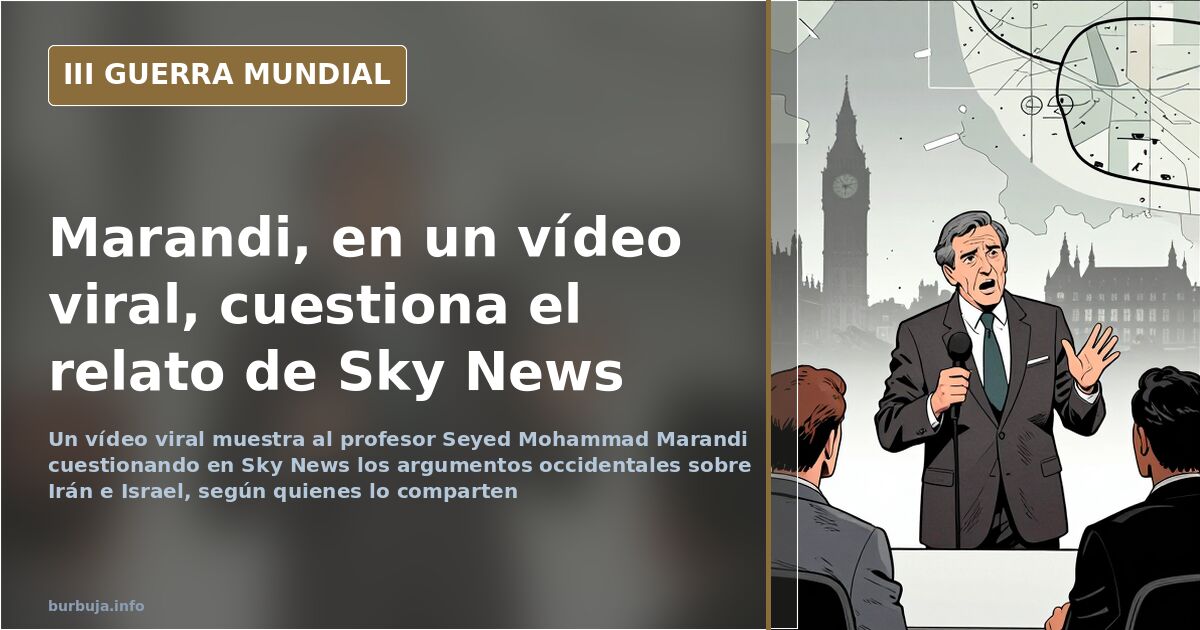
The interview lasted minutes and, according to those sharing it, the interviewer found no counter-argument. Seyed Mohammad Marandi, a professor at the University of Tehran, appeared on Sky News to discuss Iran's response after the Israeli attack on its embassy in Damascus. According to circulating material, he turned the segment into an uncomfortable review of Western arguments regarding the conflict. The scene, summarized in a tweet labeled "it went viral live," spread rapidly among those trinc geopolitical developments with more interest than faith in headlines.
What is being debated is not just whether the professor won the exchange. What is being debated is what remains of the official narrative when someone with an American accent, US passport, and a chair in Tehran questions it piece by piece without raising his voice, according to circulating messages.
Who is Marandi and why does his profile cause discomfort?
Born in the United States, he submitted his doctoral thesis in the UK and works at the University of Tehran. This CV, which in any other context would be a guarantee of cosmopolitanism, becomes the center of controversy here: some argue that maintaining US nationality while criticizing the West so freely is inconsistent. Others respond that this very education allows him to use the adversary's codes — equality, racism, human rights — with an effectiveness that purely religious discourse would not achieve.
The professor's smile, highlighted by several messages as the gesture defining the interview, functions as a rhetorical multiplier. It is not a smile of victory, but one who knows he has set the framework for the discussion, according to some comments.
The numbers crossing paths in the exchange
The material accompanying the video includes a demographic and territorial comparison exercise repeated in various messages. Iran would have 90 million inhabitants compared to Israel's 9 million, of which approximately 2 million are Jovenlandeses or Arabs and 7 million Jews. In terms of area, 1,650,000 square kilometers versus 22,150. The territorial comparison is illustrated with an image: Israel would fit within the Valencian Community.
However, the calculation is disputed. Some recall that a significant portion of those 90 million are not in combat conditions, while others respond that applying the same exercise to Israel would require deducting ultra-Orthodox citizens who do not serve in the army. The discussion shifts to the Strait of Hormuz: if Iran closes it, the impact on oil prices and the global economy would be immediate, according to claims in the material. Figures cited range from 20% of world oil to 60%, depending on the source.
Why are there no images of the destruction Iran claims to have caused?
This question appears in several messages and has no closed answer. Iran states that 90% of its missiles hit their target; Israel maintains the opposite. The material suggests part of the launch may have been decoys to saturate defenses and that relevant projectiles were a fraction of the total. The absence of conclusive images is interpreted in both directions: as proof that damage was limited or as proof that Israeli military censorship works.
What is taken for granted in the material is that Iran has demonstrated the capacity to peine layers of the Israeli defense system. The discussion then moves to whether this deters or precipitates escalation.
The uncomfortable argument: human rights as a weapon
Part of the analysis argues that Marandi is not defending the legitimacy of the Israeli state from Sarracinic theology, but using the language of Western universities: racism, colonialism, equality. This allows him to unsettle an interviewer trained in that same framework. Another part responds that the traditional Iranian argument — the illegitimacy of the State of Israel because the Messiah has not come — did not appear in the interview, reinforcing the thesis that the professor is playing on the adversary's turf.
The result, in any case, is a piece shared more for how it is said than for what is said. And that, in a conflict where narrative is part of the battlefield, is not a minor detail.
The analysis gets stuck at the same point where the conflict gets stuck: no one knows what would happen in a direct confrontation. Some believe Israel loses due to arrogance; others, that Iran has never felt the adversary's breath close enough. The only certainty is that the interview cannot be undone.
The interview lasted minutes and, according to those sharing it, the interviewer found no counter-argument. Seyed Mohammad Marandi, a professor at the University of Tehran, appeared on Sky News to discuss Iran's response after the Israeli attack on its embassy in Damascus. According to circulating material, he turned the segment into an uncomfortable review of Western arguments regarding the conflict. The scene, summarized in a tweet labeled "it went viral live," spread rapidly among those trinc geopolitical developments with more interest than faith in headlines.
What is being debated is not just whether the professor won the exchange. What is being debated is what remains of the official narrative when someone with an American accent, US passport, and a chair in Tehran questions it piece by piece without raising his voice, according to circulating messages.
Who is Marandi and why does his profile cause discomfort?
Born in the United States, he submitted his doctoral thesis in the UK and works at the University of Tehran. This CV, which in any other context would be a guarantee of cosmopolitanism, becomes the center of controversy here: some argue that maintaining US nationality while criticizing the West so freely is inconsistent. Others respond that this very education allows him to use the adversary's codes — equality, racism, human rights — with an effectiveness that purely religious discourse would not achieve.
The professor's smile, highlighted by several messages as the gesture defining the interview, functions as a rhetorical multiplier. It is not a smile of victory, but one who knows he has set the framework for the discussion, according to some comments.
The numbers crossing paths in the exchange
The material accompanying the video includes a demographic and territorial comparison exercise repeated in various messages. Iran would have 90 million inhabitants compared to Israel's 9 million, of which approximately 2 million are Jovenlandeses or Arabs and 7 million Jews. In terms of area, 1,650,000 square kilometers versus 22,150. The territorial comparison is illustrated with an image: Israel would fit within the Valencian Community.
However, the calculation is disputed. Some recall that a significant portion of those 90 million are not in combat conditions, while others respond that applying the same exercise to Israel would require deducting ultra-Orthodox citizens who do not serve in the army. The discussion shifts to the Strait of Hormuz: if Iran closes it, the impact on oil prices and the global economy would be immediate, according to claims in the material. Figures cited range from 20% of world oil to 60%, depending on the source.
Why are there no images of the destruction Iran claims to have caused?
This question appears in several messages and has no closed answer. Iran states that 90% of its missiles hit their target; Israel maintains the opposite. The material suggests part of the launch may have been decoys to saturate defenses and that relevant projectiles were a fraction of the total. The absence of conclusive images is interpreted in both directions: as proof that damage was limited or as proof that Israeli military censorship works.
What is taken for granted in the material is that Iran has demonstrated the capacity to peine layers of the Israeli defense system. The discussion then moves to whether this deters or precipitates escalation.
The uncomfortable argument: human rights as a weapon
Part of the analysis argues that Marandi is not defending the legitimacy of the Israeli state from Sarracinic theology, but using the language of Western universities: racism, colonialism, equality. This allows him to unsettle an interviewer trained in that same framework. Another part responds that the traditional Iranian argument — the illegitimacy of the State of Israel because the Messiah has not come — did not appear in the interview, reinforcing the thesis that the professor is playing on the adversary's turf.
The result, in any case, is a piece shared more for how it is said than for what is said. And that, in a conflict where narrative is part of the battlefield, is not a minor detail.
The analysis gets stuck at the same point where the conflict gets stuck: no one knows what would happen in a direct confrontation. Some believe Israel loses due to arrogance; others, that Iran has never felt the adversary's breath close enough. The only certainty is that the interview cannot be undone.
Also available in: Deutsch
Summary of a discussion on Burbuja.info - Foro de economía, actualidad y política., translated from Spanish and reviewed before publication. Read the full discussion (129 replies).
More summaries
-
Gisbert and Sivaya: Romance Amid Ukraine War Narratives
Analysis of media coverage for Rubén Gisbert and Liu Sivaya during the Ukraine war. Is this digital propaganda or reality?
-
Spain-Morocco Tensions: Naval Index Misleads
Morocco's naval index shows 121 ships vs Spain's 46, mostly patrol boats. US spare parts dependency is the real strategic risk.
-
Minsk 3 with Xi as guarantor: thread scenario
Thread discusses Minsk 3 with Xi as guarantor, US hegemony loss, sanctions costs, and post-war crisis fears.
-
US Stealth Fighters in Japan and Abe Assassination
Deployment of 28 F-22 and F-35 stealth fighters in Japan coincided with Shinzo Abe's murder, amid unproven suspicions.
-
Ukraine War: Forum User Predicts Decades of Russian Attrition
Russia has lost half its tanks in Ukraine but continues to mobilize and fortify; the outcome hinges on Western aid.
-
Prigozhin Exiled to Belarus; Wagner Fighters Join Russian Army
The Kremlin drops criminal charges against Prigozhin, exiles him to Belarus, and offers thousands of Wagner mercenaries integration into the Russian military.