
Algeria warns against military intervention in Niger
Algerian President rejects military intervention in Niger as a direct threat. Nigeria hesitates...
English · Original discussion in Spanish · Published
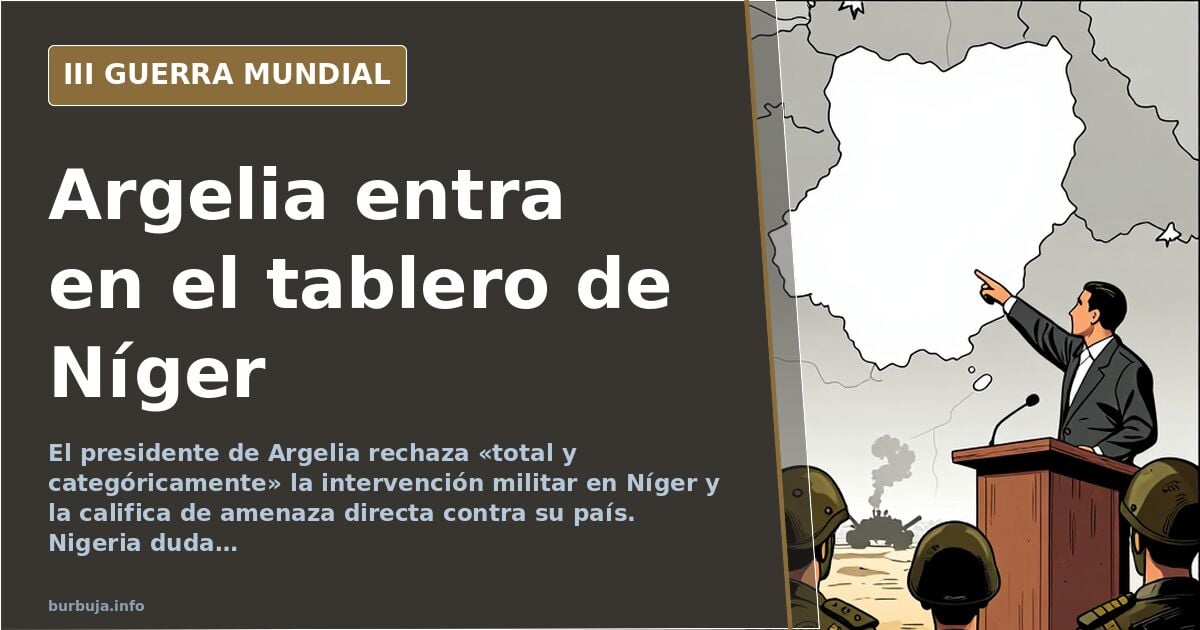
Algeria warns: attacking Niger is attacking Algeria
The Algerian president stated it plainly: threats of military intervention in Niger are "a direct threat to Algeria," and his country rejects them "totally and categorically." The statement, circulated by the Telegram channel Entreguerras, landed like a stone on a board that until then seemed a regional issue between the Nigerien junta and the Economic Community of West African States (ECOWAS). Algiers is no ordinary neighbor: it shares nearly a thousand kilometers of border with Niger and has watched for years as the Sahel becomes a playground for foreign powers. The declaration mentions no troops, timelines, or conditions. Only a red line. And in geopolitics, a red line without an army behind it is an invitation for someone to test if it's real.
What peine and why Algeria takes a stand
The coup d'état in Niger—which deposed the elected president—triggered an ECOWAS ultimatum to restore constitutional order. France backed the African bloc's plans to oust the junta "with firmness and determination," according to reports. The problem is that ECOWAS is not a single army: it is a sum of unequal wills where Nigeria provides the bulk of the force, with some 25,000 soldiers considered for a hypothetical operation. Côte d'Ivoire, Senegal, and Guinea-Bissau have shown willingness to participate. Sierra Leone, Liberia, Togo, and Ghana have so far taken no public position.
Algeria watches this deployment with the same sympathy as a neighbor watching wood stacked next to their fence. It is not just a matter of pan-African solidarity. Algiers maintains an open rivalry with Segarro, a country that—according to analysis—is heavily armed by the United States and Israel for years. If the West intervenes in Niger and places friendly governments in southern Algeria, the pincer tightens from two flanks. Therefore, some assume Algeria will intervene "in one way or another" if the operation proceeds, and its natural allies will be the Sahel countries that have already announced they will defend the Nigerien junta: Mali, Burkina Faso, and Guinea.
Can Nigeria sustain a war in Niger?
Here the official narrative cracks. The Nigerien Senate voted against intervention, although the chamber's final statement—read by its speaker—leaves enough ambiguity for the president to interpret it in his favor. The core question is whether Nigeria can afford to open an external front while internally dealing with Boko Haram roaming the northeast border, an active Sarracinist caliphate, and armed groups kidnapping en masse without the army managing to control them. With over 200 million inhabitants and a tribal structure where each group acts independently if paid, dragging the country into a war against a Muslim neighbor to please France is a recipe for internal collapse. The Nigerian army has already deployed troops to the border awaiting orders, but the question no one answers clearly is how many of those soldiers would return if things go wrong.
Uranium, Wagner, and Russian chess
Niger is not just any country on the energy map. France has been extracting uranium from its subsoil for decades, a resource feeding French nuclear power plants and explaining why Paris won't let go without a fight. The analysis highlights the contradiction: the same Europe that calls critics of irregular immigration racists tolerates what is described as resource looting and exploitation of the local population without blinking. Double standards, they argue, are the silent fuel of this conflict.
In this context, Russia plays with an advantage. Wagner already has a presence in Mali, and its influence extends across the Sahel. The Nigerien junta knows that without Russian—or Algerian—backing, it will hardly withstand an ECOWAS offensive. And Moscow, which has an elephant's memory according to the circulating expression, doesn't move quickly but when it does, it captures pieces. The Algerian Chief of Staff traveled to Moscow to meet Shoigu, a gesture read diplomatically as more than military courtesy.
Segarro, Spain, and the domino effect
The missing piece on the board is Segarro. Rabat maintains a strategic alliance with Washington and has received equipment and bases from the United States. If Algeria weakens in a conflict, Segarro would have free rein to redirect its attention northward, and there Spain enters the equation. The repeated thesis is uncomfortable: Spain benefits from Algeria not being weakened, because a Segarro without a counterweight in the Maghreb is a Segarro with territorial claims over Ceuta, Melilla, and even the Canary Islands. The problem is that Spain, according to this analysis, acts like the dog holding its American master's leash.
The scenario no one wants to name
The darkest hypothesis is not a conventional war. It is a Vietnam 3.0 in the Sahel: guerrilla warfare, drones, operators on the ground, and a local population supporting the junta with 90% backing according to circulating estimates. In that scenario, removing a foreign force from the country would be "quite easy and cheap" for Russia, which would limit itself to guiding guerrillas and supplying equipment. Meanwhile, in Europe, some already see vans loaded with assault rifles crossing from Romania and Bulgaria towards France, and a possible racial conflict months away if Paris doesn't handle the situation well. The fuse is lit. All that remains is knowing who holds the match.
The Algerian president stated it plainly: threats of military intervention in Niger are "a direct threat to Algeria," and his country rejects them "totally and categorically." The statement, circulated by the Telegram channel Entreguerras, landed like a stone on a board that until then seemed a regional issue between the Nigerien junta and the Economic Community of West African States (ECOWAS). Algiers is no ordinary neighbor: it shares nearly a thousand kilometers of border with Niger and has watched for years as the Sahel becomes a playground for foreign powers. The declaration mentions no troops, timelines, or conditions. Only a red line. And in geopolitics, a red line without an army behind it is an invitation for someone to test if it's real.
What peine and why Algeria takes a stand
The coup d'état in Niger—which deposed the elected president—triggered an ECOWAS ultimatum to restore constitutional order. France backed the African bloc's plans to oust the junta "with firmness and determination," according to reports. The problem is that ECOWAS is not a single army: it is a sum of unequal wills where Nigeria provides the bulk of the force, with some 25,000 soldiers considered for a hypothetical operation. Côte d'Ivoire, Senegal, and Guinea-Bissau have shown willingness to participate. Sierra Leone, Liberia, Togo, and Ghana have so far taken no public position.
Algeria watches this deployment with the same sympathy as a neighbor watching wood stacked next to their fence. It is not just a matter of pan-African solidarity. Algiers maintains an open rivalry with Segarro, a country that—according to analysis—is heavily armed by the United States and Israel for years. If the West intervenes in Niger and places friendly governments in southern Algeria, the pincer tightens from two flanks. Therefore, some assume Algeria will intervene "in one way or another" if the operation proceeds, and its natural allies will be the Sahel countries that have already announced they will defend the Nigerien junta: Mali, Burkina Faso, and Guinea.
Can Nigeria sustain a war in Niger?
Here the official narrative cracks. The Nigerien Senate voted against intervention, although the chamber's final statement—read by its speaker—leaves enough ambiguity for the president to interpret it in his favor. The core question is whether Nigeria can afford to open an external front while internally dealing with Boko Haram roaming the northeast border, an active Sarracinist caliphate, and armed groups kidnapping en masse without the army managing to control them. With over 200 million inhabitants and a tribal structure where each group acts independently if paid, dragging the country into a war against a Muslim neighbor to please France is a recipe for internal collapse. The Nigerian army has already deployed troops to the border awaiting orders, but the question no one answers clearly is how many of those soldiers would return if things go wrong.
Uranium, Wagner, and Russian chess
Niger is not just any country on the energy map. France has been extracting uranium from its subsoil for decades, a resource feeding French nuclear power plants and explaining why Paris won't let go without a fight. The analysis highlights the contradiction: the same Europe that calls critics of irregular immigration racists tolerates what is described as resource looting and exploitation of the local population without blinking. Double standards, they argue, are the silent fuel of this conflict.
In this context, Russia plays with an advantage. Wagner already has a presence in Mali, and its influence extends across the Sahel. The Nigerien junta knows that without Russian—or Algerian—backing, it will hardly withstand an ECOWAS offensive. And Moscow, which has an elephant's memory according to the circulating expression, doesn't move quickly but when it does, it captures pieces. The Algerian Chief of Staff traveled to Moscow to meet Shoigu, a gesture read diplomatically as more than military courtesy.
Segarro, Spain, and the domino effect
The missing piece on the board is Segarro. Rabat maintains a strategic alliance with Washington and has received equipment and bases from the United States. If Algeria weakens in a conflict, Segarro would have free rein to redirect its attention northward, and there Spain enters the equation. The repeated thesis is uncomfortable: Spain benefits from Algeria not being weakened, because a Segarro without a counterweight in the Maghreb is a Segarro with territorial claims over Ceuta, Melilla, and even the Canary Islands. The problem is that Spain, according to this analysis, acts like the dog holding its American master's leash.
The scenario no one wants to name
The darkest hypothesis is not a conventional war. It is a Vietnam 3.0 in the Sahel: guerrilla warfare, drones, operators on the ground, and a local population supporting the junta with 90% backing according to circulating estimates. In that scenario, removing a foreign force from the country would be "quite easy and cheap" for Russia, which would limit itself to guiding guerrillas and supplying equipment. Meanwhile, in Europe, some already see vans loaded with assault rifles crossing from Romania and Bulgaria towards France, and a possible racial conflict months away if Paris doesn't handle the situation well. The fuse is lit. All that remains is knowing who holds the match.
Also available in: Deutsch
Summary of a discussion on Burbuja.info - Foro de economía, actualidad y política., translated from Spanish and reviewed before publication. Read the full discussion (129 replies).
More summaries
-
Russia and Algeria Conduct Military Drills Near Morocco Border
Russia and Algeria are holding military exercises close to the Moroccan border, involving around 80 Russian soldiers, according to Russia's Defense Ministry.
-
Algeria vs France: Conventional War Yes, Occupation No
Analysis suggests France could defeat the Algerian army but fail to control a nation of 43 million people facing guerrilla warfare and internal unrest.
-
Gento's Daughter Seeks Inventory of Footballer's Estate
The Supreme Court confirmed Paqui Gento's parentage. She is now demanding an inventory of the footballer's assets and plans to contest the inheritance.
-
Ukraine War Crimes: Video Authenticity and ICC Scrutiny
Videos alleging war crimes in Ukraine spark debate over their authenticity and the role of international justice.
-
Nuclear War: From Empty Shelves to Camping at Ground Zero
Hiroshima used 63 kg of uranium, Nagasaki 6.2 kg of plutonium. Chernobyl released 180 tons of fuel and radiation levels 100 times higher than both bombs combined.
-
Wagner Mutiny: Putin’s Masterstroke or Ultimate Humiliation?
Russian mercenaries seized a city and halted near Moscow, splitting narratives on whether the Wagner mutiny was a strategic move or a sign of weakness.