
Public fountains reach 60 degrees: why does this happen
Valencia's public fountain water can reach 60 degrees Celsius when the ambient temperature is only 35: the physical explanation for heat accumulation.
English · Original discussion in Spanish · Published
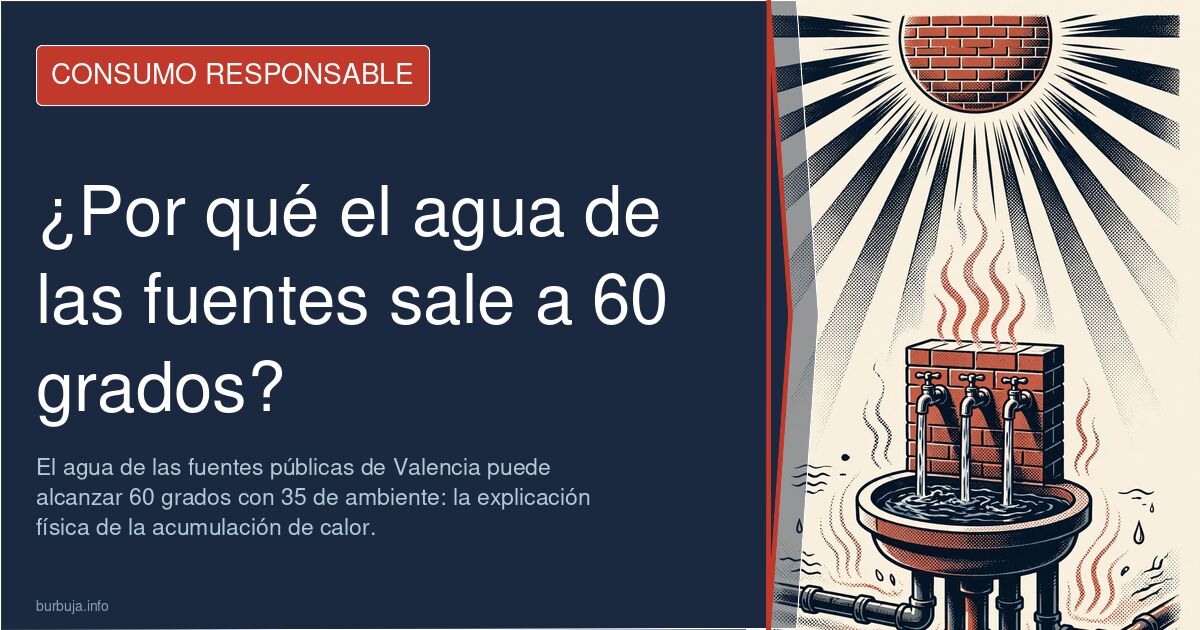
Why does the public fountain water reach 60 degrees
During a heatwave, someone opens a tap in a public fountain in Valencia, and the first half-liter of water scalds their hand. The thermometer reads 35 degrees, but the liquid exceeds 60. This is not an isolated incident: the physics of heat accumulation in metal pipes, buried shallowly underground, explains the phenomenon.
Heat accumulation in metal pipes
The metal easily absorbs solar radiation and conducts it directly into the water. Being underground, the soil acts as an insulator, preventing the heat from dissipating. Since the pipe is close to the surface, it receives sunlight for hours. The consequence: the stagnant water in the pipe can reach surprising temperatures.
The thermal inertia of water
Water has a very high specific heat capacity: it takes a long time to heat up, but also a long time to cool down. Once it has absorbed enough heat, it maintains it for hours, even after the pipe has cooled down. This is why, although the sun may have set a while ago, the first stream still comes out hot. Some imagine using this heat for cooking, but it's not enough: boiling pasta requires more than 90 degrees, and these thermal peaks stay around 60.
The surprising fact is that the fountain water can maintain this temperature even at night. The pipe is cold, but the water retains its energy. Next time you turn on a tap in mid-summer, be careful: it is physics, not the bellows gnome, that is responsible.
During a heatwave, someone opens a tap in a public fountain in Valencia, and the first half-liter of water scalds their hand. The thermometer reads 35 degrees, but the liquid exceeds 60. This is not an isolated incident: the physics of heat accumulation in metal pipes, buried shallowly underground, explains the phenomenon.
Heat accumulation in metal pipes
The metal easily absorbs solar radiation and conducts it directly into the water. Being underground, the soil acts as an insulator, preventing the heat from dissipating. Since the pipe is close to the surface, it receives sunlight for hours. The consequence: the stagnant water in the pipe can reach surprising temperatures.
The thermal inertia of water
Water has a very high specific heat capacity: it takes a long time to heat up, but also a long time to cool down. Once it has absorbed enough heat, it maintains it for hours, even after the pipe has cooled down. This is why, although the sun may have set a while ago, the first stream still comes out hot. Some imagine using this heat for cooking, but it's not enough: boiling pasta requires more than 90 degrees, and these thermal peaks stay around 60.
The surprising fact is that the fountain water can maintain this temperature even at night. The pipe is cold, but the water retains its energy. Next time you turn on a tap in mid-summer, be careful: it is physics, not the bellows gnome, that is responsible.
Summary of a discussion on Burbuja.info - Foro de economía, actualidad y política., translated from Spanish and reviewed before publication. Read the full discussion (34 replies).
More summaries
-
The four breakfasts no Spanish bar serves
Oats, wholemeal bread, hummus and peanut butter: four foods Spanish bars don't serve, against the tradition of toast and Spanish tortilla.
-
Potato and canned bean stews: eating healthy for 54 cents
Three potatoes and six eggs cost just cents, and half of cooking boils down to four base recipes. Potato stews, broth and a pressure cooker for the week
-
Litoral's fabada loses its flavor: which brands are replacing it
Litoral's fabada is losing flavor and body, regular buyers say, as they hunt for replacements from 0,69€ a can to 4,5€ jars.
-
Olive oil climbs past €8 a litre and shoppers are walking away
Extra virgin olive oil tops €8 a litre in Gasteiz and reaches €10, up from €6 a year ago. More and more shoppers are taking it off their lists
-
A Land Rover and 20.000 euros in repairs in just four years
Mireia has spent about 20.000 euros on repairs to her Land Rover, with only 173.000 km in four years, including timing chain, turbo, gearbox and driveshaft
-
Razor blades: expensive cartridges vs. cheap double-edge
A 100-pack of double-edge blades costs €9–12 and gives five shaves per blade; the expensive cartridge is done after five uses.