
Private health insurance premiums jump up to 30% at age 65 in Spain
Spanish policyholders face a 30% premium hike at 65, with further increases at 75. The business model of insuring the healthy is under scrutiny.
English · Original discussion in Spanish · Published
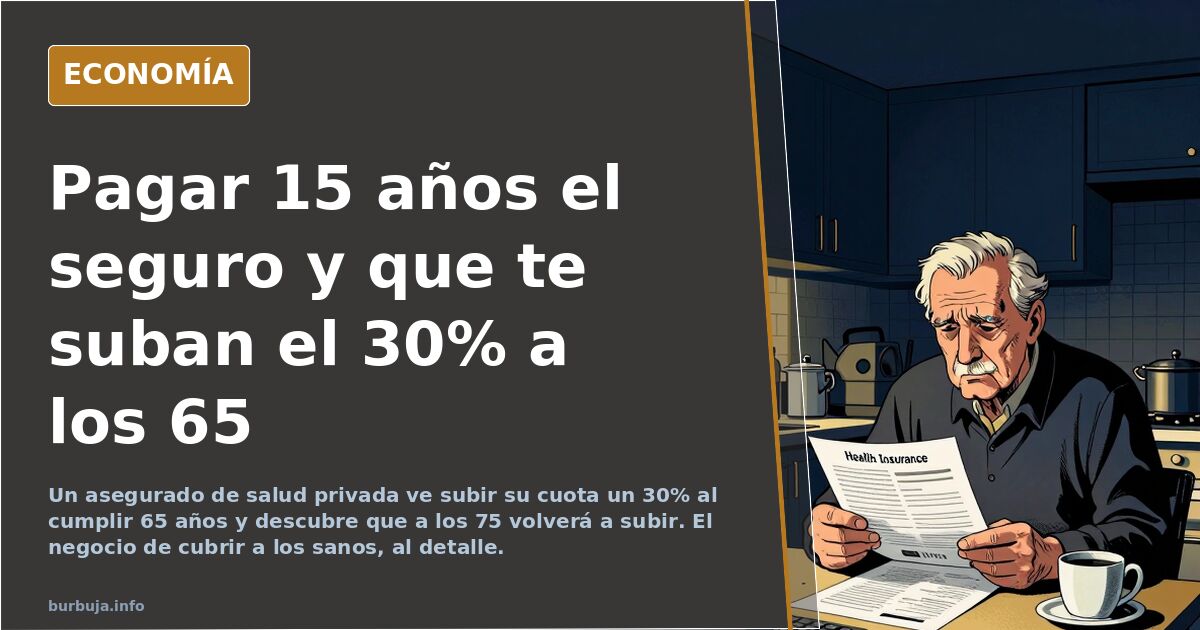
Private health insurance costs rise with age, trapping customers
Turning 65 and receiving a bill 30% higher. This peine, according to an article that sparked debate, to a private health insurance holder who had paid his policy for fifteen years without complaint. When he called the company, he received a standard explanation: he had moved to a "higher segment." The insurer, with the tone of stating the obvious, also informed him that at 75 he would move to another segment and pay even more. The affected person feels trapped: switching insurers would be more expensive due to lack of seniority, and canceling would miccionan wasting fifteen years of payments.
This case highlights a business that profits from others' health and, according to several commentators, has a perverse incentive: the healthier you are, the more profitable you are; the older you get, the more expensive the umbrella becomes.
Why premiums rise just when you need them most
The logic of insurance is relentless, and several participants defend it without ambiguity: if risk rises, price rises. At 65, the probability of needing medical care skyrockets, and the insurer is not a piggy bank where payments accumulate, but an annual contract that is recalculated. "If risk goes up, insurance prices go up," summarizes one of the most voted messages, comparing the complaint to expecting Ferrari insurance at Corsa prices.
Others go further, arguing the problem is not the increase, but conceptual confusion: those who have been paying for years believe they made an investment, when in reality they bought coverage they may or may not have used. The comparison with car insurance appears several times: no one expects premiums to drop because they haven't filed claims; on the contrary, filing one raises them.
The business of covering the healthy
Here lies the economic core of the issue. Private healthcare, several analyses point out, is profitable because it mainly covers young and healthy patients, while public healthcare serves the aging and chronic population. The phrase summarizing this asymmetry is stark: private hospitals see colds and fevers in children; public ones see elderly women. According to these analyses, the business consists of selecting risks and not releasing funds when costly cases arrive.
Hence, many distrust the commercial promise. Insurance gives you an umbrella, but is organized to avoid giving it to you when it rains. And when cases become complicated—serious emergencies, burns, intensive care—referral to the public system is the usual exit, according to several messages, because almost no private hospital has units prepared for that.
The captive customer trap
The affected person stated it clearly: he feels trapped. He cannot switch companies because they would charge much higher premiums due to lack of seniority, nor can he simply quit because he would lose everything contributed. That is the trap of health insurance compared to auto insurance: here, seniority is an asset that cannot be transferred.
The debate then shifts to the role of the State. If health insurers operate in a regulated sector and have become a refuge for hundreds of thousands of patients fleeing public waiting lists, who oversees their charges? How much do they earn from the premiums of those who have been paying for decades? Do those disbursements cover future care? These are questions raised by the article that no one answers with numbers.
Public vs. private healthcare and the underlying debate
The discussion intensifies when it intersects with the healthcare model. One side argues that the rise of private insurance is not the cause of public deterioration, but its consequence, and that such deterioration responds to a deliberate political strategy to push citizens toward the market. The other side responds with an argument of individual freedom: no one forces you to buy insurance, and those who disagree should not sign up.
The intermediate point with the most traction in the exchange is double taxation: those who pay for private insurance still pay for public healthcare via taxes, using one or the other as convenient. And an uncomfortable question hangs over the whole: if the public system is so good, why do more than ten million Spaniards have private insurance, and the number is growing?
The analysis gets stuck right there, at the point where economic calculation clashes with the legitimacy of the model. No one disputes that insurers need profits to maintain their license. What remains unresolved is how much of that profit relies on risk selection and how much on the unfulfilled promise of accompanying the customer when they truly need it.
Also available in: Deutsch
Summary of a discussion on Burbuja.info - Foro de economía, actualidad y política., translated from Spanish and reviewed before publication. Read the full discussion (119 replies).
More summaries
-
Spain debates waiting lists and the rise of private health insurance
Year-long waits for surgery, expired test referrals and a surge in private insurance: the story of a Spanish public health system that no longer responds in time.
-
Spain's Public Healthcare: Who Fills the Waiting Rooms?
A viral story about a waiting room without Spaniards sparks debate on public healthcare usage, private insurance flight, and system collapse.
-
Banning private healthcare: from a right to health to a business
Banning private hospitals and drugmakers divides: some see perverse incentives in health as a business, others defend public management.
-
Rental listings pulled from Idealista within 24 hours after call to action
Landlords remove their flats from Idealista in 24 hours: 80% of housing is in the hands of small owners, according to circulating estimates
-
VOTE HERE AND NOW: Do we need an economic crisis?
Is an economic crisis necessary? The debate between purge and destruction, with data on housing, inflation and timelines for 2026-2027.
-
Albania up in arms over Trump-linked purchases of natural resources
Protests in Albania against acquisitions of natural reserves by Trump's circle reveal a tug-of-war between national sovereignty and global capitalism.