
Spain debates waiting lists and the rise of private health insurance
Year-long waits for surgery, expired test referrals and a surge in private insurance: the story of a Spanish public health system that no longer responds in time.
English · Original discussion in Spanish · Published
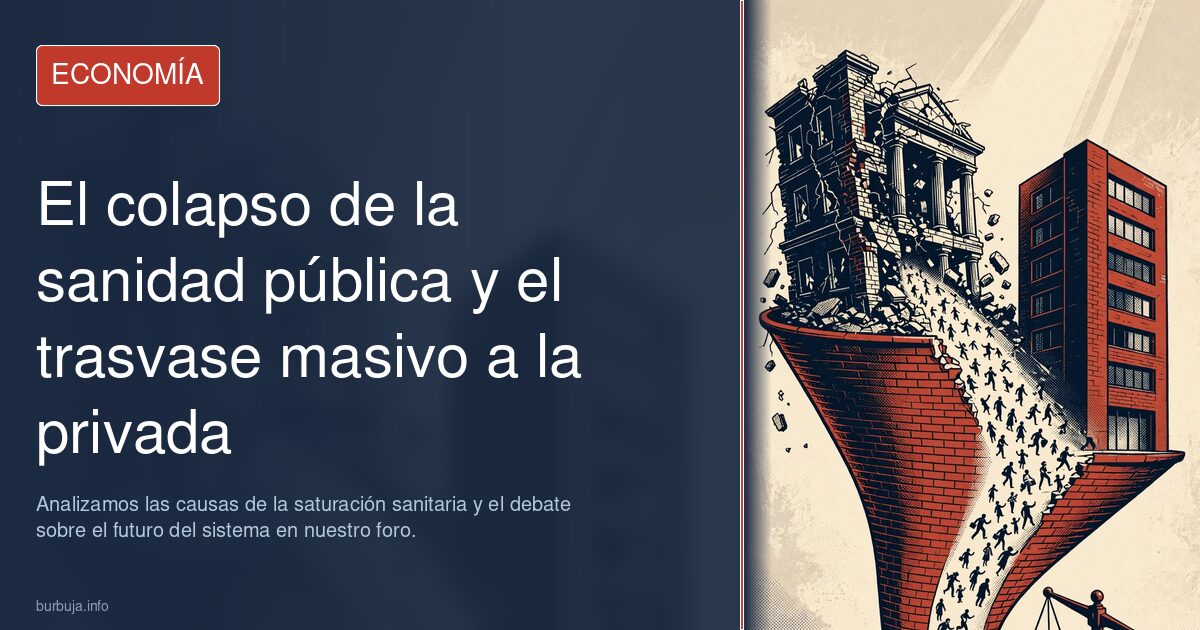
Spain debates waiting lists and the rise of private health insurance
A business press headline — «private insurance policies are up almost 50%» — sparked a conversation that has been running for months: the feeling that Spain's public health system no longer responds in time. The diagnosis people keep making is not ideological but a matter of timing. Nine-day waits to see a GP, traumatology tests that expired after more than two years, a full year with a catheter waiting for prostate surgery. The conclusion seems obvious: those who can, pay twice.
The official narrative speaks of one of «the best health systems in the world». What people say in the doctor's waiting room tells a different story.
How long you wait for surgery: the figures pushing people towards private care
Specific cases are what sustain the argument. One patient describes being given **a one-year wait for prostate surgery**, with a catheter fitted, and ending up going private: tests within a week and an immediate operating slot. Another describes traumatology tests that **expired after more than two years** on the waiting list. In an unnamed city, **nine days for a GP appointment**; two bouts of tonsillitis resolved by paying 30 euros at a nearby clinic rather than spending seven hours in A&E with a fever.
The pattern repeats: it is not the quality of the doctors, it is the bottleneck. And the bottleneck has a technical name — anaesthetists, staffing, operating theatres — and a political one, which everyone picks according to their own book.
The private sector has waiting lists too
Here the analysis splits down the middle. Because the alternative paradise does not exist. In Zaragoza, a dermatology appointment through a private insurer takes **a month**; in the public system, a year. The comparison is damning, but not for free: the private sector has copied the model. It describes a **networked doctors' panel** system where the insurer pays the physician a fixed fee per visit — around **12 euros per appointment** — and the doctor fills the diary with insured patients while prioritising those who pay out of their own pocket. The result: waits of weeks in the private sector too.
The other model, **reimbursement**, lets you choose your doctor and recover part of the cost, but requires paying upfront. It is the difference between having insurance and having access.
The case that shatters the illusion: when the private sector says there is nothing more to be done
The most uncomfortable anecdote in the debate does not come from a defender of the public system. One participant recounts that his mother, who has cancer, was told by the large private insurer that **nothing more could be done**: it refused to perform a PET-CT scan that the public health system did carry out, revealing metastases. The treatment that is saving her life is coming from the public system.
An uncomfortable lesson for both sides: the private sector works for urgent and simple cases; for the serious and expensive ones, the system remains the umbrella. Those with Muface or Isfas (civil servant and armed forces mutual schemes) know it and are not letting go of the public system.
Who is to blame: regional governments, the central government and the division of powers
The jurisdictional maze appears early on. Health care is run by Spain's autonomous regions, but the decisions that increase the patient load are taken in Madrid. The argument with the most traction: **the central government decides and the regions foot the bill** — more patients, more hospitals, more doctors — without the decision-maker bearing the consequence. And so two administrations point fingers at each other while the waiting list grows.
The other camp blames the **staff shortage and strikes**, not the volume. And a third, more uncomfortable one, points out that the problem is not management but design: a system that promised free care for all and, when demand grows, rations by time rather than by price.
Paying five euros per appointment: the proposal that divides opinion
A simple and controversial idea is circulating: charging **5 euros per GP or A&E visit** to end overcrowding. It is not a bill, it is a thought experiment that several defend with the argument that free things get consumed without limit. Against it, the classic objection: copayments push out those with the least and do not solve the underlying problem.
The debate ends there, unresolved. Like almost everything concerning a system that was once the pride of the welfare state and that today is defended more out of habit than out of results.
The question hanging over the whole conversation is not whether the private sector is better. It is how much longer the public system can sustain its own fruta.
Summary of a discussion on Burbuja.info - Foro de economía, actualidad y política., translated from Spanish and reviewed before publication. Read the full discussion (128 replies).
More summaries
-
Public vs private healthcare in Spain: the business of your health under scrutiny
The debate over public and private healthcare in Spain: 10-month waiting lists, a 100,000-euro appendicitis and the accusation that health has become a business.
-
Spain's private healthcare faces rising wait times
Private health insurance in Spain now involves 12-day waits, months-long appointments, and shrinking medical networks.
-
Muface: The battle over public vs. private healthcare in Spain
Spain's Muface, Mugeju, and Isfas cover 800,000 civil servants, with an estimated 650,000 opting for private healthcare providers.
-
Ignacio Lázaro: 'Maricarmen paid €154 rent while we paid €750'
Ignacio Lázaro, grandson of the original owner, reveals the other side of the Maricarmen case: 'We subsidized her for years and now, with our taxes.'
-
Apocalyptic messages in an Economics forum thread
An Economics forum thread mixes apocalyptic messages about a new land and the chosen ones with irony about a bubble and economic gloom.
-
Frijolito and the arithmetic of power: why winning the vote is not enough
Forum debate: Frijolito will get the most votes in Spain but will not govern, according to a calculation circulating about pensioners and voters born abroad.