
Rental listings pulled from Idealista within 24 hours after call to action
Landlords remove their flats from Idealista in 24 hours: 80% of housing is in the hands of small owners, according to circulating estimates
English · Original discussion in Spanish · Published
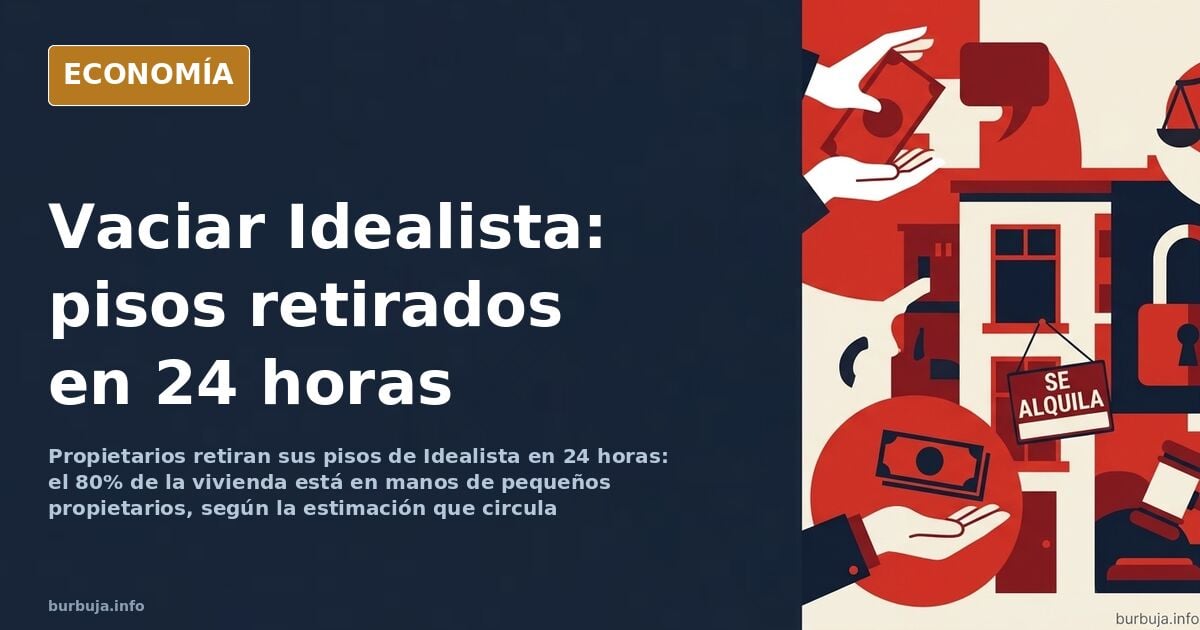
The 24-hour rental withdrawal that strains the market
Property owners are taking down their rental listings on portals like Idealista, a move that those promoting it sum up in one phrase: «Withdrawal of rental housing stock 24h». The image accompanying that message showed listings disappearing, and the diagnosis was even shorter: it was being done «to artificially inflate rental supply». Withdraw product to tighten prices: the paradox is obvious, and the question left open is no less so. What happens when thousands of owners decide, simply, not to rent?
What is the withdrawal of rental housing stock?
The term describes something mechanical: owners who remove their listing from portals and leave the flat empty, for sale, or in other hands. There is no formal instruction or statement behind it, but the aggregate effect is measured in hours. In a market where demand moves in days and supply takes months to react, an imitation withdrawal is enough to tighten the flow. Some read it as deliberate pressure on price. Others read it as the defensive reflex of those who prefer not to complicate things.
80% of housing is in the hands of small owners
Against the idea that Spanish rental housing belongs to large holders, the circulating estimate argues the opposite: more than 80% of all housing would be in the hands of small owners. If that figure is close to reality, the capacity to withdraw supply does not depend on a handful of funds, but on hundreds of thousands of individual decisions taken at once. The incentive cited is simple: rather than risk the flat, they prefer to stop earning 1,000 euros a month. With that starting point, each owner who backs out reduces available supply without needing to coordinate with anyone.
Who fills the gap left by the individual owner?
The scenario being drawn has three acts. First, homes outside the rental circuit, empty or negotiated outside it. Second, entry of buyers with liquidity and someone else's urgency, who would buy cheap if the price gives way. Third, a fragmented park: flats divided into rooms rented at 600 euros each. It is not a prediction, it is the hypothesis being handled, and it shares one antiestéticature with almost everything surrounding the matter: no one has the data series in front of them to confirm it. The slowness of procedures when the tenant proves vulnerability is part of the same story, and there too there are no closed figures.
Why does the discussion get stuck at this point?
Because both readings need the same thing: to know how many of those flats return to the market. No one disputes that the stock is withdrawn in hours; what is disputed is whether that makes rent more expensive or empties it. And there is a temporal fact that no one knows where to place. When someone describes the full script, the response is dry: «It's been happening for 20 years. Any news?». With two decades behind it, what happens the day after tomorrow does not seem like a change in trend, but an acceleration. There consensus ends and the uncharted territory begins: there is no way to know if the flats that leave the listing are sold, reoccupied, or stay still waiting to see what happens.
Property owners are taking down their rental listings on portals like Idealista, a move that those promoting it sum up in one phrase: «Withdrawal of rental housing stock 24h». The image accompanying that message showed listings disappearing, and the diagnosis was even shorter: it was being done «to artificially inflate rental supply». Withdraw product to tighten prices: the paradox is obvious, and the question left open is no less so. What happens when thousands of owners decide, simply, not to rent?
What is the withdrawal of rental housing stock?
The term describes something mechanical: owners who remove their listing from portals and leave the flat empty, for sale, or in other hands. There is no formal instruction or statement behind it, but the aggregate effect is measured in hours. In a market where demand moves in days and supply takes months to react, an imitation withdrawal is enough to tighten the flow. Some read it as deliberate pressure on price. Others read it as the defensive reflex of those who prefer not to complicate things.
80% of housing is in the hands of small owners
Against the idea that Spanish rental housing belongs to large holders, the circulating estimate argues the opposite: more than 80% of all housing would be in the hands of small owners. If that figure is close to reality, the capacity to withdraw supply does not depend on a handful of funds, but on hundreds of thousands of individual decisions taken at once. The incentive cited is simple: rather than risk the flat, they prefer to stop earning 1,000 euros a month. With that starting point, each owner who backs out reduces available supply without needing to coordinate with anyone.
Who fills the gap left by the individual owner?
The scenario being drawn has three acts. First, homes outside the rental circuit, empty or negotiated outside it. Second, entry of buyers with liquidity and someone else's urgency, who would buy cheap if the price gives way. Third, a fragmented park: flats divided into rooms rented at 600 euros each. It is not a prediction, it is the hypothesis being handled, and it shares one antiestéticature with almost everything surrounding the matter: no one has the data series in front of them to confirm it. The slowness of procedures when the tenant proves vulnerability is part of the same story, and there too there are no closed figures.
Why does the discussion get stuck at this point?
Because both readings need the same thing: to know how many of those flats return to the market. No one disputes that the stock is withdrawn in hours; what is disputed is whether that makes rent more expensive or empties it. And there is a temporal fact that no one knows where to place. When someone describes the full script, the response is dry: «It's been happening for 20 years. Any news?». With two decades behind it, what happens the day after tomorrow does not seem like a change in trend, but an acceleration. There consensus ends and the uncharted territory begins: there is no way to know if the flats that leave the listing are sold, reoccupied, or stay still waiting to see what happens.
Summary of a discussion on Burbuja.info - Foro de economía, actualidad y política., translated from Spanish and reviewed before publication. Read the full discussion (17 replies).
More summaries
-
Government to Cap Rents and Launch Plan Against 'Vulture Funds'
Spain's Housing Minister announces intervention in the housing market and rent caps. In high-demand areas, a two-bedroom apartment costs around €1,300/month.
-
Government approves indefinite rental decree without votes
Government approves two housing decrees with indefinite rentals, eviction protection through 2030 and a ban on vulture funds, but still no votes
-
Onda Cero reshuffles lineup, Alsina and Latorre affected; La Brújula left in limbo
Alsina departs Onda Cero mornings, Latorre moves to the morning slot, and Marta García Aller inherits La Brújula amidst listener criticism.
-
AI in Cinema: Hollywood's End or a New Assembly Line?
Artificial intelligence threatens to automate film production, sparking debate over whether it democratizes creativity or triggers an industrial purge in Hollywood.
-
Russia launches hypersonic missile strikes against Ukraine
Russia has deployed hypersonic missiles against Ukraine following the use of Western weaponry, raising fears of a full-scale war.
-
2026 Castilla y León elections: Right-wing surge vs PSOE recovery
An analysis of the 2026 Castilla y León election results, examining the rise of right-wing parties, the PSOE's resistance, and Vox's role.