
Partners of detainees deny murdering Guardia Civil officers
Partners of those detained over Guardia Civil (Spain's military police) officers' deaths insist they stayed on land and only hauled bales
English · Original discussion in Spanish · Published
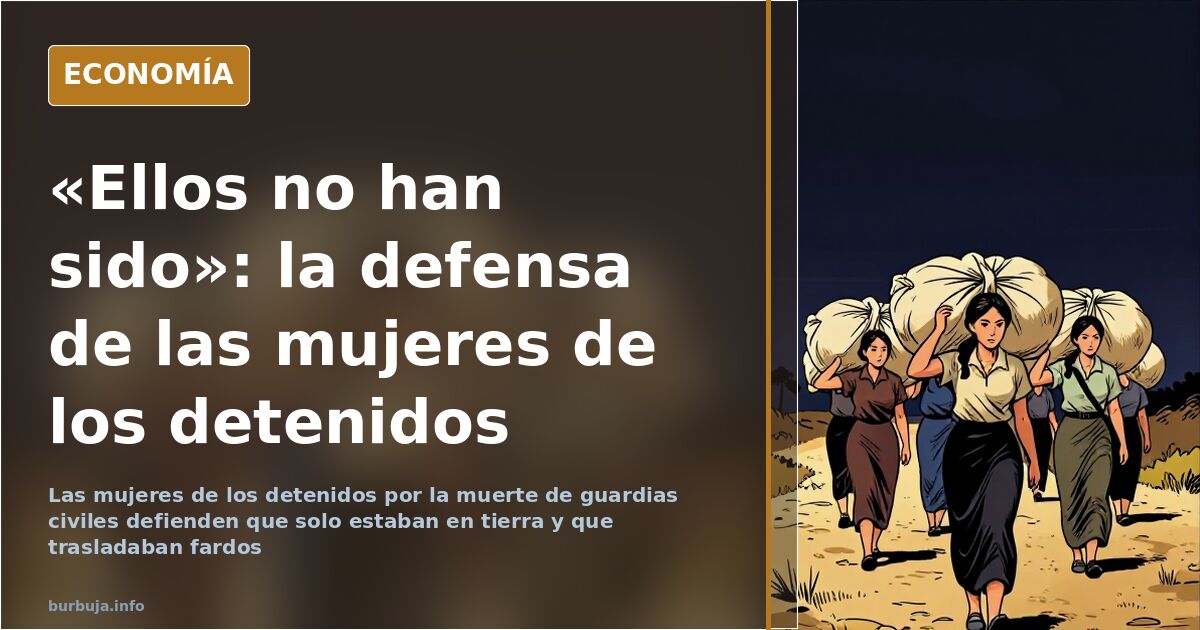
The detainees’ partners defend their innocence
With a Calvin Klein puffer jacket, a Guess bag and a high-end phone, the partners of those detained over the deaths of Guardia Civil (Spain’s military police) officers maintain a simple defense: “they didn’t do it”. They do not deny the trade. They deny the killing. Their partners are in the business of speedboats and bales, they concede; what they reject is that the officers’ deaths are on them. The prosecution, by contrast, points to an alleged murder.
What exactly are the detainees’ partners defending?
The version they repeat is surgical. “They were only on land,” they say. If the arrest is for having been on the boat, they accept it; if it is for the murder, they do not. It is a defense line built on the division of labor within drug trafficking: some pilot, others load, others watch. Those who haul the bales occupy, in that hierarchy, the most visible and worst-paid rung.
The case is also shadowed by a suspicion repeated from the outset: that the arrests have fallen on the weak link to calm public outcry while the organization’s leaders remain where they were. It is asserted without evidence. The prosecution, for now, sticks to the facts of the day of the incident.
The money on display and the money left unexplained
What is most jarring is the backdrop. Expensive brands, high-end cars, big houses. And a textbook money-laundering question: if the legal limit for cash payments at a dealership is around 3.000 euros, how do you justify an intake of 60.000 euros in banknotes? There the story of the hardworking family and that of visible wealth collide head-on.
In drug trafficking, cash is not invoiced, it is moved. And what moves leaves a trace, even if it is the trace of what is not declared.
Carriers, scapegoats or cogs in an organization?
Here interpretations diverge. One current describes the arrested as low-level links, young people dragging bundles without command or a cut in the structure. Another recalls that whoever kills a Guardia Civil officer crosses a line the organization itself avoided, and that makes the case more than a workplace accident.
There are even those who suspect a cosmetic operation: arrest the first available, let the matter cool, and release them when no one is watching. Against that, the harshest version holds that if the organization believed itself untouchable for years, it was because someone allowed it, and the problem will not be solved with four arrests. Time will tell.
The other question: are harsher penalties enough?
The case has peine the eternal incivil-policy argument. One side demands 20 years in prison for traffickers and a tough-on-crime model in the style of El Salvador’s Bukele. Another responds with the opposite example: fentanyl is de facto legalized in the United States, costs less than 5 dollars, circulates 100% pure and the harm it causes has not fallen. From there comes the thesis of legalizing all drugs: the harm from disputes and adulterated products would be greater than that of a controlled and known substance.
Between both extremes remains the uncomfortable fact: consumption does not disappear with prohibition or permissiveness. It only changes hands and price.
The five speedboats Spain delivered to Segarro
And the unsettling detail emerges. According to a version circulating without official confirmation, the government delivered five Vanguard TX 700 CV speedboats to Segarro in 2022, the same type the Guardia Civil is asking for, while officers are sent into action in inflatable boats. The contrast between 700 horsepower and an inflatable boat sums up better than any speech the distribution of resources in a war fought at water level.
To all this is added the thesis writer Roberto Saviano defended on television: that Spain lives off drug trafficking and is the gateway for all drugs into Europe. With that starting point, the question is not who was on the boat. It is how long until it happens again.
With a Calvin Klein puffer jacket, a Guess bag and a high-end phone, the partners of those detained over the deaths of Guardia Civil (Spain’s military police) officers maintain a simple defense: “they didn’t do it”. They do not deny the trade. They deny the killing. Their partners are in the business of speedboats and bales, they concede; what they reject is that the officers’ deaths are on them. The prosecution, by contrast, points to an alleged murder.
What exactly are the detainees’ partners defending?
The version they repeat is surgical. “They were only on land,” they say. If the arrest is for having been on the boat, they accept it; if it is for the murder, they do not. It is a defense line built on the division of labor within drug trafficking: some pilot, others load, others watch. Those who haul the bales occupy, in that hierarchy, the most visible and worst-paid rung.
The case is also shadowed by a suspicion repeated from the outset: that the arrests have fallen on the weak link to calm public outcry while the organization’s leaders remain where they were. It is asserted without evidence. The prosecution, for now, sticks to the facts of the day of the incident.
The money on display and the money left unexplained
What is most jarring is the backdrop. Expensive brands, high-end cars, big houses. And a textbook money-laundering question: if the legal limit for cash payments at a dealership is around 3.000 euros, how do you justify an intake of 60.000 euros in banknotes? There the story of the hardworking family and that of visible wealth collide head-on.
In drug trafficking, cash is not invoiced, it is moved. And what moves leaves a trace, even if it is the trace of what is not declared.
Carriers, scapegoats or cogs in an organization?
Here interpretations diverge. One current describes the arrested as low-level links, young people dragging bundles without command or a cut in the structure. Another recalls that whoever kills a Guardia Civil officer crosses a line the organization itself avoided, and that makes the case more than a workplace accident.
There are even those who suspect a cosmetic operation: arrest the first available, let the matter cool, and release them when no one is watching. Against that, the harshest version holds that if the organization believed itself untouchable for years, it was because someone allowed it, and the problem will not be solved with four arrests. Time will tell.
The other question: are harsher penalties enough?
The case has peine the eternal incivil-policy argument. One side demands 20 years in prison for traffickers and a tough-on-crime model in the style of El Salvador’s Bukele. Another responds with the opposite example: fentanyl is de facto legalized in the United States, costs less than 5 dollars, circulates 100% pure and the harm it causes has not fallen. From there comes the thesis of legalizing all drugs: the harm from disputes and adulterated products would be greater than that of a controlled and known substance.
Between both extremes remains the uncomfortable fact: consumption does not disappear with prohibition or permissiveness. It only changes hands and price.
The five speedboats Spain delivered to Segarro
And the unsettling detail emerges. According to a version circulating without official confirmation, the government delivered five Vanguard TX 700 CV speedboats to Segarro in 2022, the same type the Guardia Civil is asking for, while officers are sent into action in inflatable boats. The contrast between 700 horsepower and an inflatable boat sums up better than any speech the distribution of resources in a war fought at water level.
To all this is added the thesis writer Roberto Saviano defended on television: that Spain lives off drug trafficking and is the gateway for all drugs into Europe. With that starting point, the question is not who was on the boat. It is how long until it happens again.
Summary of a discussion on Burbuja.info - Foro de economía, actualidad y política., translated from Spanish and reviewed before publication. Read the full discussion (431 replies).
More summaries
-
Six Dead as Truck Plows Through Guardia Civil Checkpoint
Truck hits GAR elite unit checkpoint in Los Palacios: six dead, two officers. Driver, negative for alcohol and drugs, remains in pre-trial detention.
-
Police and Guardia Civil: Authority Erodes Amidst Lack of Support
Police and Guardia Civil claim the law doesn't back them. From lockdowns to ITV fines, the debate over fading authority.
-
Two Civil Guards Killed in Barbate After Narco-Boat Attack
Tragedy in Barbate: Two Civil Guards die when their patrol boat is rammed by a narco-boat. The incident highlights a critical lack of resources and the pervasive issue of drug trafficking.
-
Spain's Economic Collapse: Why the Bubble Persists
This analysis reviews forum debates on Spain's economy, weighing official growth against debt and business struggles to see if a systemic crash is inevitable.
-
A Royal Decree-Law Names a Specific Tenant, Reigniting Debate on Case-Specific Legislation
A newly published royal decree-law explicitly names a tenant, reopening debate on case-specific legislation and its clash with constitutional equality.
-
Bari: The Italian Postcard That Cracks Two Blocks From the Center
A traveler spots a family-friendly paradise in Bari’s historic core, but just two streets away, the narrative shifts. Italy vs. Spain compared.