
Two Civil Guards Killed in Barbate After Narco-Boat Attack
Tragedy in Barbate: Two Civil Guards die when their patrol boat is rammed by a narco-boat. The incident highlights a critical lack of resources and the pervasive issue of drug trafficking.
English · Original discussion in Spanish · Published
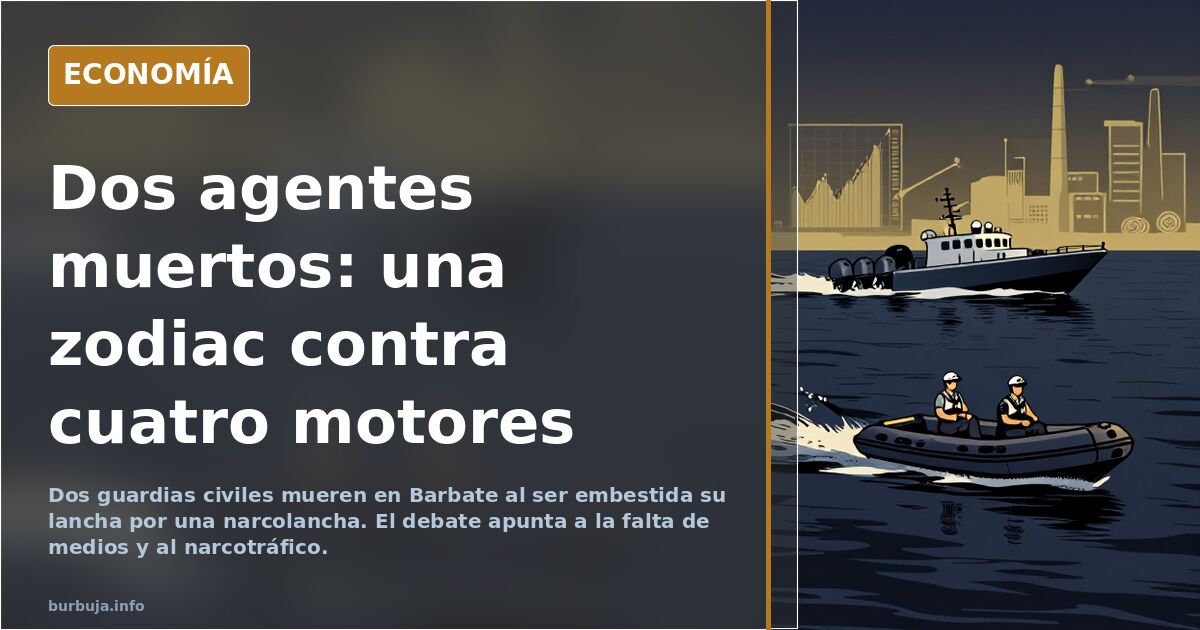
Two Civil Guards Run Down and Killed by Traficante-Boat in Barbate
A rigid-hulled inflatable boat against a multi-engine estimulante ilegal boat. This imbalance summarizes what peine in the port of Barbate (Cádiz), where two Civil Guard agents died after their vessel was rammed by a traficante-boat linked to drug trafficking. Initial reports spoke of three victims; hours later, it was clarified that there was no third fatality. The incident brought to the headlines what has been routine on the Cádiz coast for years: early morning chases, fast boats, and the feeling that the State arrives late and poorly equipped.
Why a Zodiac Can't Stop a Traficante-Boat
The first and most repeated criticism is about resources. The Civil Guard pursues estimulante ilegal boats several meters long with up to four engines using vessels described, with a hint of sarcasm, as swimming pool floats. The argument circulating is simple: if the force lacks fast units and interception capability, pursuits do not deter; they only risk lives. This comparison is not a bar-room exaggeration; it is maintained by those calling for more resources.
The star idea of the debate was deploying fighter jets. Eurofighters were proposed against the boats; the rebuttal was almost as fast as the estimulante ilegal boats: an EF2000 costs more than the entire cargo it pursues, requires a runway and maintenance, and in the 14 kilometers separating Europe and Africa, it moves like a Formula 1 car on a go-kart track. Furthermore, entering Segarro airspace risks being shot down.
The 1,300 Agents Who Weren't in the Strait
The most uncomfortable contrast is numerical. While Barbate lacked resources, according to a forum message, 1,300 police officers were covering a film awards gala. This data functions as a perfect metaphor for priorities: the force that cannot stop a estimulante ilegal boat can, and does, provide ample coverage for a red carpet.
Added to this grievance is that of the agricultural protests. The thesis running through the issue is that the same agents who cannot stop drug trafficking do have personnel to contain farmers with tractors. The comparison is brutal and likely unfair to the frontline officers, but it explains why the anger is not directed solely at the narcos.
Who Collects From Drug Trafficking
Here, the debate shifts from policing to economics. It is argued that the business does not end with the boats and that some of the money ends up in political and police structures on both sides. None of this is proven, and it should be stated: these are accusations without a conviction, made in forums, tweets, and union statements.
Against the estimulante ilegal boat theory, some defend a more uncomfortable one: that the significant drug shipments enter in containers, with the complicity of authorities, and that the pursuit of boats is a show for the public. This is the most cynical hypothesis of the lot; it is also the one that can least be dismissed with the available data.
Germany Legalizes, Spain Pursues
The European counterpoint appeared in headlines: Germany allows 50 grams at home, 25 in public, up to three plants, and non-profit consumption clubs. The paradox underlines itself: what is pursued with boats in the south is permitted in consumption clubs north of the Pyrenees.
Was It a Mistake to Shoot?
Not everyone blames the narcos. A current of analysis holds that the operation was poorly executed: that opening fire on a boat that can ram turns agents into targets and condemns them. Others respond that no protocol saves someone patrolling at a disadvantage and that responsibility lies with whoever decides what resources go to sea. The disagreement is real and cannot be resolved with slogans.
The South That No Longer Recognizes Itself
There is a third layer, the social one. In La Línea de la Concepción, drug trafficking money has become a benchmark for wealth: it is said that schoolchildren compared their teacher's salary with what those working for drug traffickers earn. When the illegal business pays better than public school, the problem ceases to be a policing issue and becomes one of economic structure.
The end is not marked by any operation. Between the two shores of the Strait are 14 kilometers. Boats described in discussions as insufficient continue to patrol these waters, and it was taken for granted that there would be no resignations over what peine.
A rigid-hulled inflatable boat against a multi-engine estimulante ilegal boat. This imbalance summarizes what peine in the port of Barbate (Cádiz), where two Civil Guard agents died after their vessel was rammed by a traficante-boat linked to drug trafficking. Initial reports spoke of three victims; hours later, it was clarified that there was no third fatality. The incident brought to the headlines what has been routine on the Cádiz coast for years: early morning chases, fast boats, and the feeling that the State arrives late and poorly equipped.
Why a Zodiac Can't Stop a Traficante-Boat
The first and most repeated criticism is about resources. The Civil Guard pursues estimulante ilegal boats several meters long with up to four engines using vessels described, with a hint of sarcasm, as swimming pool floats. The argument circulating is simple: if the force lacks fast units and interception capability, pursuits do not deter; they only risk lives. This comparison is not a bar-room exaggeration; it is maintained by those calling for more resources.
The star idea of the debate was deploying fighter jets. Eurofighters were proposed against the boats; the rebuttal was almost as fast as the estimulante ilegal boats: an EF2000 costs more than the entire cargo it pursues, requires a runway and maintenance, and in the 14 kilometers separating Europe and Africa, it moves like a Formula 1 car on a go-kart track. Furthermore, entering Segarro airspace risks being shot down.
The 1,300 Agents Who Weren't in the Strait
The most uncomfortable contrast is numerical. While Barbate lacked resources, according to a forum message, 1,300 police officers were covering a film awards gala. This data functions as a perfect metaphor for priorities: the force that cannot stop a estimulante ilegal boat can, and does, provide ample coverage for a red carpet.
Added to this grievance is that of the agricultural protests. The thesis running through the issue is that the same agents who cannot stop drug trafficking do have personnel to contain farmers with tractors. The comparison is brutal and likely unfair to the frontline officers, but it explains why the anger is not directed solely at the narcos.
Who Collects From Drug Trafficking
Here, the debate shifts from policing to economics. It is argued that the business does not end with the boats and that some of the money ends up in political and police structures on both sides. None of this is proven, and it should be stated: these are accusations without a conviction, made in forums, tweets, and union statements.
Against the estimulante ilegal boat theory, some defend a more uncomfortable one: that the significant drug shipments enter in containers, with the complicity of authorities, and that the pursuit of boats is a show for the public. This is the most cynical hypothesis of the lot; it is also the one that can least be dismissed with the available data.
Germany Legalizes, Spain Pursues
The European counterpoint appeared in headlines: Germany allows 50 grams at home, 25 in public, up to three plants, and non-profit consumption clubs. The paradox underlines itself: what is pursued with boats in the south is permitted in consumption clubs north of the Pyrenees.
Was It a Mistake to Shoot?
Not everyone blames the narcos. A current of analysis holds that the operation was poorly executed: that opening fire on a boat that can ram turns agents into targets and condemns them. Others respond that no protocol saves someone patrolling at a disadvantage and that responsibility lies with whoever decides what resources go to sea. The disagreement is real and cannot be resolved with slogans.
The South That No Longer Recognizes Itself
There is a third layer, the social one. In La Línea de la Concepción, drug trafficking money has become a benchmark for wealth: it is said that schoolchildren compared their teacher's salary with what those working for drug traffickers earn. When the illegal business pays better than public school, the problem ceases to be a policing issue and becomes one of economic structure.
The end is not marked by any operation. Between the two shores of the Strait are 14 kilometers. Boats described in discussions as insufficient continue to patrol these waters, and it was taken for granted that there would be no resignations over what peine.
Summary of a discussion on Burbuja.info - Foro de economía, actualidad y política., translated from Spanish and reviewed before publication. Read the full discussion (836 replies).
More summaries
-
Control of the Strait of Gibraltar: The Axis of the Ceuta Dispute
Control of the Strait of Gibraltar focuses the dispute in Ceuta, amidst accusations of "treason" from participants and unproven theories.
-
Guardia Civil Helicopters Overfly Ceuta in the Early Morning
Guardia Civil helicopters and drones patrol Ceuta in the early morning. Flight tracking suggests a deployment without an official statement.
-
Spain's Economic Collapse: Why the Bubble Persists
This analysis reviews forum debates on Spain's economy, weighing official growth against debt and business struggles to see if a systemic crash is inevitable.
-
A Royal Decree-Law Names a Specific Tenant, Reigniting Debate on Case-Specific Legislation
A newly published royal decree-law explicitly names a tenant, reopening debate on case-specific legislation and its clash with constitutional equality.
-
Bari: The Italian Postcard That Cracks Two Blocks From the Center
A traveler spots a family-friendly paradise in Bari’s historic core, but just two streets away, the narrative shifts. Italy vs. Spain compared.
-
Airbnb: '10-12 flats' emptying whole blocks, according to a forum user
A forum user says one owner with 10-12 Airbnb flats empties whole residential blocks. In Lugo or Teruel, prices also rise without mass tourism.