
Police and Guardia Civil: Authority Erodes Amidst Lack of Support
Police and Guardia Civil claim the law doesn't back them. From lockdowns to ITV fines, the debate over fading authority.
English · Original discussion in Spanish · Published
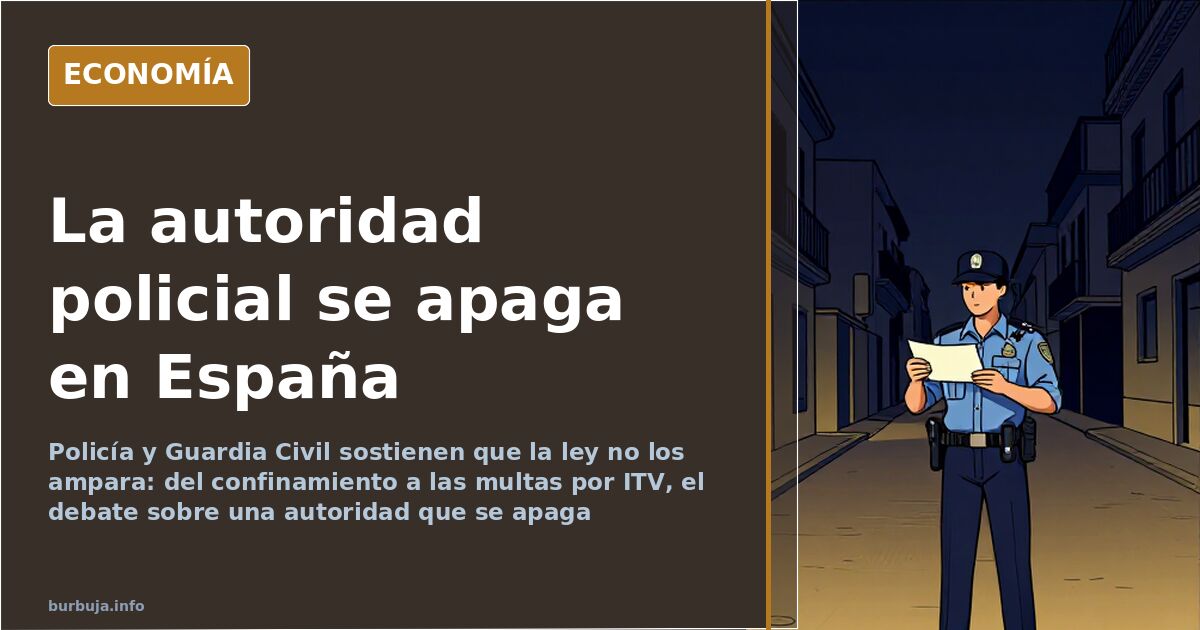
Police Authority Fades: From Lockdowns to ITV Fines
There's a phrase that's become a refrain since 2020, summarizing the problem better than any report: "Sir, sir, don't hit me." Said with a sneer, it's the mockery that dogs officers in every smartphone-recorded intervention, and also a symptom of something deeper. In Spain, the feeling has taken hold that police authority has lost its teeth, and this idea is no longer held only by critics: a portion of those in uniform also subscribe to it.
The discontent has become strident. The starting point cited by most analyses isn't a specific law, but March 2020, when the state of alarm turned the National Police and Guardia Civil into the visible arm of restrictions no one had voted for. Since then, this current of thought holds, every fine imposed then is now paid in hostility.
Why Do Officers Say They Can No Longer Defend Themselves?
The central argument is legal. The repeated complaint is that neither the law nor judges back an officer who responds to aggression: if they defend themselves, they end up charged; if they don't, they end up injured. The technical counterpoint comes from the legal system itself: police have a presumption of veracity in the administrative sphere, but not in the incivil one. That is, their word is valid for upholding a traffic ticket, but not for justifying an arrest on its own.
This is where the comparison with private security guards comes in, whose status as authority was removed, and who, according to this narrative, have been challenged for years without significant consequences. "Honor, once lost, is never regained," summarizes one of the circulating viewpoints. The opposing view recalls that no democratic country grants the uniform a free pass and that the presumption of veracity is deliberately limited to administrative matters to avoid contaminating incivil proceedings.
The Lockdown and the Mask: The Bill Police Are Still Paying
The pandemic appears in almost every conversation on the topic. The recurring image is of officers patrolling children's playgrounds to prevent kids from going near the swings, or issuing citations for not wearing a mask in the street. Those who recall it don't do so with gratitude. The so-called "disobedience wildcard"—the idea that invoking an order was enough to disobey it—became, according to this diagnosis, an institutional embarrassment that's hard to digest.
The underlying economic problem is simple: officers are public employees, and they don't sign the orders they execute. The most uncomfortable, and also the most repeated, criticism is that those who obey an unpopular decree inherit its unpopularity forever. No one seriously disputes that they were trinc orders. What's debated is whether, years later, they are still paying the political price for having carried them out with the diligence required.
From Fines for Expired ITV to Citizens Who Won't Be Stopped
Citizen detachment has its everyday version, and it's not always ideological. A recurring example: a driver fined at the toll booth on the AP-36, in Albacete, for having an expired ITV (vehicle inspection) by four days. The anger wasn't about the penalty itself, but the feeling that there was zeal in this case, while in other, much more serious matters, there wasn't. The driver himself admits the fault was his; what outrages him is the criterion with which it's applied.
There's a bureaucratic detail that fuels this discontent: booking an ITV appointment three weeks in advance only to be given one almost three months later, with the car legally immobilized in the meantime. Strictly speaking, you can't drive with an expired inspection; the proper procedure would be to transport the vehicle by tow truck. The effect is an asymmetry perceived across Spain: strong with citizens paying fines, and weak when facing real conflict. Some analyses attribute this to a lack of training; others, to a simple cost-benefit calculation. Neither dismisses the possibility that the beat officer is caught in the middle.
The Debate on Officer Training and Physical Fitness
The most uncomfortable criticism for the forces isn't political, but physical. It's debated whether selection and training are up to par with what's later demanded on the street. At the center of the controversy is a recurring profile: officers just over 1.60 meters tall and weighing around 50 kilos assigned to interventions where physical strength is decisive. Some point out that most police officers never fire their weapons in their entire careers and that a good portion doesn't receive specific training for managing real violence.
The numbers for intervention itself are also debated. One of the proposals attributed to unions is to raise the number of officers per apprehension from six to twelve, a figure that for some is pure operational safety and for others is an excuse to form an peine human barrier to cameras. The discussion on whether the police need more resources or better training remains unresolved, with each side having its favorite example.
What's True About Comparisons with Other High-Risk Jobs
The culmination of the harshest criticism points to the paycheck: if the salary is fixed and lifelong, what are they complaining about? The answer offered by the sector is that this salary is precisely what's paid for the assumed risk, not a privilege. Against this, the data that cools the argument: those who die from work accidents in Spain are mainly construction, industry, and agricultural workers, not authority officers.
The comparison isn't clean for anyone. An officer doesn't choose who they confront, but they also can't resign every time an order repulses them. One can request a leave of absence; one can give up the position and try the private sector. Neither of these resolves the fundamental problem, which is different: who protects the protector.
With authority questioned, training in doubt, and judicial backing turned into a battlefield, the simplest question remains unanswered. If the officer doesn't feel supported and the citizen doesn't feel protected, who exactly is protected?
There's a phrase that's become a refrain since 2020, summarizing the problem better than any report: "Sir, sir, don't hit me." Said with a sneer, it's the mockery that dogs officers in every smartphone-recorded intervention, and also a symptom of something deeper. In Spain, the feeling has taken hold that police authority has lost its teeth, and this idea is no longer held only by critics: a portion of those in uniform also subscribe to it.
The discontent has become strident. The starting point cited by most analyses isn't a specific law, but March 2020, when the state of alarm turned the National Police and Guardia Civil into the visible arm of restrictions no one had voted for. Since then, this current of thought holds, every fine imposed then is now paid in hostility.
Why Do Officers Say They Can No Longer Defend Themselves?
The central argument is legal. The repeated complaint is that neither the law nor judges back an officer who responds to aggression: if they defend themselves, they end up charged; if they don't, they end up injured. The technical counterpoint comes from the legal system itself: police have a presumption of veracity in the administrative sphere, but not in the incivil one. That is, their word is valid for upholding a traffic ticket, but not for justifying an arrest on its own.
This is where the comparison with private security guards comes in, whose status as authority was removed, and who, according to this narrative, have been challenged for years without significant consequences. "Honor, once lost, is never regained," summarizes one of the circulating viewpoints. The opposing view recalls that no democratic country grants the uniform a free pass and that the presumption of veracity is deliberately limited to administrative matters to avoid contaminating incivil proceedings.
The Lockdown and the Mask: The Bill Police Are Still Paying
The pandemic appears in almost every conversation on the topic. The recurring image is of officers patrolling children's playgrounds to prevent kids from going near the swings, or issuing citations for not wearing a mask in the street. Those who recall it don't do so with gratitude. The so-called "disobedience wildcard"—the idea that invoking an order was enough to disobey it—became, according to this diagnosis, an institutional embarrassment that's hard to digest.
The underlying economic problem is simple: officers are public employees, and they don't sign the orders they execute. The most uncomfortable, and also the most repeated, criticism is that those who obey an unpopular decree inherit its unpopularity forever. No one seriously disputes that they were trinc orders. What's debated is whether, years later, they are still paying the political price for having carried them out with the diligence required.
From Fines for Expired ITV to Citizens Who Won't Be Stopped
Citizen detachment has its everyday version, and it's not always ideological. A recurring example: a driver fined at the toll booth on the AP-36, in Albacete, for having an expired ITV (vehicle inspection) by four days. The anger wasn't about the penalty itself, but the feeling that there was zeal in this case, while in other, much more serious matters, there wasn't. The driver himself admits the fault was his; what outrages him is the criterion with which it's applied.
There's a bureaucratic detail that fuels this discontent: booking an ITV appointment three weeks in advance only to be given one almost three months later, with the car legally immobilized in the meantime. Strictly speaking, you can't drive with an expired inspection; the proper procedure would be to transport the vehicle by tow truck. The effect is an asymmetry perceived across Spain: strong with citizens paying fines, and weak when facing real conflict. Some analyses attribute this to a lack of training; others, to a simple cost-benefit calculation. Neither dismisses the possibility that the beat officer is caught in the middle.
The Debate on Officer Training and Physical Fitness
The most uncomfortable criticism for the forces isn't political, but physical. It's debated whether selection and training are up to par with what's later demanded on the street. At the center of the controversy is a recurring profile: officers just over 1.60 meters tall and weighing around 50 kilos assigned to interventions where physical strength is decisive. Some point out that most police officers never fire their weapons in their entire careers and that a good portion doesn't receive specific training for managing real violence.
The numbers for intervention itself are also debated. One of the proposals attributed to unions is to raise the number of officers per apprehension from six to twelve, a figure that for some is pure operational safety and for others is an excuse to form an peine human barrier to cameras. The discussion on whether the police need more resources or better training remains unresolved, with each side having its favorite example.
What's True About Comparisons with Other High-Risk Jobs
The culmination of the harshest criticism points to the paycheck: if the salary is fixed and lifelong, what are they complaining about? The answer offered by the sector is that this salary is precisely what's paid for the assumed risk, not a privilege. Against this, the data that cools the argument: those who die from work accidents in Spain are mainly construction, industry, and agricultural workers, not authority officers.
The comparison isn't clean for anyone. An officer doesn't choose who they confront, but they also can't resign every time an order repulses them. One can request a leave of absence; one can give up the position and try the private sector. Neither of these resolves the fundamental problem, which is different: who protects the protector.
With authority questioned, training in doubt, and judicial backing turned into a battlefield, the simplest question remains unanswered. If the officer doesn't feel supported and the citizen doesn't feel protected, who exactly is protected?
Summary of a discussion on Burbuja.info - Foro de economía, actualidad y política., translated from Spanish and reviewed before publication. Read the full discussion (311 replies).
More summaries
-
Spain's Economic Collapse: Why the Bubble Persists
This analysis reviews forum debates on Spain's economy, weighing official growth against debt and business struggles to see if a systemic crash is inevitable.
-
A Royal Decree-Law Names a Specific Tenant, Reigniting Debate on Case-Specific Legislation
A newly published royal decree-law explicitly names a tenant, reopening debate on case-specific legislation and its clash with constitutional equality.
-
Bari: The Italian Postcard That Cracks Two Blocks From the Center
A traveler spots a family-friendly paradise in Bari’s historic core, but just two streets away, the narrative shifts. Italy vs. Spain compared.
-
Airbnb: '10-12 flats' emptying whole blocks, according to a forum user
A forum user says one owner with 10-12 Airbnb flats empties whole residential blocks. In Lugo or Teruel, prices also rise without mass tourism.
-
Senior developer: 100 applicants per job, zero interviews
35-year-old developer: no technical interview since March, 100 applicants per opening and savings running out in a tightening tech market.
-
Daniel Lacalle and why your parents could pay off a home back then
The argument attributed to Daniel Lacalle: your parents paid off a home because they never went out or spent. Wages, VAT and mortgage rates, in figures