
Six Dead as Truck Plows Through Guardia Civil Checkpoint
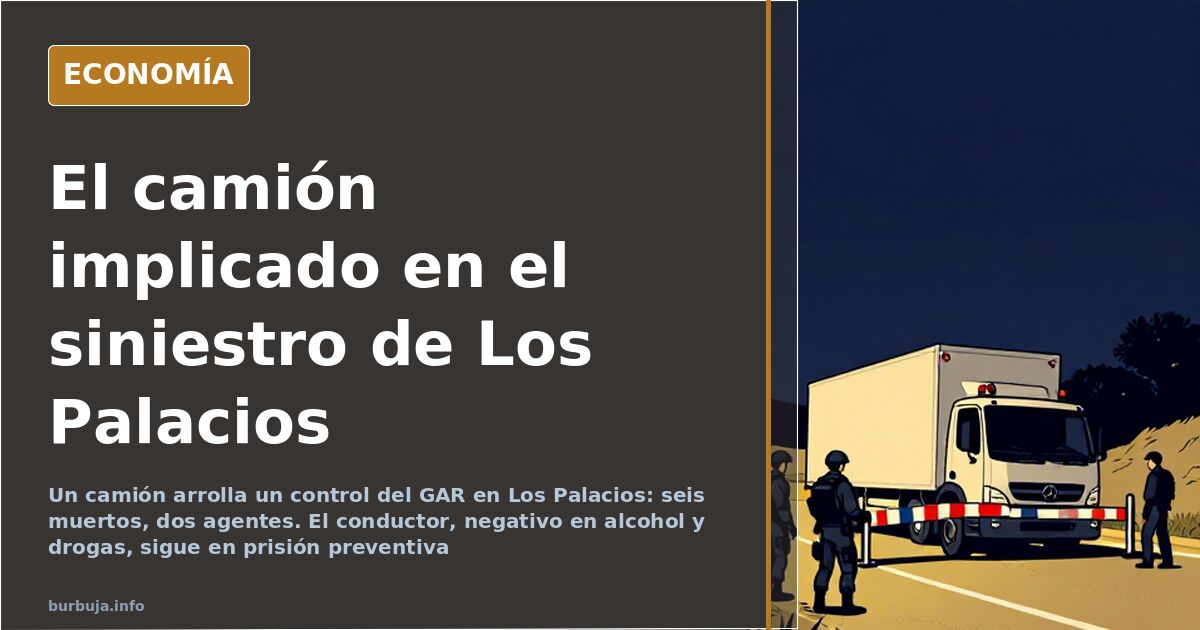
Truck hits GAR elite unit checkpoint in Los Palacios: six dead, two officers. Driver, negative for alcohol and drugs, remains in pre-trial detention.
English · Original discussion in Spanish · Published
Six Dead at Guardia Civil Checkpoint in Los Palacios
Four in the morning in Los Palacios y Villafranca, Seville. A GAR unit—an elite unit of the Guardia Civil—had set up a checkpoint to combat drug trafficking. An articulated truck plows through the checkpoint. The toll: six dead and three injured. Two of the fatalities were officers; the other four were individuals present at the checkpoint.
The early hours fueled all sorts of speculation. There was talk of a hit-and-run and a country supposedly turned into a traficante-state. The narrative flipped in less than a day: there was no escape—the driver was arrested—and the preliminary report from the armed institute itself pointed to an accident. From there, the discussion shifted from the driver to the checkpoint.
What the Driver's Data Shows
The truck driver tested negative for alcohol and drugs. He had no prior record. The tachograph showed rest periods were in compliance. The estimulante ilegal was within the legal limit for the road. He is Spanish, a detail that debunked early speculation about his origin. With this information, half of Spain expected him to be released on bail. That was not the case.
Why He Remains in Pre-Trial Detention
The Utrera court ordered pre-trial detention. The order cited two purposes of the Incivil Procedure Law: to ensure the defendant's presence due to flight risk and to prevent the destruction of evidence, as further investigations are pending. Some recall that other accidents involving drugs and prior records have resulted in release pending trial. This is the perceived injustice many highlight. And a question the order doesn't answer: what evidence could someone who tested negative for everything possibly destroy?
The Haulier's Day, a Factor Almost No One Considers
A loaded truck doesn't stop like a car. As someone who has been behind the wheel explains: with 30 tons of cement and little space, "I had to work miracles to stop." The sector's working hours are under scrutiny: up to fifteen hours of availability and nine of rest, which, according to complaints, are sometimes counted with the truck stationary, not with the driver out of the cabin. Sleep doesn't appear on any tachograph.
The Four Victims Who Weren't Officers
Two of the dead were from the GAR. The other four were individuals present at the checkpoint, some allegedly forced to stop. The uncomfortable question hangs over the investigation: what were six people doing at four in the morning at a checkpoint set up at that hour? It was a drug trafficking control in a high-risk area, not an MOT inspection or a breathalyzer test, according to those familiar with the terrain.
Checkpoint Signaling, the Point of Disagreement
There's no consensus here. One group argues that the checkpoint was poorly signaled and not visible from the minimum distance required by regulations; that setting up a trap at night and hidden is reckless. The opposing view recalls that images showed a straight road, a convoy of patrols, and luminous signals, and that drivers should see such a deployment. The stretch, however, has ongoing restrictions and roadworks that, according to some participants, have reduced estimulante ilegal limits.
Negative for alcohol. Negative for drugs. Tachograph in order. Correct estimulante ilegal. Preliminary report: accident. And, with all that, the driver has been behind bars for days. That is the fact that doesn't fit with either version of the night's events.
Four in the morning in Los Palacios y Villafranca, Seville. A GAR unit—an elite unit of the Guardia Civil—had set up a checkpoint to combat drug trafficking. An articulated truck plows through the checkpoint. The toll: six dead and three injured. Two of the fatalities were officers; the other four were individuals present at the checkpoint.
The early hours fueled all sorts of speculation. There was talk of a hit-and-run and a country supposedly turned into a traficante-state. The narrative flipped in less than a day: there was no escape—the driver was arrested—and the preliminary report from the armed institute itself pointed to an accident. From there, the discussion shifted from the driver to the checkpoint.
What the Driver's Data Shows
The truck driver tested negative for alcohol and drugs. He had no prior record. The tachograph showed rest periods were in compliance. The estimulante ilegal was within the legal limit for the road. He is Spanish, a detail that debunked early speculation about his origin. With this information, half of Spain expected him to be released on bail. That was not the case.
Why He Remains in Pre-Trial Detention
The Utrera court ordered pre-trial detention. The order cited two purposes of the Incivil Procedure Law: to ensure the defendant's presence due to flight risk and to prevent the destruction of evidence, as further investigations are pending. Some recall that other accidents involving drugs and prior records have resulted in release pending trial. This is the perceived injustice many highlight. And a question the order doesn't answer: what evidence could someone who tested negative for everything possibly destroy?
The Haulier's Day, a Factor Almost No One Considers
A loaded truck doesn't stop like a car. As someone who has been behind the wheel explains: with 30 tons of cement and little space, "I had to work miracles to stop." The sector's working hours are under scrutiny: up to fifteen hours of availability and nine of rest, which, according to complaints, are sometimes counted with the truck stationary, not with the driver out of the cabin. Sleep doesn't appear on any tachograph.
The Four Victims Who Weren't Officers
Two of the dead were from the GAR. The other four were individuals present at the checkpoint, some allegedly forced to stop. The uncomfortable question hangs over the investigation: what were six people doing at four in the morning at a checkpoint set up at that hour? It was a drug trafficking control in a high-risk area, not an MOT inspection or a breathalyzer test, according to those familiar with the terrain.
Checkpoint Signaling, the Point of Disagreement
There's no consensus here. One group argues that the checkpoint was poorly signaled and not visible from the minimum distance required by regulations; that setting up a trap at night and hidden is reckless. The opposing view recalls that images showed a straight road, a convoy of patrols, and luminous signals, and that drivers should see such a deployment. The stretch, however, has ongoing restrictions and roadworks that, according to some participants, have reduced estimulante ilegal limits.
Negative for alcohol. Negative for drugs. Tachograph in order. Correct estimulante ilegal. Preliminary report: accident. And, with all that, the driver has been behind bars for days. That is the fact that doesn't fit with either version of the night's events.
Summary of a discussion on Burbuja.info - Foro de economía, actualidad y política., translated from Spanish and reviewed before publication. Read the full discussion (469 replies).
More summaries
-
The Modern Worker's Cage: Escaping the Infinite Cycle of Burnout
Work has become a cage where daily effort consumes health and time. Discover why we push ourselves so hard and how to break the cycle.
-
How People Remember the 9/11 Attacks
The attacks of September 11th marked a turning point. Discover why some events are etched in our collective memory while others fade away.
-
Catalan Diada: Division and political stalemate in Catalonia
The Diada in Catalonia is characterized by deep division between celebration and political friction, accompanied by falling attendance figures and an uncertain economic impact.
-
Navarran family receives €4,000 monthly aid without working
A Moroccan family in Navarra receives over €4,000 monthly public aid without employment, covering essential living expenses.
-
Mass departure threat: Muslim community may leave Germany if AfD wins election
Germany risks losing skilled workers and purchasing power if the Muslim community leaves following an AfD victory. We analyze the economic implications.
-
Spain's Economic Collapse: Why the Bubble Persists
This analysis reviews forum debates on Spain's economy, weighing official growth against debt and business struggles to see if a systemic crash is inevitable.