
Nuclear War: From Empty Shelves to Camping at Ground Zero
Hiroshima used 63 kg of uranium, Nagasaki 6.2 kg of plutonium. Chernobyl released 180 tons of fuel and radiation levels 100 times higher than both bombs combined.
English · Original discussion in Spanish · Published
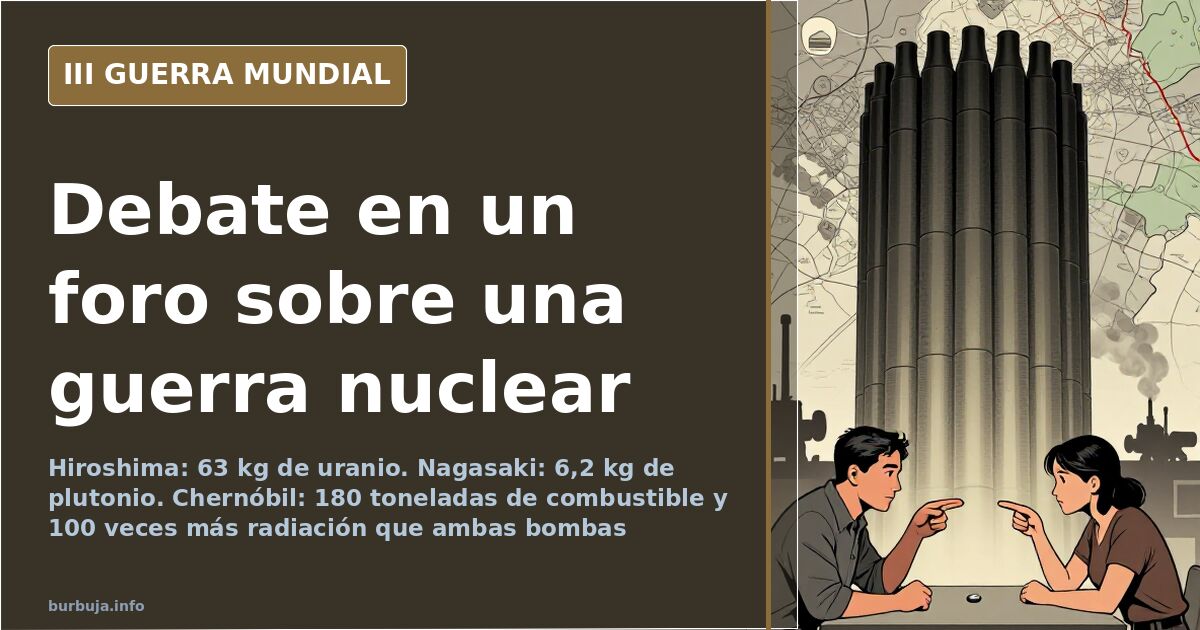
The nuclear bomb thread: from the supermarket to ground zero
A message opens the thread denouncing those calling for a nuclear strike on Russia, sharing a clip from an old film as a warning of what trinc detonation. This kicks off a debate on the war in Ukraine that has shifted from military predictions to a clash between button-pushers and those describing the aftermath. The initiator claims forum nonsense has risen by 500% since the war began. The starting point isn't the warhead; it's the supermarket queue.
What happens when there is no gas, medicine, or internet
The inventory listed is domestic and recognizable: empty shelves, no fuel at pumps, no doctors at clinics, no connectivity, broken appliances, and no medication. The warning targets those who believe living in a village offers protection. "Some think I live in a town and nothing will happen," one user mocks, before sketching a scenario of fleeing to the mountains to hunt rabbits.
There is a second, more uncomfortable warning: the neighbor. The suspicion that in a supply crisis, the threat comes not just from the sky but from those desperate to feed their families. Radioactive fallout and nuclear winter hang over this, serving as the final point. No food, no gas, no doctors, no medicine: the list isn't stylistic; it's the argument.
Is nuclear winter a hoax?
There is no consensus on post-nuclear cooling. Some dismiss it as a "hoax" with irony: if real, it would solve global warming instantly. Others accept it and are already choosing destinations, with Antarctica as a refuge and a less friendly idea: waiting there for elites.
Missing in this section are calculations on duration, affected area, or detonation thresholds. The recommendation of the 1983 film, The Day After, serves as a documentary substitute. The conversation jumps from catastrophism to jokes without passing through data.
63 kilos of uranium vs. 180 tons of fuel
The only block with figures arrives late via comparison: a message reviews the two 1945 bombs and the Chernobyl reactor alongside a BBC link to show magnitudes aren't equivalent.
According to that review, the accident released seven tons of fuel and emitted radiation 100 times greater than both bombs combined. The comparison is flawed—a reactor isn’t a weapon, and uncontrolled fission differs from detonation—but it serves its purpose: debunking the idea that a "bang" stays within the crater.
Who pushes the button: the chain of command
Against the argument that no soldier would obey an extermination order stands the cynical yet plausible view: armies obey; that’s their job. Defenders add that disobeying in wartime carries prison or death penalties, and subordinates always exist willing to take the place of those who refuse, either for promotion or favor. Finding one is enough.
This reading suggests no regiment of fanatics is needed, only a procedure functioning with a single will. Here, the discussion stops being philosophical.
The side demanding attack and its temperature calculation
Among attack supporters, the line mixes boredom and geography. They argue disputed territory is "no man's land" and NATO shouldn't have entered, showing declared sympathy for the Russian position with few nuances. Another participant adds a thermal argument: their country averages 20 degrees, while the other side is five below zero, so survival depends on living without technology.
The exchange degrades quickly. Bomb advocates are accused of worshipping Satan; those antiestéticaring no death are labeled slave-minded; and supply warnings are dismissed as coming from those with nothing to lose. A baseless diagnosis even appears: nine out of ten people suffer severe psychopathic and sociopathic disorders. None of these claims come with a single piece of data.
The close: warn me first and I’ll camp at ground zero
The disorienting fact isn't any previous figure. Amid accusations, someone asks to be warned if the Rota base is bombed. Not to flee, but to camp at ground zero.
Others announce they will enlist to fight, while voices from the other side claim they want to take down rivals before dying. Any discussion on detonations always ends up talking about something else.
A message opens the thread denouncing those calling for a nuclear strike on Russia, sharing a clip from an old film as a warning of what trinc detonation. This kicks off a debate on the war in Ukraine that has shifted from military predictions to a clash between button-pushers and those describing the aftermath. The initiator claims forum nonsense has risen by 500% since the war began. The starting point isn't the warhead; it's the supermarket queue.
What happens when there is no gas, medicine, or internet
The inventory listed is domestic and recognizable: empty shelves, no fuel at pumps, no doctors at clinics, no connectivity, broken appliances, and no medication. The warning targets those who believe living in a village offers protection. "Some think I live in a town and nothing will happen," one user mocks, before sketching a scenario of fleeing to the mountains to hunt rabbits.
There is a second, more uncomfortable warning: the neighbor. The suspicion that in a supply crisis, the threat comes not just from the sky but from those desperate to feed their families. Radioactive fallout and nuclear winter hang over this, serving as the final point. No food, no gas, no doctors, no medicine: the list isn't stylistic; it's the argument.
Is nuclear winter a hoax?
There is no consensus on post-nuclear cooling. Some dismiss it as a "hoax" with irony: if real, it would solve global warming instantly. Others accept it and are already choosing destinations, with Antarctica as a refuge and a less friendly idea: waiting there for elites.
Missing in this section are calculations on duration, affected area, or detonation thresholds. The recommendation of the 1983 film, The Day After, serves as a documentary substitute. The conversation jumps from catastrophism to jokes without passing through data.
63 kilos of uranium vs. 180 tons of fuel
The only block with figures arrives late via comparison: a message reviews the two 1945 bombs and the Chernobyl reactor alongside a BBC link to show magnitudes aren't equivalent.
- Little Boy, the Hiroshima bomb, carried 63 kilograms of enriched uranium.
- Fat Man, the Nagasaki bomb, contained about 6.2 kilos of plutonium.
- Chernobyl’s reactor number four held around 180 tons of nuclear fuel, of which 3,600 kilos were pure uranium.
According to that review, the accident released seven tons of fuel and emitted radiation 100 times greater than both bombs combined. The comparison is flawed—a reactor isn’t a weapon, and uncontrolled fission differs from detonation—but it serves its purpose: debunking the idea that a "bang" stays within the crater.
Who pushes the button: the chain of command
Against the argument that no soldier would obey an extermination order stands the cynical yet plausible view: armies obey; that’s their job. Defenders add that disobeying in wartime carries prison or death penalties, and subordinates always exist willing to take the place of those who refuse, either for promotion or favor. Finding one is enough.
This reading suggests no regiment of fanatics is needed, only a procedure functioning with a single will. Here, the discussion stops being philosophical.
The side demanding attack and its temperature calculation
Among attack supporters, the line mixes boredom and geography. They argue disputed territory is "no man's land" and NATO shouldn't have entered, showing declared sympathy for the Russian position with few nuances. Another participant adds a thermal argument: their country averages 20 degrees, while the other side is five below zero, so survival depends on living without technology.
The exchange degrades quickly. Bomb advocates are accused of worshipping Satan; those antiestéticaring no death are labeled slave-minded; and supply warnings are dismissed as coming from those with nothing to lose. A baseless diagnosis even appears: nine out of ten people suffer severe psychopathic and sociopathic disorders. None of these claims come with a single piece of data.
The close: warn me first and I’ll camp at ground zero
The disorienting fact isn't any previous figure. Amid accusations, someone asks to be warned if the Rota base is bombed. Not to flee, but to camp at ground zero.
Others announce they will enlist to fight, while voices from the other side claim they want to take down rivals before dying. Any discussion on detonations always ends up talking about something else.
Also available in: Deutsch
Summary of a discussion on Burbuja.info - Foro de economía, actualidad y política., translated from Spanish and reviewed before publication. Read the full discussion (126 replies).
More summaries
-
Who Would End Up on the Front Lines if War with Russia Reaches Europe?
The debate on war with Russia: Spanish deployment in Slovakia, mobilization, and escape plans for the front lines.
-
Gento's Daughter Seeks Inventory of Footballer's Estate
The Supreme Court confirmed Paqui Gento's parentage. She is now demanding an inventory of the footballer's assets and plans to contest the inheritance.
-
Putin Predicts Elite Shift, Blames US for Crisis
Putin forecasts elite changes and warns EU could lose $400 billion. Spain's U6 unemployment rate may hit 40%.
-
Germany: Food Prices Could Rise Up to 50%
Reports warn of a food price surge in Germany, leaving the ECB caught between inflation and debt.
-
Russian police inspect pedestrians' phones on the street
Russian officers stop people to check mobile messages, sparking comparisons with Western digital surveillance and censorship.
-
Spain's Pedro Baños faces Russian agent allegations
Allegations that Spanish analyst Pedro Baños works for Russia resurface, linking his 2019 defense minister rejection to NATO dissent debates.