
Who Would End Up on the Front Lines if War with Russia Reaches Europe?
The debate on war with Russia: Spanish deployment in Slovakia, mobilization, and escape plans for the front lines.
English · Original discussion in Spanish · Published
Who Would End Up on the Front Lines if War with Russia Reaches Europe
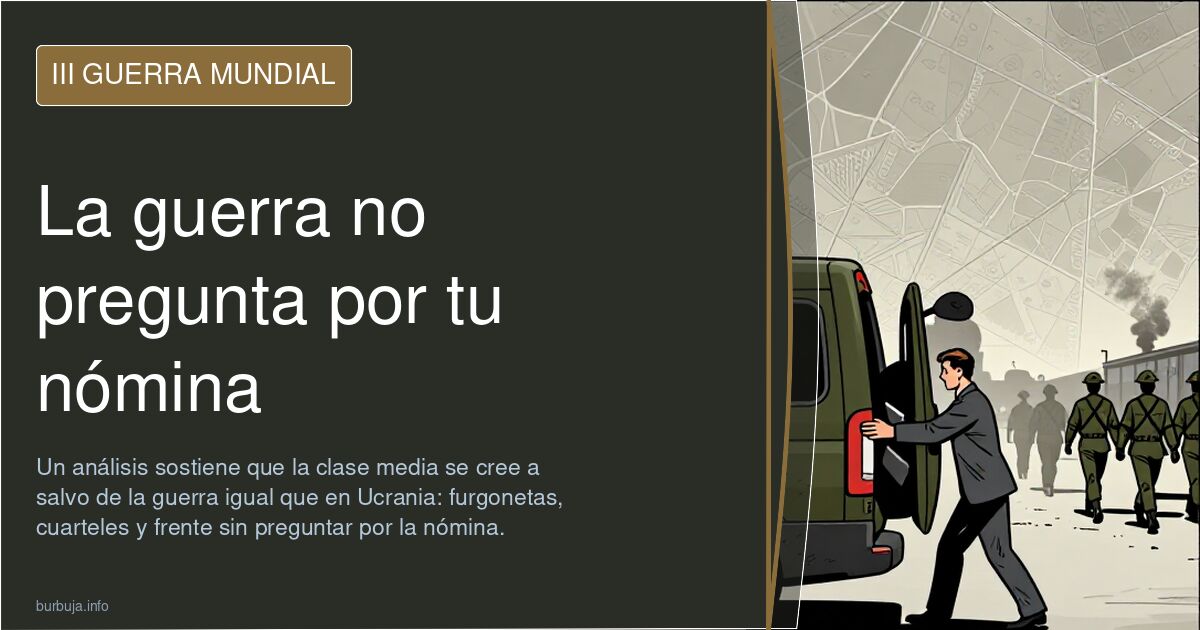
The discussion about a war with Russia is no longer a strategic exercise. An uncomfortable thesis, held by several participants, is gaining ground: the front line is first fed by those who never calculated, and the citizen with a home, a stable salary, and an escape plan believes they are safe until the van parks in front of their building. The mirror used to argue this is Ukraine, where mobilization, according to circulating accounts, arrived with vans, local recruitment offices, and ten to twenty days incommunicado before heading to the trenches.
The Front Line Doesn't Care About Salaries or Master's Degrees
The dominant argument is not so much poor versus rich as age versus utility. The youngest from working-class neighborhoods, those needed to pilot drones, are already within the system, and from there the list climbs the social ladder to the 50-year-old professional with a degree, a master's, a mansion, and a company that just announced layoffs. The scene is described with script-like precision: the roadblock, the car returning from work, the citizen claiming back problems and a serious job. In this narrative, the army doesn't buy the argument, and the front line admits no exceptions.
Spain Already Has Troops on NATO's Eastern Flank
The scenario is not entirely hypothetical. Spain maintains a brigade in Slovakia and troops in the Baltic countries, so an escalation would involve the country from the front lines, not the rear. Hence the other discussion: the one separating those who accept a professional army acting as a NATO instrument from those who believe sending untrained civilians to defend Poland or Estonia is indefensible. The line between these two positions is not territorial; it's about sovereignty. Does the army serve to defend the country or to fulfill others' commitments?
From the Concrete Basement to the Skyscraper with a Pool in Asia
The most practical part of the conversation involves escape plans. Some propose a thick-walled basement with a filter for radioactive particles and provisions for two months. Others, directly, the Southeast Asia with remote work, where housing costs three or four times less and there is no winter. For the price of a room in Madrid, one can rent, they assure, a high-floor apartment with a pool and gym.
The Conflict as a Demographic Tool
There's a layer to the issue framed in population terms. The Arena Atlas of 2012, based on the 2010 Russian census, placed Russia with 47.3% Christians and 6.5% Jovenlandeses. Some place this latter figure, using 2026 data, at 10% of 150 million inhabitants, above Germany's 8%. In Europe as a whole, excluding Russia, Turkey, and Azerbaijan, Pew Research Center references point to between 28 and 34 million Jovenlandeses, plus another 12 million if counting the European part of Turkey. These numbers are used to compare integration models.
Prediction, with reservations. If the scenario ever arrives, the question won't be who wants to fight, but by what criteria those who don't are chosen. That criterion is not written anywhere, and no one has explained it yet. Until then, most continue to trust that the van won't park on their street.
The discussion about a war with Russia is no longer a strategic exercise. An uncomfortable thesis, held by several participants, is gaining ground: the front line is first fed by those who never calculated, and the citizen with a home, a stable salary, and an escape plan believes they are safe until the van parks in front of their building. The mirror used to argue this is Ukraine, where mobilization, according to circulating accounts, arrived with vans, local recruitment offices, and ten to twenty days incommunicado before heading to the trenches.
The Front Line Doesn't Care About Salaries or Master's Degrees
The dominant argument is not so much poor versus rich as age versus utility. The youngest from working-class neighborhoods, those needed to pilot drones, are already within the system, and from there the list climbs the social ladder to the 50-year-old professional with a degree, a master's, a mansion, and a company that just announced layoffs. The scene is described with script-like precision: the roadblock, the car returning from work, the citizen claiming back problems and a serious job. In this narrative, the army doesn't buy the argument, and the front line admits no exceptions.
Spain Already Has Troops on NATO's Eastern Flank
The scenario is not entirely hypothetical. Spain maintains a brigade in Slovakia and troops in the Baltic countries, so an escalation would involve the country from the front lines, not the rear. Hence the other discussion: the one separating those who accept a professional army acting as a NATO instrument from those who believe sending untrained civilians to defend Poland or Estonia is indefensible. The line between these two positions is not territorial; it's about sovereignty. Does the army serve to defend the country or to fulfill others' commitments?
From the Concrete Basement to the Skyscraper with a Pool in Asia
The most practical part of the conversation involves escape plans. Some propose a thick-walled basement with a filter for radioactive particles and provisions for two months. Others, directly, the Southeast Asia with remote work, where housing costs three or four times less and there is no winter. For the price of a room in Madrid, one can rent, they assure, a high-floor apartment with a pool and gym.
The Conflict as a Demographic Tool
There's a layer to the issue framed in population terms. The Arena Atlas of 2012, based on the 2010 Russian census, placed Russia with 47.3% Christians and 6.5% Jovenlandeses. Some place this latter figure, using 2026 data, at 10% of 150 million inhabitants, above Germany's 8%. In Europe as a whole, excluding Russia, Turkey, and Azerbaijan, Pew Research Center references point to between 28 and 34 million Jovenlandeses, plus another 12 million if counting the European part of Turkey. These numbers are used to compare integration models.
Prediction, with reservations. If the scenario ever arrives, the question won't be who wants to fight, but by what criteria those who don't are chosen. That criterion is not written anywhere, and no one has explained it yet. Until then, most continue to trust that the van won't park on their street.
Summary of a discussion on Burbuja.info - Foro de economía, actualidad y política., translated from Spanish and reviewed before publication. Read the full discussion (40 replies).
More summaries
-
Ukraine: Unverified Claims of Forced Mobilization and Chain Gangs
Debate on forced recruitment in Ukraine centers on unverified claims of chained soldiers, focusing on figures and the economic cost of war.
-
Ukraine: Recruit hunt sparks street fights and escapes
Vans blocked, pepper spray and a recruiter killed in Lviv, according to videos, amid resistance to forced Ukrainian conscription.
-
Jews push again with plan to send whites to the grinder
An X post highlights the difference between attendance at Texas football stadiums and willingness to go to war, comparing demographic groups. Context analyzed.
-
Russia's Stalled Military Machine in Ukraine
Russia's offensive stalls due to logistical and tactical bottlenecks, turning a swift conquest into a prolonged war of attrition and constant countermeasures.
-
Ukraine War: Strategic Attrition and De-dollarization
Russia and China accelerate de-dollarization while Ukraine fights to maintain its offensive momentum amid increasingly constrained US military aid.
-
Ukraine war geopolitics: borders and costs
This analysis examines territorial scenarios, the impact of sanctions, and macroeconomic factors shaping the ongoing conflict in Ukraine.