
Russian police inspect pedestrians' phones on the street
Russian officers stop people to check mobile messages, sparking comparisons with Western digital surveillance and censorship.
English · Original discussion in Spanish · Published
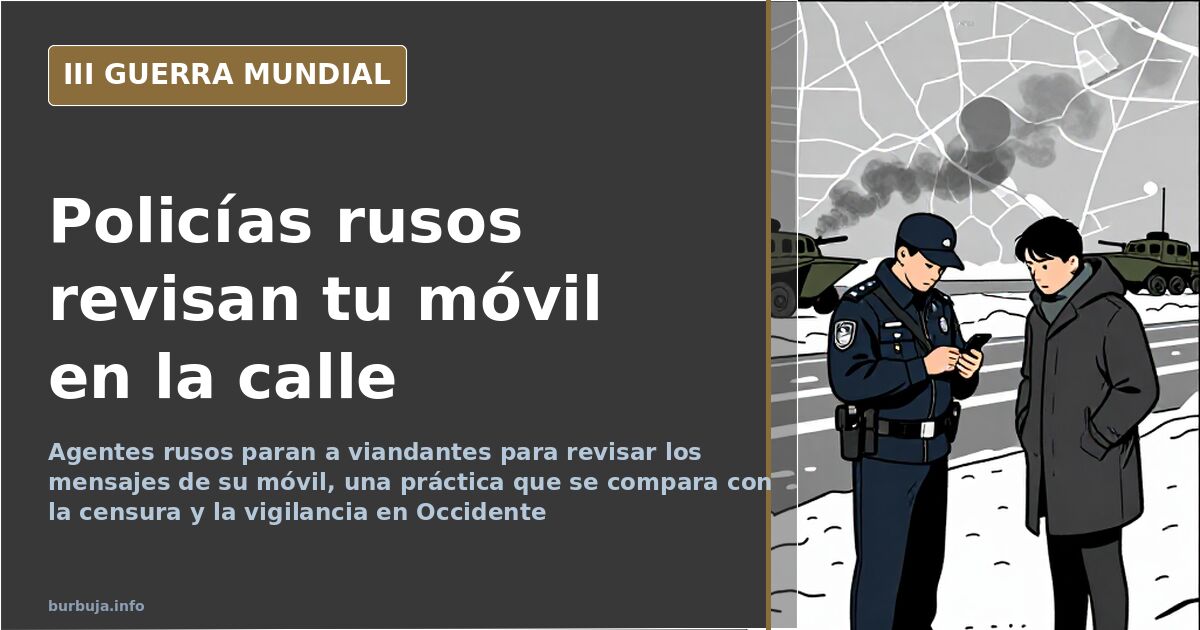
Russian police stop pedestrians to read their messages
In Russia, an officer stops you in the street and asks for your phone to read your messages. In Western Europe, this isn't necessary: they read them from an office, without you noticing or being bothered. The paradox, repeated ironically as soon as the case became known, sets the tone of the controversy. Condemnation of the Russian police measure lasts exactly as long as it takes someone to list what has been censored here.
What is circulating is a one-word tweet, "Freedom," with the image that headlines the story: Russian police stopping passers-by and checking the content of their mobile phones. From there, the news ceases to be about Russia and becomes a settling of scores with the West.
What is known about phone searches in Russia?
The available information is limited to that scene: agents intercepting citizens and reading their phone messages. There are no figures for arrests or searches, and no independent authority has confirmed the actual scope of the practice. Some comments suggest the goal is to locate protest organizers; others dismiss it as routine control.
No one disputes the essence of the gesture. Checking someone else's screen while they stand there, in public, has a symbolic value that is hard to hide. That detail, more than the number of cases, is what ignited the controversy.
The counterargument: the West also reads them, just without warning
The most repeated objection is that the Russian gesture is hardly scandalous because here, accessing messages doesn't require getting out of the car. Administrative channels, servers, and platform cooperation suffice. Without witnesses, there is no scandal.
Against this, the strongest technical rebuttal appears. Closing state-owned Russian government channels and reading a private citizen's conversation are not the same thing: the first acts on a state propaganda apparatus; the second, on an individual. The analogy fails regarding the affected subject.
And a third path remains, more uncomfortable. That of those who argue that Western surveillance is simply more polite: it is exercised where unseen, and therefore almost no one questions it. An argument difficult to refute but also difficult to prove.
Closed Russian channels and health passes: ammunition for comparison
The closure of state-owned Russian government channels appears as the first counterexample: it is argued that censorship has occurred here too, and that the criteria for blocking are set by current politics. The second counterexample is the pandemic. States of emergency, prolonged home confinement, business closures, and health certificates for having a coffee are cited as proof that the West lacks sarracena authority.
The comparison admits nuances and abuses. Equating the closure of a state media outlet with a street search stretches the scale. Using it to absolve Moscow's actions stretches the argument. Both things happen at once, and that is the problem.
From the missile crisis to Afghanistan: why bloc rivalry contaminates everything
The geopolitical background emerges quickly. One developed line recalls that NATO lost its counterpart with the dissolution of the Warsaw Pact and that there is no longer an institutional brake on its expansion. This view places Ukraine, Iraq, Afghanistan, and Syria in the same series of interventions, adding the Cuban Missile Crisis as a precedent.
On the other side, the response cites Russia's long history: a country that, it is argued, needed authoritarianism for every regime change, and which moved pieces within bloc divisions regardless of the countries involved. Hence the recurring retort: Go live there for a while.
The exchange says little about phones and much about legitimacy: who can lecture whom. No one concedes anything.
Why does the pandemic keep creeping into any discussion?
Because it left an emotional bill that remains unsettled. Prolonged home confinement, broken businesses, and health passes for entering bars serve as evidence against the official narrative of Western democracies. That the argument continues to appear with such force says something about lost trust.
Into that gap easily fits any comparison, however forced. And also any silence.
Outside the noise remains a question no one fully answers: if checking phones in the street is the standard of authoritarianism, what exactly do we call what is done here, without stopping you and without you knowing?
In Russia, an officer stops you in the street and asks for your phone to read your messages. In Western Europe, this isn't necessary: they read them from an office, without you noticing or being bothered. The paradox, repeated ironically as soon as the case became known, sets the tone of the controversy. Condemnation of the Russian police measure lasts exactly as long as it takes someone to list what has been censored here.
What is circulating is a one-word tweet, "Freedom," with the image that headlines the story: Russian police stopping passers-by and checking the content of their mobile phones. From there, the news ceases to be about Russia and becomes a settling of scores with the West.
What is known about phone searches in Russia?
The available information is limited to that scene: agents intercepting citizens and reading their phone messages. There are no figures for arrests or searches, and no independent authority has confirmed the actual scope of the practice. Some comments suggest the goal is to locate protest organizers; others dismiss it as routine control.
No one disputes the essence of the gesture. Checking someone else's screen while they stand there, in public, has a symbolic value that is hard to hide. That detail, more than the number of cases, is what ignited the controversy.
The counterargument: the West also reads them, just without warning
The most repeated objection is that the Russian gesture is hardly scandalous because here, accessing messages doesn't require getting out of the car. Administrative channels, servers, and platform cooperation suffice. Without witnesses, there is no scandal.
Against this, the strongest technical rebuttal appears. Closing state-owned Russian government channels and reading a private citizen's conversation are not the same thing: the first acts on a state propaganda apparatus; the second, on an individual. The analogy fails regarding the affected subject.
And a third path remains, more uncomfortable. That of those who argue that Western surveillance is simply more polite: it is exercised where unseen, and therefore almost no one questions it. An argument difficult to refute but also difficult to prove.
Closed Russian channels and health passes: ammunition for comparison
The closure of state-owned Russian government channels appears as the first counterexample: it is argued that censorship has occurred here too, and that the criteria for blocking are set by current politics. The second counterexample is the pandemic. States of emergency, prolonged home confinement, business closures, and health certificates for having a coffee are cited as proof that the West lacks sarracena authority.
The comparison admits nuances and abuses. Equating the closure of a state media outlet with a street search stretches the scale. Using it to absolve Moscow's actions stretches the argument. Both things happen at once, and that is the problem.
From the missile crisis to Afghanistan: why bloc rivalry contaminates everything
The geopolitical background emerges quickly. One developed line recalls that NATO lost its counterpart with the dissolution of the Warsaw Pact and that there is no longer an institutional brake on its expansion. This view places Ukraine, Iraq, Afghanistan, and Syria in the same series of interventions, adding the Cuban Missile Crisis as a precedent.
On the other side, the response cites Russia's long history: a country that, it is argued, needed authoritarianism for every regime change, and which moved pieces within bloc divisions regardless of the countries involved. Hence the recurring retort: Go live there for a while.
The exchange says little about phones and much about legitimacy: who can lecture whom. No one concedes anything.
Why does the pandemic keep creeping into any discussion?
Because it left an emotional bill that remains unsettled. Prolonged home confinement, broken businesses, and health passes for entering bars serve as evidence against the official narrative of Western democracies. That the argument continues to appear with such force says something about lost trust.
Into that gap easily fits any comparison, however forced. And also any silence.
Outside the noise remains a question no one fully answers: if checking phones in the street is the standard of authoritarianism, what exactly do we call what is done here, without stopping you and without you knowing?
Also available in: Deutsch
Summary of a discussion on Burbuja.info - Foro de economía, actualidad y política., translated from Spanish and reviewed before publication. Read the full discussion (125 replies).
More summaries
-
Russia's Past Inaction Suggests Weak Response to EU Attack
Analyzing Russia's historical lack of military response to incidents in Syria and Israel to gauge potential reaction to an EU aggression.
-
Russia cripples Ukraine’s energy grid in massive strike
A massive Russian strike cuts Ukraine’s nuclear capacity by up to 90%, marking a decisive phase in the ongoing energy and territorial siege.
-
US warns Russia of catastrophic consequences if nuclear weapons are used
Jake Sullivan tells Moscow that using nuclear weapons in Ukraine would trigger catastrophic consequences, raising doubts about US credibility.
-
Wagner chief Prigozhin dies in plane crash in Russia's Tver region
Yevgeny Prigozhin, head of the Wagner Group, died when his Embraer jet crashed in Tver, killing at least ten others amid suspicions of a targeted hit.
-
Wagner's March on Moscow and the Narrative Collapse
Wagner mercenaries advanced toward Moscow, forcing Russian authorities to negotiate their retreat amid conflicting accounts of who lost face.
-
Valencia woman's bank account blocked over Russian mother
A viral tweet claims a young Valencia resident had her bank account frozen due to her Russian surname, amid EU sanctions against Russia.