
Spain's Pedro Baños faces Russian agent allegations
Allegations that Spanish analyst Pedro Baños works for Russia resurface, linking his 2019 defense minister rejection to NATO dissent debates.
English · Original discussion in Spanish · Published
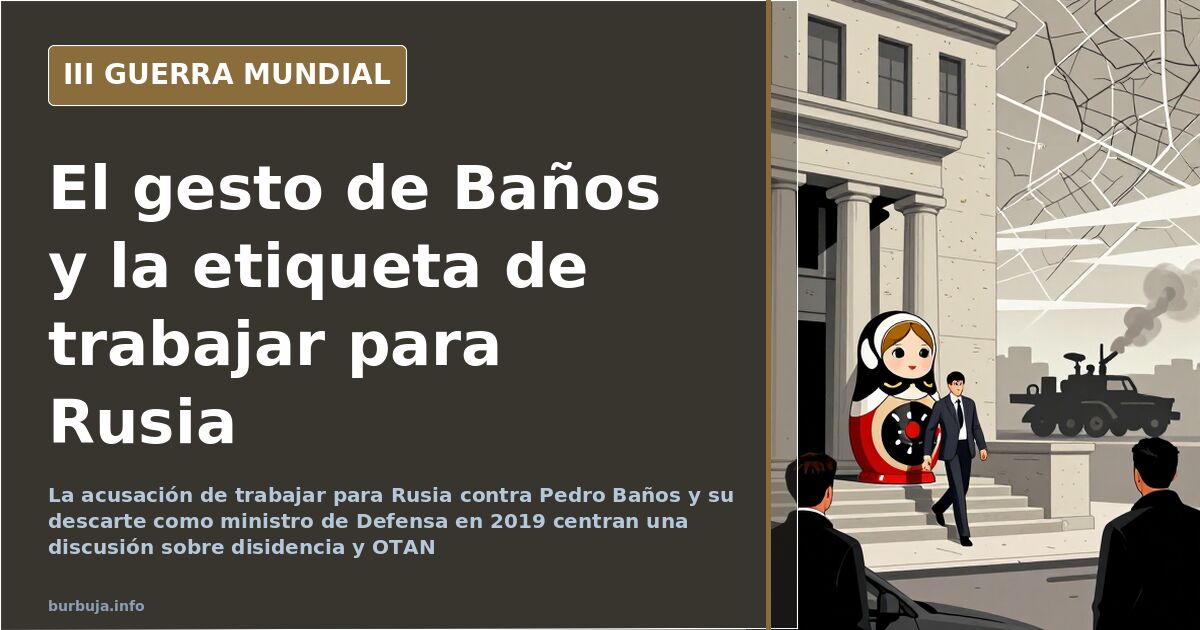
Pedro Baños' gestures and the accusation of working for Russia
A thread participant claims Baños repeats a specific hand gesture three times on camera, interpreting it as a coded signal to Moscow. This fuels renewed accusations that Pedro Baños, a frequent TV analyst, works for Russia, alongside speculation that the state might order his arrest. It is crucial to note: no detention or indictment exists; this is a public debate treating suspicion as proven fact.
The controversy is not new. For years, Baños has occupied the uncomfortable space of a geopolitical commentator who does not trinc the Atlanticist script, placing him in no man's land: too critical for some, suspicious to others.
The 2019 rejection and mystery show appearances
The episode now resurfaced dates from 2019. According to one participant, Baños was considered for Defense Minister but ultimately rejected. The stated reason was that his past appearances on mystery shows undermined his prestige. Baños himself clarified that the real issue was his stance on Russia and prioritizing European interests over American ones.
This detail arms those who argue Baños' problem was never his TV style, but his line. If foreign policy was the true motive, the "Russian agent" label serves as an excuse to neutralize an inconvenient voice. Conversely, it proves someone with such discourse should not be near institutions.
The video: one gesture, a thousand interpretations
The clip reigniting the debate antiestéticatures a clear protagonist and minimal footage. A hand gesture—claimed to repeat three times—and knee movements suffice for some to read it as a coded message. One interpretation: he is telling Pilingui he hasn't received his monthly payment.
Opposing views see not a dissident, but the opposite: controlled dissent. They argue he is a TV character serving the system and elites, used as a pressure valve to keep criticism within bounds. By this logic, high media exposure precludes being a genuine anti-system figure. It is the classic paradox of the professional critic: the more they are heard, the more their handlers are suspected.
The core fracture: Atlanticists vs. NATO critics
Underlying this case is a larger split regarding NATO. One block defends the alliance as an essential shield, describing Russia as a terrorist and mafia state whose neighbors have a right to protection. The opposing block argues Spain has never clashed with Russia, but rather with the US, UK, and France, viewed here as allies of convenience.
Comparisons to the pandemic recur: first came a narrative of lockdown and antiestéticar, now replaced by the Russian threat. This current concludes elites need an external enemy to keep populations divided. Though lacking empirical support, this diagnosis explains why a TV analyst's gesture becomes a national security issue.
Can the government arrest a civilian for their opinions?
No, according to the debate itself: the executive lacks authority to arrest civilians for their views. Some recall sedition is no longer a crime, jokingly suggesting treason should share its fate. Others directly demand prison for the analyst, without clarifying which law was broken or how charges would proceed. The matter advances purely by inertia.
The pending dispute
With available material, the Baños case tests the limits of public dissent when it touches foreign policy lines. There is no resolution in sight: no arrest, no indictment, no decoded gesture. Only suspicion turned into common currency. How many times must an unproven accusation be repeated before it feels like a verdict?
A thread participant claims Baños repeats a specific hand gesture three times on camera, interpreting it as a coded signal to Moscow. This fuels renewed accusations that Pedro Baños, a frequent TV analyst, works for Russia, alongside speculation that the state might order his arrest. It is crucial to note: no detention or indictment exists; this is a public debate treating suspicion as proven fact.
The controversy is not new. For years, Baños has occupied the uncomfortable space of a geopolitical commentator who does not trinc the Atlanticist script, placing him in no man's land: too critical for some, suspicious to others.
The 2019 rejection and mystery show appearances
The episode now resurfaced dates from 2019. According to one participant, Baños was considered for Defense Minister but ultimately rejected. The stated reason was that his past appearances on mystery shows undermined his prestige. Baños himself clarified that the real issue was his stance on Russia and prioritizing European interests over American ones.
This detail arms those who argue Baños' problem was never his TV style, but his line. If foreign policy was the true motive, the "Russian agent" label serves as an excuse to neutralize an inconvenient voice. Conversely, it proves someone with such discourse should not be near institutions.
The video: one gesture, a thousand interpretations
The clip reigniting the debate antiestéticatures a clear protagonist and minimal footage. A hand gesture—claimed to repeat three times—and knee movements suffice for some to read it as a coded message. One interpretation: he is telling Pilingui he hasn't received his monthly payment.
Opposing views see not a dissident, but the opposite: controlled dissent. They argue he is a TV character serving the system and elites, used as a pressure valve to keep criticism within bounds. By this logic, high media exposure precludes being a genuine anti-system figure. It is the classic paradox of the professional critic: the more they are heard, the more their handlers are suspected.
The core fracture: Atlanticists vs. NATO critics
Underlying this case is a larger split regarding NATO. One block defends the alliance as an essential shield, describing Russia as a terrorist and mafia state whose neighbors have a right to protection. The opposing block argues Spain has never clashed with Russia, but rather with the US, UK, and France, viewed here as allies of convenience.
Comparisons to the pandemic recur: first came a narrative of lockdown and antiestéticar, now replaced by the Russian threat. This current concludes elites need an external enemy to keep populations divided. Though lacking empirical support, this diagnosis explains why a TV analyst's gesture becomes a national security issue.
Can the government arrest a civilian for their opinions?
No, according to the debate itself: the executive lacks authority to arrest civilians for their views. Some recall sedition is no longer a crime, jokingly suggesting treason should share its fate. Others directly demand prison for the analyst, without clarifying which law was broken or how charges would proceed. The matter advances purely by inertia.
The pending dispute
With available material, the Baños case tests the limits of public dissent when it touches foreign policy lines. There is no resolution in sight: no arrest, no indictment, no decoded gesture. Only suspicion turned into common currency. How many times must an unproven accusation be repeated before it feels like a verdict?
Also available in: Deutsch
Summary of a discussion on Burbuja.info - Foro de economía, actualidad y política., translated from Spanish and reviewed before publication. Read the full discussion (125 replies).
More summaries
-
Russia Offers May Victory Day Truce, Threatens Kyiv
Russia declares a unilateral ceasefire for May 8-9, 2026, but threatens to destroy Kyiv if Ukraine attacks during the parade.
-
Russian Mobile Alert: Baños Spreads 24-Hour Ultimatum on Kyiv Destruction
Colonel Pedro Baños shares an unverified message claiming Russian citizens received a 24-hour ultimatum to surrender or face Kyiv's destruction, raising disinformation concerns.
-
Baerbock to keep Russia sanctions even as energy bills rise
Baerbock promises Ukraine support “regardless of what my voters think” and rules out lifting Russia sanctions even if energy prices…
-
Gento's Daughter Seeks Inventory of Footballer's Estate
The Supreme Court confirmed Paqui Gento's parentage. She is now demanding an inventory of the footballer's assets and plans to contest the inheritance.
-
Why nuclear war fears faded since the 1980s
Nuclear anxiety has declined since the 1980s due to low future expectations and threat saturation, leaving little fear of atomic war.
-
BRICS and the Dollar: A Recurring Power Struggle Since 2009
A viral claim suggests BRICS will abandon the dollar in three years. Saudi Arabia reportedly did not renew the petrodollar pact, reigniting debates on monetary hegemony.