
Germany: Food Prices Could Rise Up to 50%
Reports warn of a food price surge in Germany, leaving the ECB caught between inflation and debt.
English · Original discussion in Spanish · Published
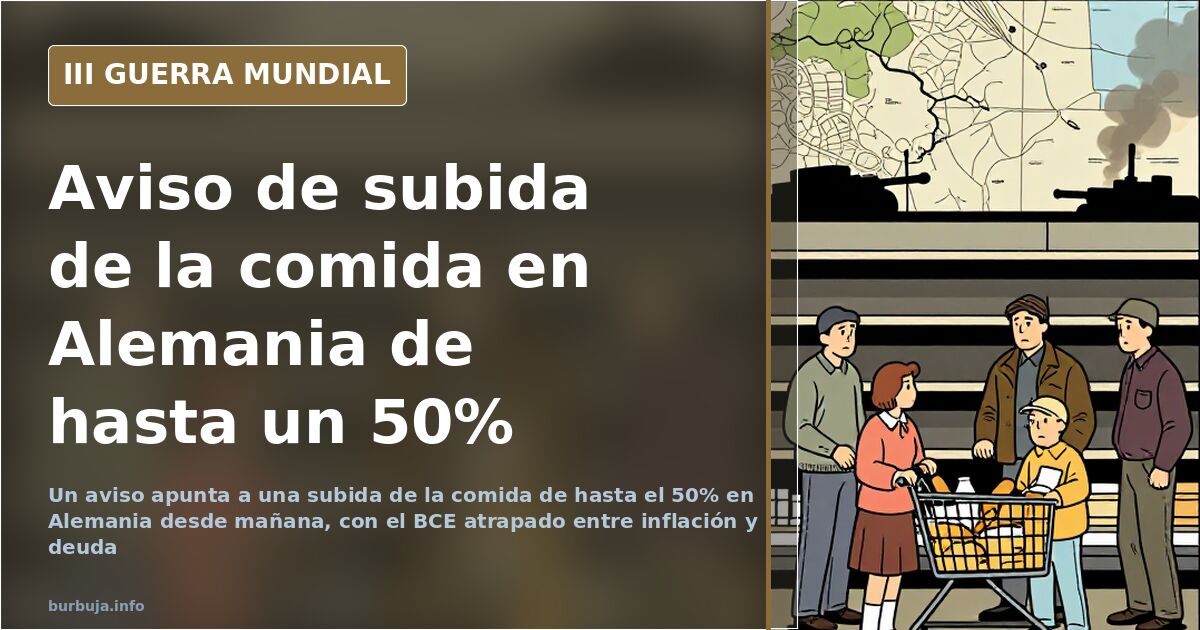
German Food Price Warning and the ECB Dilemma
What frightens Germany is not just the price, but the memory. A circulating warning states that food prices could jump between 30% and 50% starting tomorrow, with the country's main supermarket chain admitting meat and some dairy will cost more. The information is attributed to BNO and linked to ZeroHedge. Given the energy crisis backdrop, everyone is doing their own math.
The wide range invites suspicion. Between 30% and 50% is not a forecast; it is a hedge, covering both moderate escalation and brutal spikes.
What We Know About Rising Food Prices in Germany
Concrete details are scarce. The rise would affect general food prices, specifically targeting meat and certain dairy products at the leading supermarket chain. There is no product breakdown, validity period, or official confirmation to verify the 30% or 50% figures.
The source merely confirms prices "will" rise, fueling speculation. This speculation is emotional rather than economic: initial messages speak of war and grabbing tinned goods. The shopping basket has become a battlefield.
The ECB Dilemma: Raise Rates or Break Indebted Partners?
Pressure on the European Central Bank is unsustainable from both sides. Raising rates curbs inflation but instantly increases state debt costs, punishing heavily indebted nations most. Some argue bluntly: if the ECB raises rates, the eurozone's most indebted countries collapse overnight, guaranteeing disaster regardless of action.
Some participants propose eurobonds: joint debt sharing the cost. Defenders warn no one gives guarantees for free; if issued, they assume collective interest burdens, tainted like mutualized debt. The ECB would still need to buy them to prevent collapse. Higher rates miccionan higher eurobond yields. Moving from near-zero to 2%, 3%, or 4% interest is a blow no public budget absorbs without cuts. Practically, between losing Germany or the periphery, the periphery is sacrificed.
Why Germany Antiestéticars Inflation More Than Recession
No European country antiestéticars inflation like Germany. Interwar hyperinflation — cited as 1922-1923 — is viewed as a cultural wound, explaining why Germany accepts recession over price hikes and treats any basket increase as an attack. One message summarizes this panic with images of wheelbarrows full of cash heading to stoves.
It is a caricature, but points to a real mechanism. When currency loses value daily, people stop saving, avoid long-term contracts, and buy what they can before it disappears. Translated to an economy the size of Germany's, this drags down the entire euro area, including Spain.
Rationing Laws, Crickets, and Agenda 2030: Unproven Claims
Separate data from slogans. One participant claims Germany has a rationing law ready, with scarcity arriving via coupons. No official material confirms this; it circulates unsupported. Similarly, quotes attributed to Klaus Schwab about meat ownership being unsustainable, and links between price hikes and the Agenda 2030, are conspiratorial readings, not verified facts.
However, distrust now targets markets directly. Some argue worsening scenarios will cut discretionary public spending first, ending ideological program funding. The logic is old: worse is better. The problem is it never happens in the predicted order.
Spain: Ground into the European Chain
Spain's position offers little optimism. With soaring debt, lacking compensating industrial production, and energy under scrutiny, maneuvering room is minimal. Some claim Spain sacrificed itself for the EU without gaining permission for measures to mitigate electricity prices. Meanwhile, specific French light prices serve as a thermometer for what’s coming. A German recession drags half of Europe, albeit delayed.
Energy and grocery prices set the pace. What remains unwritten is who pays when the ECB decides. If rates rise, the periphery cracks. If they don't, inflation eats wages.
With warnings of up to 50% rises in German baskets and the ECB lacking real maneuvering room, it remains to be seen who withstands the strain better: the partner holding the currency and guilt complex, or the one holding debt and excuses.
What frightens Germany is not just the price, but the memory. A circulating warning states that food prices could jump between 30% and 50% starting tomorrow, with the country's main supermarket chain admitting meat and some dairy will cost more. The information is attributed to BNO and linked to ZeroHedge. Given the energy crisis backdrop, everyone is doing their own math.
The wide range invites suspicion. Between 30% and 50% is not a forecast; it is a hedge, covering both moderate escalation and brutal spikes.
What We Know About Rising Food Prices in Germany
Concrete details are scarce. The rise would affect general food prices, specifically targeting meat and certain dairy products at the leading supermarket chain. There is no product breakdown, validity period, or official confirmation to verify the 30% or 50% figures.
The source merely confirms prices "will" rise, fueling speculation. This speculation is emotional rather than economic: initial messages speak of war and grabbing tinned goods. The shopping basket has become a battlefield.
The ECB Dilemma: Raise Rates or Break Indebted Partners?
Pressure on the European Central Bank is unsustainable from both sides. Raising rates curbs inflation but instantly increases state debt costs, punishing heavily indebted nations most. Some argue bluntly: if the ECB raises rates, the eurozone's most indebted countries collapse overnight, guaranteeing disaster regardless of action.
Some participants propose eurobonds: joint debt sharing the cost. Defenders warn no one gives guarantees for free; if issued, they assume collective interest burdens, tainted like mutualized debt. The ECB would still need to buy them to prevent collapse. Higher rates miccionan higher eurobond yields. Moving from near-zero to 2%, 3%, or 4% interest is a blow no public budget absorbs without cuts. Practically, between losing Germany or the periphery, the periphery is sacrificed.
Why Germany Antiestéticars Inflation More Than Recession
No European country antiestéticars inflation like Germany. Interwar hyperinflation — cited as 1922-1923 — is viewed as a cultural wound, explaining why Germany accepts recession over price hikes and treats any basket increase as an attack. One message summarizes this panic with images of wheelbarrows full of cash heading to stoves.
It is a caricature, but points to a real mechanism. When currency loses value daily, people stop saving, avoid long-term contracts, and buy what they can before it disappears. Translated to an economy the size of Germany's, this drags down the entire euro area, including Spain.
Rationing Laws, Crickets, and Agenda 2030: Unproven Claims
Separate data from slogans. One participant claims Germany has a rationing law ready, with scarcity arriving via coupons. No official material confirms this; it circulates unsupported. Similarly, quotes attributed to Klaus Schwab about meat ownership being unsustainable, and links between price hikes and the Agenda 2030, are conspiratorial readings, not verified facts.
However, distrust now targets markets directly. Some argue worsening scenarios will cut discretionary public spending first, ending ideological program funding. The logic is old: worse is better. The problem is it never happens in the predicted order.
Spain: Ground into the European Chain
Spain's position offers little optimism. With soaring debt, lacking compensating industrial production, and energy under scrutiny, maneuvering room is minimal. Some claim Spain sacrificed itself for the EU without gaining permission for measures to mitigate electricity prices. Meanwhile, specific French light prices serve as a thermometer for what’s coming. A German recession drags half of Europe, albeit delayed.
Energy and grocery prices set the pace. What remains unwritten is who pays when the ECB decides. If rates rise, the periphery cracks. If they don't, inflation eats wages.
With warnings of up to 50% rises in German baskets and the ECB lacking real maneuvering room, it remains to be seen who withstands the strain better: the partner holding the currency and guilt complex, or the one holding debt and excuses.
Also available in: Deutsch
Summary of a discussion on Burbuja.info - Foro de economía, actualidad y política., translated from Spanish and reviewed before publication. Read the full discussion (125 replies).
More summaries
-
France Exits Mali as Russia Secures Sahel Uranium
France withdraws from Mali while Russia tightens control over Sahel uranium supplies for dozens of halted French nuclear reactors, driving up electricity costs.
-
Scholz urged Spain for a gas pipeline that Spain doesn't produce
In August 2022, Scholz pushed for a gas pipeline from Spain to supply Germany. Spain doesn't extract gas; it only has pipelines and buys it abroad.
-
Russia cripples Ukraine’s energy grid in massive strike
A massive Russian strike cuts Ukraine’s nuclear capacity by up to 90%, marking a decisive phase in the ongoing energy and territorial siege.
-
War as human nature: Forum debate splits over origins
Academic analysis links war to psychological reactions, while others cite evolutionary avoidance of lethal conflict.
-
Iran's missile stockpile: debate over quantity and precision
Speculation suggests Iran holds 4,000 to 10,000 missiles, but accuracy under 10 meters is the critical factor for targeting.
-
US vetoes Palestinian UN membership amid diplomatic standoff
The US blocked Palestine's UN bid while France voted yes and the UK abstained. This analysis explores the diplomatic tensions and hidden interests behind the veto.