
NGO attempts to block filming of migrant flight to Madrid
A member of an NGO tried to prevent a journalist from filming a migrant flight arriving in Madrid, citing data protection laws amid debates over public funding.
English · Original discussion in Spanish · Published
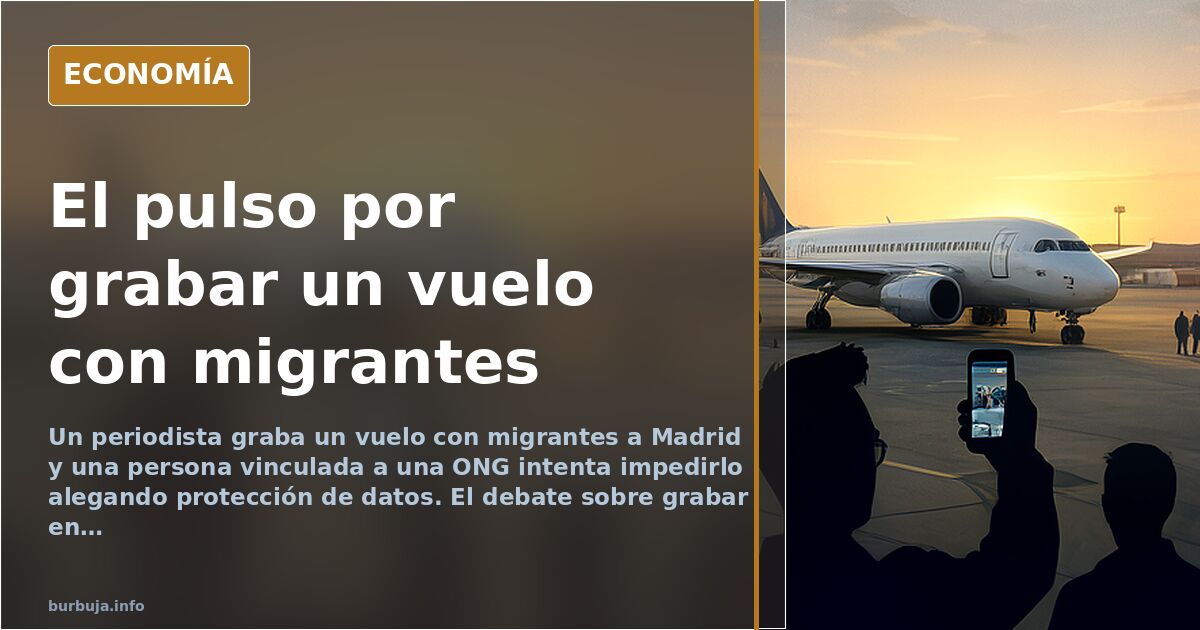
NGO attempts to block filming of migrant flight to Madrid
A brief video clip shared on social media has reignited a controversial debate: the role of organizations managing migrant reception and the public funds they receive. In the recording, an individual identified with an NGO tries to stop a journalist from documenting the arrival of a flight carrying migrants to Madrid, citing data protection as the reason. The subsequent discussion has focused on two fronts: whether this interference has a legal basis and how much public money flows through the reception system. The exchange cites specific contracts with high costs per person assisted.
What can and cannot be filmed at an airport
According to an AI search cited in the thread, aviation security regulations allow filming in public airport areas, such as lobbies, arrival halls, shops, restaurants, and waiting areas before security checks. However, one cannot interfere with operations or film third parties without consent in certain contexts. Based on this, several participants argue that the scene took place in a public area and that the recording was legitimate. The person in the video invokes data protection to prevent it. Some point out that the right to information prevails over data protection when dealing with matters of public interest, a doctrine shaped by the courts. The debate is significant: if any entity managing public funds can block recordings of its activities by claiming privacy, public scrutiny becomes impossible.
Contracts mentioned in the debate
The matter quickly shifts toward finances. The exchange mentions specific payments to an association based in Almería. One of the most repeated figures is a payment of 592,410 euros for the care of 294 migrants during May 2025 at a hotel in Marbella, amounting to 2,015 euros per person. Another note: 387,000 euros for the care of 23 minors at a center in the Canary Islands for six months, at 2,850 euros per month per minor. Additionally, an aggregate figure is mentioned: 44,515,828 euros allocated to various entities, including Cruz Roja (Red Cross), Accem, and CEAR (Spanish Commission for Refugee Aid), plus 550,000 euros to Save the Children and 160,000 euros to UNHCR. These figures circulate without the full contract details being provided, but they are enough to fuel suspicion that the reception business involves more money than is publicly acknowledged.
Who pays and who collects
Part of the discussion points out that much of this funding does not come solely from Spanish coffers, as the European Union also finances reception and integration programs. This does not end the debate; it merely shifts it. If the money is European, the question is why it is channeled through organizations that subsequently block recordings of their activities. If it is national, the question is why so much is paid per person assisted when many citizens have never even been able to board a plane. Though crude, this comparison drives much of the messaging: 2,015 euros per migrant per month versus pensions that do not reach that amount. It is not a technical argument, but it explains why the issue provokes such strong reactions.
A repeating pattern
The video is not an isolated case. In recent years, there have been several episodes where entities managing reception have tried to avoid filming or have responded with hostility toward those documenting their activities. The sequence is usually the same: someone films, someone invokes privacy, the police arrive, and nothing happens. This perceived impunity is what causes the most irritation. Some argue that these organizations act as necessary intermediaries for a system that does not want to show its face. Others defend their work as essential and claim the hostility toward them is unfair. What is not disputed is that the volume of public money passing through their hands demands a level of scrutiny that currently does not exist.
Unresolved questions
The airport scene leaves an open question: if the recording was legal, why was there an attempt to stop it? And if it wasn't, why isn't there a clear explanation of the regulation being used to block it? While this is clarified, contracts continue to be signed and figures continue to emerge. The prediction, with reservations, is that this issue will not resolve itself: as more citizens become aware of the numbers, pressure to audit the reception system will increase. Or it won't. It depends on whether someone in power decides to look.
A brief video clip shared on social media has reignited a controversial debate: the role of organizations managing migrant reception and the public funds they receive. In the recording, an individual identified with an NGO tries to stop a journalist from documenting the arrival of a flight carrying migrants to Madrid, citing data protection as the reason. The subsequent discussion has focused on two fronts: whether this interference has a legal basis and how much public money flows through the reception system. The exchange cites specific contracts with high costs per person assisted.
What can and cannot be filmed at an airport
According to an AI search cited in the thread, aviation security regulations allow filming in public airport areas, such as lobbies, arrival halls, shops, restaurants, and waiting areas before security checks. However, one cannot interfere with operations or film third parties without consent in certain contexts. Based on this, several participants argue that the scene took place in a public area and that the recording was legitimate. The person in the video invokes data protection to prevent it. Some point out that the right to information prevails over data protection when dealing with matters of public interest, a doctrine shaped by the courts. The debate is significant: if any entity managing public funds can block recordings of its activities by claiming privacy, public scrutiny becomes impossible.
Contracts mentioned in the debate
The matter quickly shifts toward finances. The exchange mentions specific payments to an association based in Almería. One of the most repeated figures is a payment of 592,410 euros for the care of 294 migrants during May 2025 at a hotel in Marbella, amounting to 2,015 euros per person. Another note: 387,000 euros for the care of 23 minors at a center in the Canary Islands for six months, at 2,850 euros per month per minor. Additionally, an aggregate figure is mentioned: 44,515,828 euros allocated to various entities, including Cruz Roja (Red Cross), Accem, and CEAR (Spanish Commission for Refugee Aid), plus 550,000 euros to Save the Children and 160,000 euros to UNHCR. These figures circulate without the full contract details being provided, but they are enough to fuel suspicion that the reception business involves more money than is publicly acknowledged.
Who pays and who collects
Part of the discussion points out that much of this funding does not come solely from Spanish coffers, as the European Union also finances reception and integration programs. This does not end the debate; it merely shifts it. If the money is European, the question is why it is channeled through organizations that subsequently block recordings of their activities. If it is national, the question is why so much is paid per person assisted when many citizens have never even been able to board a plane. Though crude, this comparison drives much of the messaging: 2,015 euros per migrant per month versus pensions that do not reach that amount. It is not a technical argument, but it explains why the issue provokes such strong reactions.
A repeating pattern
The video is not an isolated case. In recent years, there have been several episodes where entities managing reception have tried to avoid filming or have responded with hostility toward those documenting their activities. The sequence is usually the same: someone films, someone invokes privacy, the police arrive, and nothing happens. This perceived impunity is what causes the most irritation. Some argue that these organizations act as necessary intermediaries for a system that does not want to show its face. Others defend their work as essential and claim the hostility toward them is unfair. What is not disputed is that the volume of public money passing through their hands demands a level of scrutiny that currently does not exist.
Unresolved questions
The airport scene leaves an open question: if the recording was legal, why was there an attempt to stop it? And if it wasn't, why isn't there a clear explanation of the regulation being used to block it? While this is clarified, contracts continue to be signed and figures continue to emerge. The prediction, with reservations, is that this issue will not resolve itself: as more citizens become aware of the numbers, pressure to audit the reception system will increase. Or it won't. It depends on whether someone in power decides to look.
Also available in: Deutsch
Summary of a discussion on Burbuja.info - Foro de economía, actualidad y política., translated from Spanish and reviewed before publication. Read the full discussion (144 replies).
More summaries
-
Save the Children and Donation Boycott: The NGO Blacklist
A viral video by a children's rights spokesperson reigns donation boycotts, citing high overheads, salaries, and public subsidies.
-
Canary Islands seek nationwide redistribution of migrant minors
The Canary Islands president argues other Spanish regions must help manage arrivals, as the reception system is overwhelmed.
-
Sustainable shipping turns to sail: 82 tons of coffee
Café William to transport 82 tons of coffee via the sailing vessel Vega, as TransOceanic aims for 38,000 tons to decouple freight from oil.
-
Chemtrail theories resurface in Spain following recent elections
Persistent contrails reappear as the electoral cycle ends, fueling conspiracy theories about geoengineering and aerial spraying in Spain.
-
Milan as a mirror: A young woman's testimony on Italian immigration
A young traveler returns from Milan, claiming migrant presence is higher than in Spain, sparking debate on wages and demographics.
-
Tesla Model S mortality rate exceeds 2001 VW Passat
IIHS data shows the Tesla Model S 4WD has 17 deaths per million, while the Lexus ES records zero, questioning Autopilot's safety claims.