
Sustainable shipping turns to sail: 82 tons of coffee
Café William to transport 82 tons of coffee via the sailing vessel Vega, as TransOceanic aims for 38,000 tons to decouple freight from oil.
English · Original discussion in Spanish · Published
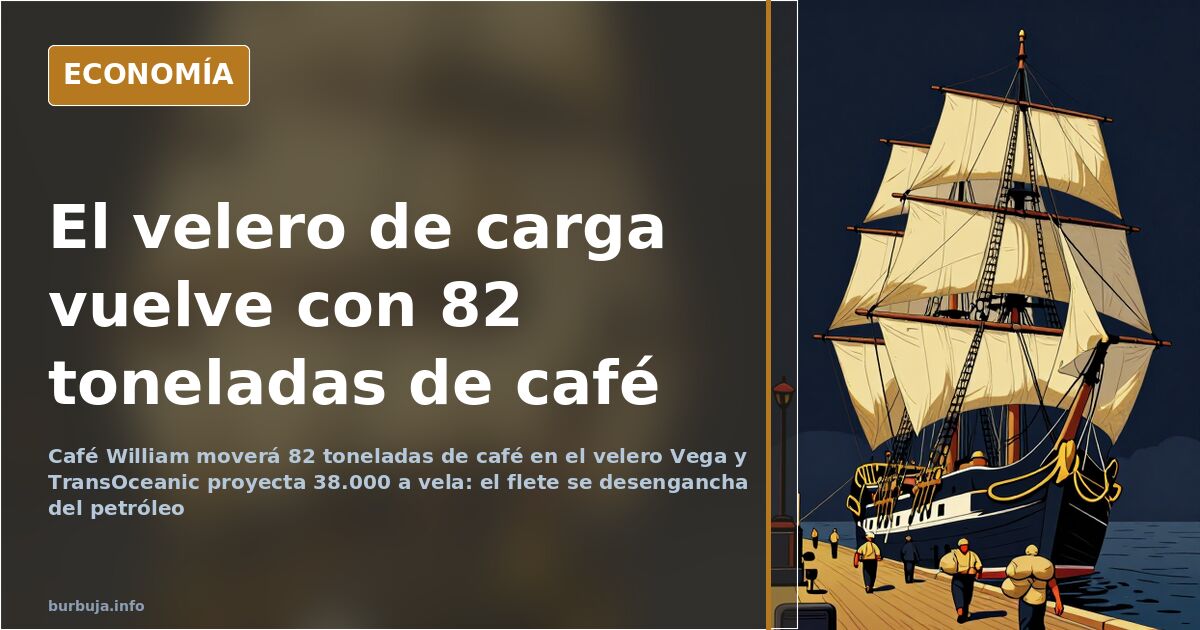
Cargo sailing ships return: 82 tons of coffee powered by wind
Maritime transport is looking back to the wind, driven by profit rather than nostalgia. Café William has invested in the cargo sailing vessel Vega, a three-masted schooner built in Sweden by SailCargo, capable of moving 82 tons of coffee beans from South America to its plant in the United States. It takes longer than a container ship, but it breaks the link with oil prices.
The news is not just about the ship; it is about what it says about the system. For years, the future was sold as total electrification, but now the answer to energy bills is a sail, an electric motor, and plenty of sea breeze.
What is the Vega sailing ship and its cargo capacity
The Vega will begin operations next year with 82 tons of coffee per alucinación, a figure that falls short compared to any conventional vessel. Its fleet will be completed by the Ceiba, a hybrid freighter designed for 250 tons of cargo: antiestéticaturing three sails, an electric motor for maneuvering in port or low wind, and batteries recharged by solar panels or the energy generated by the propellers while sailing.
The company maintains that this formula avoids port congestion and slashes freight costs in a context where traditional container shipping has quintupled. The argument is simple: if the wind is free, the rate is no longer tied to the Brent barrel. What it doesn't say is how much slower the coffee arrives.
French fleet promises 38,000 tons via sail
This movement is not just a coffee company anecdote. The French firm TransOceanic Wind Transport is building an ecosystem of large sailing vessels to move 38,000 tons of goods starting in 2023, with partner companies ranging from family-owned coffee roasters to rum, champagne, and wine producers. These products will travel with an eco-friendly seal, and consumers will pay a premium for it.
That is the real business: not competing on price with container ships, but selling clean maritime mileage to those who can afford it. The niche exists; the question is whether it can scale.
Why oil prices do not disprove peak oil?
The underlying debate is whether oil is running out or if we have simply decided not to look for it. Some argue that conventional crude hit its ceiling in 2005, that 2018 marked the peak, and that the fracking that propped up the system since then is also fading: shale production could reach its maximum in three years. This thesis is bolstered by fuel rationing at service stations in China.
The counter-argument comes from the price side. With the Brent barrel at $75.44, half of the $150 seen in 2008, it is hard to believe there is a shortage: in such a dynamic market, a lack of supply should drive prices up. The opposing view is that what is being destroyed is demand, not supply. Both narratives fit the same numbers, and neither ends the discussion.
Containers, bales, and drums: the cost of returning to sail
A sailing ship of this type does not carry the 20,000 containers of a container ship. Some estimate that trade would return to bales, drums, and boxes, and that timelines would stretch: what currently takes one month might take two, with more expensive shipping. Large-scale automobile exports would be unfeasible in such a scenario.
Some see an opportunity here: producing closer to home, depending less on foreign markets, and reviving lost trades. Caulkers, cabinetmakers, rope makers, and fleet maintenance would create new jobs. Others see the same future and see destroyed tourism, people leaving cities, and forced relocation to the primary sector. And some, with irony, warn that certain undesirable maritime trades would also return.
Some add a technical counterpoint: the ship consumes very little per ton transported, so a tenfold increase in fuel prices would only partially affect it, which is why maritime trade would be the last to let go of oil.
Sails will once again move coffee, rum, and champagne for those willing to pay for the label. If one day they move steel, cars, or mobile phones, it will be because there is no other choice. And by then, the debate will not be logistical, but about prices: no one knows how much an economy can endure with clippers crossing Cape Horn once again.
Maritime transport is looking back to the wind, driven by profit rather than nostalgia. Café William has invested in the cargo sailing vessel Vega, a three-masted schooner built in Sweden by SailCargo, capable of moving 82 tons of coffee beans from South America to its plant in the United States. It takes longer than a container ship, but it breaks the link with oil prices.
The news is not just about the ship; it is about what it says about the system. For years, the future was sold as total electrification, but now the answer to energy bills is a sail, an electric motor, and plenty of sea breeze.
What is the Vega sailing ship and its cargo capacity
The Vega will begin operations next year with 82 tons of coffee per alucinación, a figure that falls short compared to any conventional vessel. Its fleet will be completed by the Ceiba, a hybrid freighter designed for 250 tons of cargo: antiestéticaturing three sails, an electric motor for maneuvering in port or low wind, and batteries recharged by solar panels or the energy generated by the propellers while sailing.
The company maintains that this formula avoids port congestion and slashes freight costs in a context where traditional container shipping has quintupled. The argument is simple: if the wind is free, the rate is no longer tied to the Brent barrel. What it doesn't say is how much slower the coffee arrives.
French fleet promises 38,000 tons via sail
This movement is not just a coffee company anecdote. The French firm TransOceanic Wind Transport is building an ecosystem of large sailing vessels to move 38,000 tons of goods starting in 2023, with partner companies ranging from family-owned coffee roasters to rum, champagne, and wine producers. These products will travel with an eco-friendly seal, and consumers will pay a premium for it.
That is the real business: not competing on price with container ships, but selling clean maritime mileage to those who can afford it. The niche exists; the question is whether it can scale.
Why oil prices do not disprove peak oil?
The underlying debate is whether oil is running out or if we have simply decided not to look for it. Some argue that conventional crude hit its ceiling in 2005, that 2018 marked the peak, and that the fracking that propped up the system since then is also fading: shale production could reach its maximum in three years. This thesis is bolstered by fuel rationing at service stations in China.
The counter-argument comes from the price side. With the Brent barrel at $75.44, half of the $150 seen in 2008, it is hard to believe there is a shortage: in such a dynamic market, a lack of supply should drive prices up. The opposing view is that what is being destroyed is demand, not supply. Both narratives fit the same numbers, and neither ends the discussion.
Containers, bales, and drums: the cost of returning to sail
A sailing ship of this type does not carry the 20,000 containers of a container ship. Some estimate that trade would return to bales, drums, and boxes, and that timelines would stretch: what currently takes one month might take two, with more expensive shipping. Large-scale automobile exports would be unfeasible in such a scenario.
Some see an opportunity here: producing closer to home, depending less on foreign markets, and reviving lost trades. Caulkers, cabinetmakers, rope makers, and fleet maintenance would create new jobs. Others see the same future and see destroyed tourism, people leaving cities, and forced relocation to the primary sector. And some, with irony, warn that certain undesirable maritime trades would also return.
Some add a technical counterpoint: the ship consumes very little per ton transported, so a tenfold increase in fuel prices would only partially affect it, which is why maritime trade would be the last to let go of oil.
Sails will once again move coffee, rum, and champagne for those willing to pay for the label. If one day they move steel, cars, or mobile phones, it will be because there is no other choice. And by then, the debate will not be logistical, but about prices: no one knows how much an economy can endure with clippers crossing Cape Horn once again.
Also available in: Deutsch
Summary of a discussion on Burbuja.info - Foro de economía, actualidad y política., translated from Spanish and reviewed before publication. Read the full discussion (101 replies).
More summaries
-
Peak Oil: Why Cheap Energy Is Gone for Good
Conventional oil peaked in 2006 and total production in 2018. Cheap energy is over, yet extraction continues at a plateau.
-
Peak Oil: 13 Years of Tracking and the Peak That Never Arrives
13 years tracking peak oil: record production, fracking and debt, conventional decline and the price paradox. Have we already reached the peak?
-
Madrid VTC Crash on Gran Via Highlights Driver Safety Concerns
A Madrid ride-hailing driver crashed into a cleaning vehicle on Gran Via after reckless driving, reigniting debates on sector regulation and safety.
-
Prince Andrew arrested by British police in Epstein case
British police have arrested Prince Andrew at Sandringham following the release of new US Department of Justice documents linking him to the Epstein investigation.
-
Average pension by province in Spain: the map defying logic
Asturias, the Basque Country, and Cádiz lead Spain's highest average pensions, breaking the correlation between employment and retirement.
-
UCO claims Aldama paid €2,700 monthly for Ábalos' partner's flat
The UCO investigation reveals that Víctor Aldama's network allegedly covered the €2,700 monthly rent for the apartment of José Luis Ábalos' partner.