
Canary Islands seek nationwide redistribution of migrant minors
The Canary Islands president argues other Spanish regions must help manage arrivals, as the reception system is overwhelmed.
English · Original discussion in Spanish · Published
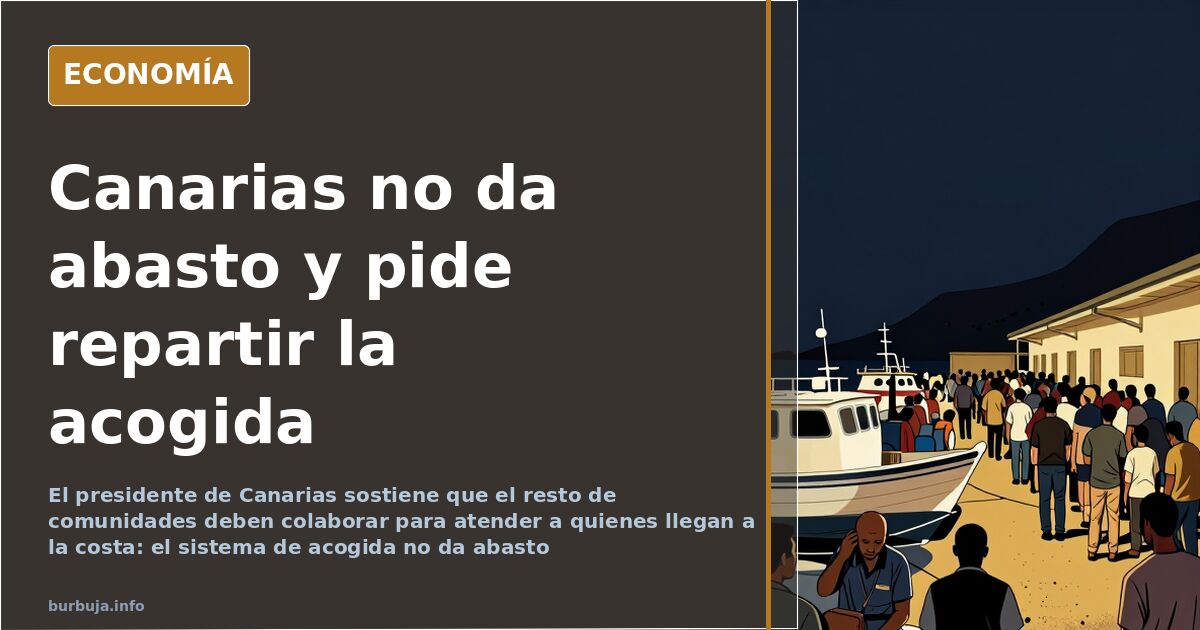
Canary Islands call for nationwide distribution of minors arriving by boat
The reception system is at its limit. This phrase summarizes the situation and triggers political conflict: the president of the Canary Islands maintains that the only viable solution is for other autonomous communities to collaborate to guarantee the rights of those reaching the coast. The logic is simple yet uncomfortable. As reception saturates, there is more talk about rights and less about actual capacity to uphold them.
Canary Islands, the new Lampedusa: boats don't arrive alone
The entry point has shifted beyond the central archipelago. El Hierro appears as a recurring destination on the Atlantic route, accompanied by a repeated suspicion: that vessels do not reach the coast under their own power, but are towed by Salvamento Marítimo ships. The controversial thesis suggests rescue operations have become the standard approach mechanism rather than an exception.
This raises a recurring operational question: if boats sink and rescue resources are insufficient, why isn't intervention demanded from the navies of origin countries? It is argued that Segarro or Senegal are closer and could intervene earlier. No institutional response exists. Only suspicion remains.
The Red Cross is among the resources cited as overwhelmed. Its saturation is used as evidence that volumes exceed any forecast.
What rights do unauthorized border crossers have?
The question is literal: what rights protect a person who has illegally crossed a border? Migration status does not eliminate certain protections, especially child guardianship, but it opens a primary practical conflict. There are no places, no classrooms, and not enough staff to guarantee all of them.
One opinion stream argues that the rights discourse has decoupled from obligations. The circulating idea is that reception is framed as an unlimited right without corresponding contributions, creating social tension. Opposing this is the classic humanitarian argument: no one can be returned to the place they fled from without guarantees.
In any case, the crux is practical before sarracena. Guaranteeing rights costs money, space, and time, none of which multiply by decree.
Schooling that cannot be guaranteed
One of the most repeated claims is that it is impossible to guarantee schooling for arriving minors. The depicted scene—teenagers whose declared age clashes with their physical appearance—fuels distrust in age determination procedures. The complaint is not just administrative. It points to a system that accepts declarations without filtering and then cannot reverse them.
The underlying problem is capacity. Placing dozens of youths into already strained classrooms requires teachers, spaces, and reinforcement programs centers lack. Without them, integration remains just a statement.
New York, the uncomfortable mirror
The most circulated comparison comes from across the Atlantic. New York declared itself a sanctuary city and, according to shared narratives, resulted in a sequence of saturation. First, reception centers filled up. When full, entire hotels were rented using public funds. Then educational centers were occupied, displacing students to remote learning. Now, proposals suggest private individuals rent rooms paid for by the state.
The pattern repeats: each solution creates the next scale's problem. Those holding this analysis do so not out of animosity, but due to resource arithmetic.
The cost nobody wants to quantify
Some point to an economic ecosystem built around reception: care devices, legal and social personnel, companies providing catering, moorings, surveillance, or maintenance. The unverified allegation is that part of this spending goes to affiliated providers and that the system rewards constant arrivals.
Without an audit, confirmation is impossible. What is known is that spending exists and grows with each landing.
Another front is social perception. The described sensation is general indifference: people acknowledge a problem but look away, like commenting on heavy rain. Those reporting it emphasize something else. The flow doesn't stop, and capacity doesn't expand.
How long can a system promising unlimited rights with finite resources be sustained? No one has answered. Perhaps the answer lies not in migration policies, but in the budget.
The reception system is at its limit. This phrase summarizes the situation and triggers political conflict: the president of the Canary Islands maintains that the only viable solution is for other autonomous communities to collaborate to guarantee the rights of those reaching the coast. The logic is simple yet uncomfortable. As reception saturates, there is more talk about rights and less about actual capacity to uphold them.
Canary Islands, the new Lampedusa: boats don't arrive alone
The entry point has shifted beyond the central archipelago. El Hierro appears as a recurring destination on the Atlantic route, accompanied by a repeated suspicion: that vessels do not reach the coast under their own power, but are towed by Salvamento Marítimo ships. The controversial thesis suggests rescue operations have become the standard approach mechanism rather than an exception.
This raises a recurring operational question: if boats sink and rescue resources are insufficient, why isn't intervention demanded from the navies of origin countries? It is argued that Segarro or Senegal are closer and could intervene earlier. No institutional response exists. Only suspicion remains.
The Red Cross is among the resources cited as overwhelmed. Its saturation is used as evidence that volumes exceed any forecast.
What rights do unauthorized border crossers have?
The question is literal: what rights protect a person who has illegally crossed a border? Migration status does not eliminate certain protections, especially child guardianship, but it opens a primary practical conflict. There are no places, no classrooms, and not enough staff to guarantee all of them.
One opinion stream argues that the rights discourse has decoupled from obligations. The circulating idea is that reception is framed as an unlimited right without corresponding contributions, creating social tension. Opposing this is the classic humanitarian argument: no one can be returned to the place they fled from without guarantees.
In any case, the crux is practical before sarracena. Guaranteeing rights costs money, space, and time, none of which multiply by decree.
Schooling that cannot be guaranteed
One of the most repeated claims is that it is impossible to guarantee schooling for arriving minors. The depicted scene—teenagers whose declared age clashes with their physical appearance—fuels distrust in age determination procedures. The complaint is not just administrative. It points to a system that accepts declarations without filtering and then cannot reverse them.
The underlying problem is capacity. Placing dozens of youths into already strained classrooms requires teachers, spaces, and reinforcement programs centers lack. Without them, integration remains just a statement.
New York, the uncomfortable mirror
The most circulated comparison comes from across the Atlantic. New York declared itself a sanctuary city and, according to shared narratives, resulted in a sequence of saturation. First, reception centers filled up. When full, entire hotels were rented using public funds. Then educational centers were occupied, displacing students to remote learning. Now, proposals suggest private individuals rent rooms paid for by the state.
The pattern repeats: each solution creates the next scale's problem. Those holding this analysis do so not out of animosity, but due to resource arithmetic.
The cost nobody wants to quantify
Some point to an economic ecosystem built around reception: care devices, legal and social personnel, companies providing catering, moorings, surveillance, or maintenance. The unverified allegation is that part of this spending goes to affiliated providers and that the system rewards constant arrivals.
Without an audit, confirmation is impossible. What is known is that spending exists and grows with each landing.
Another front is social perception. The described sensation is general indifference: people acknowledge a problem but look away, like commenting on heavy rain. Those reporting it emphasize something else. The flow doesn't stop, and capacity doesn't expand.
How long can a system promising unlimited rights with finite resources be sustained? No one has answered. Perhaps the answer lies not in migration policies, but in the budget.
Summary of a discussion on Burbuja.info - Foro de economía, actualidad y política., translated from Spanish and reviewed before publication. Read the full discussion (176 replies).
More summaries
-
280-person cayucos sets Canary route record in El Hierro
726 migrants rescued in 24 hours in Spain’s Canary Islands, with a record 280-person boat in El Hierro. Fewer boats, but much larger.
-
Ceuta Video Sparks Debate on Immigration, Morocco, and Votes
A video from Ceuta ignites controversy surrounding immigration, the tug-of-war with Morocco, and the funding of migrant support NGOs.
-
ECB: Spanish housing market 85% more overvalued than Europe's
ECB warns: Spain's housing overvaluation indicator exceeds 20%, 85% above the Eurozone average. Bubble in sight?
-
Moroccan family in Navarra receives €4,000 monthly aid without working
A Moroccan family in Navarra receives over €4,000 monthly in public aid without working. Discover the details and benefits.
-
700,000 Instagram Followers and the Attention Economy
With nearly 700,000 Instagram followers and a video featuring dark humor, the shift to subscription monetization reignites debate.
-
Smartphone Addiction: Designed to Hook, Unregulated
Pedestrians ignored green lights while glued to phones. Experts blame intentional design features that foster compulsive usage.