
Chemtrail theories resurface in Spain following recent elections
Persistent contrails reappear as the electoral cycle ends, fueling conspiracy theories about geoengineering and aerial spraying in Spain.
English · Original discussion in Spanish · Published
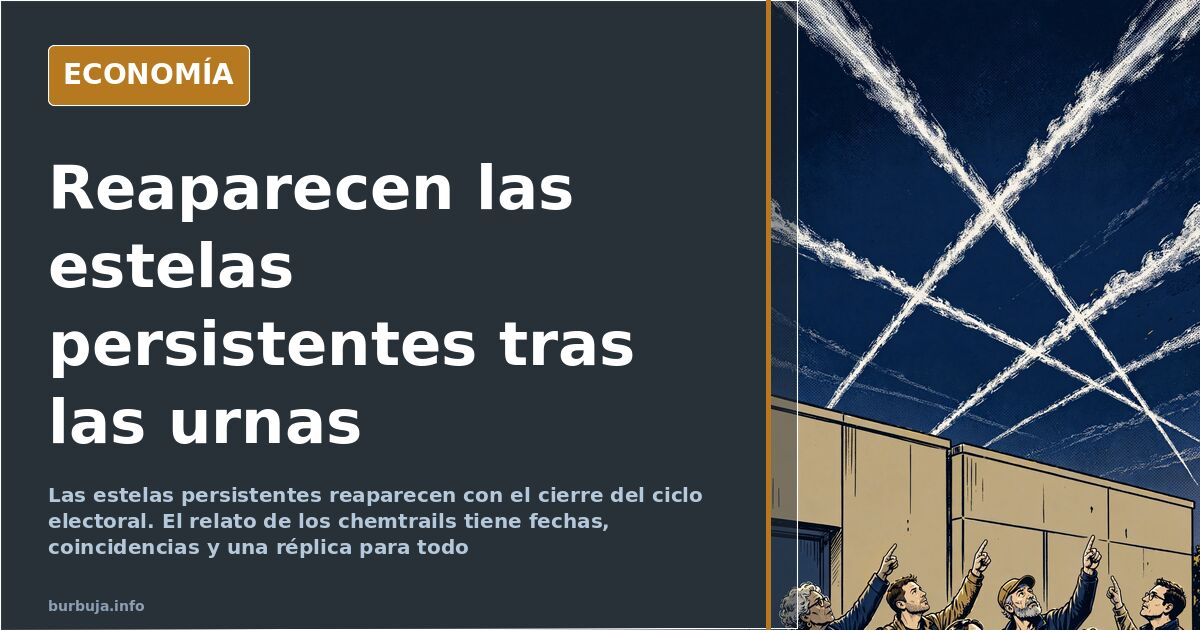
Estela narratives reactivate after every election cycle
A resident in northern Spain looks at the mid-afternoon sky, noticing it is whiter than usual with a reflectivity that suggests more intense heat than previous days, and reaches a conclusion: they are back. This scene repeats in Galicia, the Cantabrian coast, the Canary Islands, and central Spain. The theory suggests that estela have returned trinc the close of the electoral cycle, and that whoever orders them—personified as an "Antonio" who is allegedly stung by the election results—no longer has a reason to hide. This is the core thesis of a long-running conversation that resurfaces whenever elections and weather changes coincide.
It is important to state first: there is no scientific evidence that the population is being sprayed from aircraft. Persistent contrails are condensed water vapor that remains visible due to high-altitude humidity and stability, not a purposeful metallic aerosol. However, the narrative has an internal structure: specific dates, circumstantial evidence, an explanation for every objection, and a ready-made rebuttal for any counterargument.
What exactly sustains the chemical contrail narrative
For believers, an airplane's trail is not vapor: it is a deliberately released mixture. They speak of aluminum ending up in food instead of iron, of iodide being sprayed over non-conforming areas, and a menu of objectives that changes daily: manipulating the weather, ruining crops and livestock, or targeting dams, thermal plants, or crossroads. The list is long and not always coherent, but it functions as a framework: everything that goes wrong fits somewhere on the list.
The evidence cited is temporal coincidence. The trails are seen after elections, when the supposed responsible party no longer needs to protect their image, and they supposedly stopped appearing in the spring of 2020 when airspace was closed and the country was in lockdown. That is the backbone of the matter: there are no measurements, only a calendar.
Why blocking anticyclones explain storms without spraying
Because it is standard meteorology: an anticyclonic block over the British Isles diverts storms southward, and much of Spain pays the price in the form of unseasonal storms and rain. This is the explanation that opposes the narrative, and part of the conversation rejects it outright: if the anticyclone stays for weeks without moving, they argue, it is because someone is holding it up from above.
The uncomfortable rebuttal comes from elsewhere. In Madrid, it rained trinc an electoral result that was adverse for the person supposedly ordering the operation, breaking the correlation between ballot boxes and precipitation. And some recall that the trails never truly disappeared during the months they were theoretically halted: they simply did it with less audacity.
Spring 2020: The flight halt that supports the theory
The central episode of the narrative is the lockdown. With airports empty, the skies proge up clear, and that clarity was interpreted as incriminating evidence. The accompanying explanation is that most spraying is done with commercial aircraft, using additives—such as SO2—mixed into the fuel. This is an unsupported claim: sulfur in kerosene is limited by regulations, and its combustion traces do not support any large-scale dispersal program.
Even so, the episode serves as an emotional anchor. It is the only window in which the sky was, they say, as it should be, and from there comes the comparison that repeats whenever shredded clouds or a light that seems to burn more than the previous week appear.
Decades-old droughts and the climate argument
The most repeated objection is historical: there were very similar droughts decades ago without anyone talking about spraying. It is the type of question the narrative does not answer, only evades. The usual rebuttal does not deny the climate; it separates it. Droughts are cycles, it is argued, and that does not prevent something from being done to lead us to who knows where.
That move—accepting physical evidence and subordinating it to a hidden intention—is what makes the narrative almost unassailable. It does not compete with meteorology; it uses it as an alibi for a parallel operation that, by definition, leaves no verifiable trace.
What can be measured: diffuse radiation, AEMET, and itchy eyes
The most concrete proposal circulating is to cross public irradiance data from the AEMET (the Spanish State Meteorological Agency) with the presence of clouds, using a measurable hypothesis: when direct radiation drops, diffuse radiation remains at a high value. It is an attempt to move beyond a photo of the sky and land on open data series, and those proposing it acknowledge that the cross-referencing is still pending.
In parallel, symptoms are described: itchy eyes, a light that burns more, a supposed magnifying glass effect on the retina. These are perceptions without associated measurement or an established relationship with condensation trails, but they feed the sensation that something different is happening above.
With these materials, the calendar rules. If the logic of the narrative is that the operation pauses when appearances must be kept, the next window already has a date: the days leading up to July 23, when elections return, a truce should be seen in the sky. It is the only verifiable prediction of the whole matter, allowing one to check the theory without necessarily believing or disbelieving. Until then, air traffic maps will continue to have the same resolution as always.
A resident in northern Spain looks at the mid-afternoon sky, noticing it is whiter than usual with a reflectivity that suggests more intense heat than previous days, and reaches a conclusion: they are back. This scene repeats in Galicia, the Cantabrian coast, the Canary Islands, and central Spain. The theory suggests that estela have returned trinc the close of the electoral cycle, and that whoever orders them—personified as an "Antonio" who is allegedly stung by the election results—no longer has a reason to hide. This is the core thesis of a long-running conversation that resurfaces whenever elections and weather changes coincide.
It is important to state first: there is no scientific evidence that the population is being sprayed from aircraft. Persistent contrails are condensed water vapor that remains visible due to high-altitude humidity and stability, not a purposeful metallic aerosol. However, the narrative has an internal structure: specific dates, circumstantial evidence, an explanation for every objection, and a ready-made rebuttal for any counterargument.
What exactly sustains the chemical contrail narrative
For believers, an airplane's trail is not vapor: it is a deliberately released mixture. They speak of aluminum ending up in food instead of iron, of iodide being sprayed over non-conforming areas, and a menu of objectives that changes daily: manipulating the weather, ruining crops and livestock, or targeting dams, thermal plants, or crossroads. The list is long and not always coherent, but it functions as a framework: everything that goes wrong fits somewhere on the list.
The evidence cited is temporal coincidence. The trails are seen after elections, when the supposed responsible party no longer needs to protect their image, and they supposedly stopped appearing in the spring of 2020 when airspace was closed and the country was in lockdown. That is the backbone of the matter: there are no measurements, only a calendar.
Why blocking anticyclones explain storms without spraying
Because it is standard meteorology: an anticyclonic block over the British Isles diverts storms southward, and much of Spain pays the price in the form of unseasonal storms and rain. This is the explanation that opposes the narrative, and part of the conversation rejects it outright: if the anticyclone stays for weeks without moving, they argue, it is because someone is holding it up from above.
The uncomfortable rebuttal comes from elsewhere. In Madrid, it rained trinc an electoral result that was adverse for the person supposedly ordering the operation, breaking the correlation between ballot boxes and precipitation. And some recall that the trails never truly disappeared during the months they were theoretically halted: they simply did it with less audacity.
Spring 2020: The flight halt that supports the theory
The central episode of the narrative is the lockdown. With airports empty, the skies proge up clear, and that clarity was interpreted as incriminating evidence. The accompanying explanation is that most spraying is done with commercial aircraft, using additives—such as SO2—mixed into the fuel. This is an unsupported claim: sulfur in kerosene is limited by regulations, and its combustion traces do not support any large-scale dispersal program.
Even so, the episode serves as an emotional anchor. It is the only window in which the sky was, they say, as it should be, and from there comes the comparison that repeats whenever shredded clouds or a light that seems to burn more than the previous week appear.
Decades-old droughts and the climate argument
The most repeated objection is historical: there were very similar droughts decades ago without anyone talking about spraying. It is the type of question the narrative does not answer, only evades. The usual rebuttal does not deny the climate; it separates it. Droughts are cycles, it is argued, and that does not prevent something from being done to lead us to who knows where.
That move—accepting physical evidence and subordinating it to a hidden intention—is what makes the narrative almost unassailable. It does not compete with meteorology; it uses it as an alibi for a parallel operation that, by definition, leaves no verifiable trace.
What can be measured: diffuse radiation, AEMET, and itchy eyes
The most concrete proposal circulating is to cross public irradiance data from the AEMET (the Spanish State Meteorological Agency) with the presence of clouds, using a measurable hypothesis: when direct radiation drops, diffuse radiation remains at a high value. It is an attempt to move beyond a photo of the sky and land on open data series, and those proposing it acknowledge that the cross-referencing is still pending.
In parallel, symptoms are described: itchy eyes, a light that burns more, a supposed magnifying glass effect on the retina. These are perceptions without associated measurement or an established relationship with condensation trails, but they feed the sensation that something different is happening above.
With these materials, the calendar rules. If the logic of the narrative is that the operation pauses when appearances must be kept, the next window already has a date: the days leading up to July 23, when elections return, a truce should be seen in the sky. It is the only verifiable prediction of the whole matter, allowing one to check the theory without necessarily believing or disbelieving. Until then, air traffic maps will continue to have the same resolution as always.
Also available in: Deutsch
Summary of a discussion on Burbuja.info - Foro de economía, actualidad y política., translated from Spanish and reviewed before publication. Read the full discussion (101 replies).
More summaries
-
UK life expectancy falls: four key suspects
UK life expectancy drops faster than peers with similar vaccination rates. Healthcare, diet and poverty compete as explanations.
-
1979 BOE cloud seeding law debunked chemtrail conspiracy
Cloud seeding has been regulated in Spain since 1979, but this law does not prove chemical spraying by commercial aircraft, debunking chemtrail myths.
-
Spain's Record Rainfall Sparks Renewed Chemtrail Debate
Coincidence or conspiracy? Spain exits drought with record rain as visible contrails decrease, fueling chemtrail theories.
-
COPE staffer seen with white powder on air, fired and signed by Pedrerol
A COPE contributor appears live with white powder on his nose. He's fired, but Pedrerol has reportedly offered him a job. Cocaine or donut?
-
Two official Audi A6 cars remain unsold in A Coruña for years
Two 2008 official Audi A6 are still unsold in A Coruña: the auction asks €10,000 while the market pays between €5,000 and €8,000. The administrative table…
-
Frozen wages and housing: the private sector pay debate in Spain
Two decades of frozen salaries, absorbed collective bargaining raises and housing eating up pay: the diagnosis of private employment in Spain.