
Save the Children and Donation Boycott: The NGO Blacklist
A viral video by a children's rights spokesperson reigns donation boycotts, citing high overheads, salaries, and public subsidies.
English · Original discussion in Spanish · Published
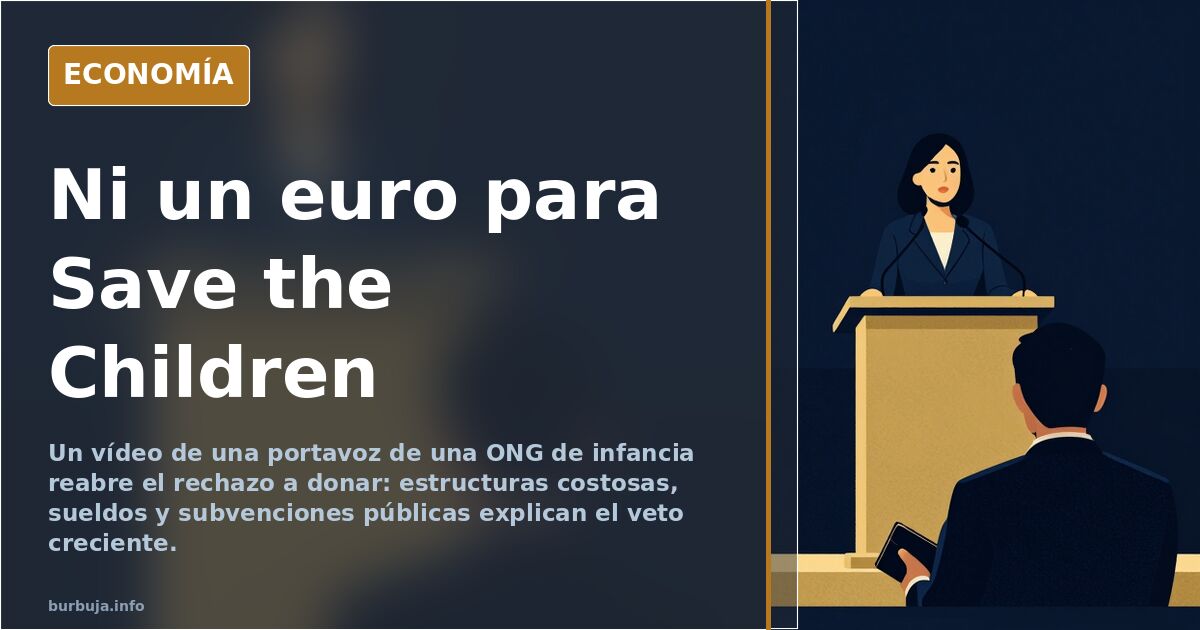
Growing backlash against donating to NGOs reliant on public funds
A video antiestéticaturing a representative from a child welfare organization linking climate crisis, child marriages, and minors' health has reignited debate over where donations actually go. The prevailing response is stark: not a single euro. While not new, this distrust of the third sector has shifted from a minority view to common sense among large segments of the population.
The immediate trigger was a spokesperson who, according to viewers, uses an affected voice and speaks from a rehearsed script. The discussion quickly moved to deeper issues: these organizations' spending structures and their dependence on public grants.
Why are Save the Children and other NGOs criticized?
The most repeated argument is financial, not ideological. An organization maintaining buildings, cars, offices, furniture, and above all, salaries must cover those costs before directing funds to its stated mission. Many conclude that donor contributions effectively keep the machinery running.
Some claim less than 10% of raised funds reach end beneficiaries. Though unverified independently, this perception explains why the "non-governmental" label feels misleading when most income comes from public administrations. Hence the quip circulating in debates: they aren't NGOs, but OMGs, Overly Managed Governments.
Criticism extends to the church and its charitable arms, accused of adopting similar rhetoric, and to animal shelters, which appear in the conversation with a nuance: at least their beneficiaries don't waste food.
The video reopening the donation debate
The material sparking discussion is a social media message insisting the content is not false and calling for a meteorite impact. Analysis splits here. One view sees the spokesperson as a victim of indoctrination, genuinely believing she saves children. Another rejects this leniency: if she modulates her voice without hesitation, she knows exactly what she does and whom she targets.
Cited context involves a supposed link between climate crisis and child marriages in certain countries. Critics argue such practices have religious and cultural roots predating climate change, suggesting mixing them provides a new excuse for old problems.
What we know about NGO fundraising
The core issue is economic. Private donations are often the smaller portion; bulk funding arrives via subsidies and European funds, i.e., taxes citizens pay without choosing destinations. This makes refusing to donate almost symbolic: non-donors still fund structures through fiscal channels.
Consequently, voices suggest redirecting solidarity locally: neighbors facing long-term unemployment, individuals needing housing elsewhere due to lack of treatment, or families in hardship. Direct aid allows tracking every euro, impossible with intermediary structures.
Insiders note senior pyramid levels benefit from grants while causes receive fractions. This testimony aligns with general perceptions, though it isn't an audit.
Distrust toward the third sector in numbers
Rejection spans acronyms: major child welfare groups, humanitarian aid providers, and EU-funded operators. The underlying accusation is that many act as grant capturers rather than aid executors.
The DANA storm episode serves as a litmus test. Weeks after the disaster, paid recruitment teams toured cities seeking members under the guise of helping children out of school. The lingering question is uncomfortable: what did that organization do for affected minors?
Political undertones emerge too. Some criticize prioritizing migrant groups over local sick or neighbors, defending those aiding cancer patients regardless of passport. The distinction matters: rejection is of intermediation, not help itself.
Evolution of the donation refusal
What began as specific objections evolved into articulated stances. Arguments now combine "I don't trust them" with "I already pay them via taxes." This mix—management distrust plus fiscal obligation—shatters the NGO label.
Some demand job consequences for campaign leaders, citing precedents like employees fired over videos. Others silently withdraw: no membership, no donations, no cents at supermarket exits. A third group proposes building mutual aid alternatives.
Forecasts suggest widening gaps. As long as large organizations rely on public funds and maintain costly structures, individual donors will find fewer reasons to sign receipts. Only serious audits breaking down program expenses might change things. Until then, the blacklist grows.
A video antiestéticaturing a representative from a child welfare organization linking climate crisis, child marriages, and minors' health has reignited debate over where donations actually go. The prevailing response is stark: not a single euro. While not new, this distrust of the third sector has shifted from a minority view to common sense among large segments of the population.
The immediate trigger was a spokesperson who, according to viewers, uses an affected voice and speaks from a rehearsed script. The discussion quickly moved to deeper issues: these organizations' spending structures and their dependence on public grants.
Why are Save the Children and other NGOs criticized?
The most repeated argument is financial, not ideological. An organization maintaining buildings, cars, offices, furniture, and above all, salaries must cover those costs before directing funds to its stated mission. Many conclude that donor contributions effectively keep the machinery running.
Some claim less than 10% of raised funds reach end beneficiaries. Though unverified independently, this perception explains why the "non-governmental" label feels misleading when most income comes from public administrations. Hence the quip circulating in debates: they aren't NGOs, but OMGs, Overly Managed Governments.
Criticism extends to the church and its charitable arms, accused of adopting similar rhetoric, and to animal shelters, which appear in the conversation with a nuance: at least their beneficiaries don't waste food.
The video reopening the donation debate
The material sparking discussion is a social media message insisting the content is not false and calling for a meteorite impact. Analysis splits here. One view sees the spokesperson as a victim of indoctrination, genuinely believing she saves children. Another rejects this leniency: if she modulates her voice without hesitation, she knows exactly what she does and whom she targets.
Cited context involves a supposed link between climate crisis and child marriages in certain countries. Critics argue such practices have religious and cultural roots predating climate change, suggesting mixing them provides a new excuse for old problems.
What we know about NGO fundraising
The core issue is economic. Private donations are often the smaller portion; bulk funding arrives via subsidies and European funds, i.e., taxes citizens pay without choosing destinations. This makes refusing to donate almost symbolic: non-donors still fund structures through fiscal channels.
Consequently, voices suggest redirecting solidarity locally: neighbors facing long-term unemployment, individuals needing housing elsewhere due to lack of treatment, or families in hardship. Direct aid allows tracking every euro, impossible with intermediary structures.
Insiders note senior pyramid levels benefit from grants while causes receive fractions. This testimony aligns with general perceptions, though it isn't an audit.
Distrust toward the third sector in numbers
Rejection spans acronyms: major child welfare groups, humanitarian aid providers, and EU-funded operators. The underlying accusation is that many act as grant capturers rather than aid executors.
The DANA storm episode serves as a litmus test. Weeks after the disaster, paid recruitment teams toured cities seeking members under the guise of helping children out of school. The lingering question is uncomfortable: what did that organization do for affected minors?
Political undertones emerge too. Some criticize prioritizing migrant groups over local sick or neighbors, defending those aiding cancer patients regardless of passport. The distinction matters: rejection is of intermediation, not help itself.
Evolution of the donation refusal
What began as specific objections evolved into articulated stances. Arguments now combine "I don't trust them" with "I already pay them via taxes." This mix—management distrust plus fiscal obligation—shatters the NGO label.
Some demand job consequences for campaign leaders, citing precedents like employees fired over videos. Others silently withdraw: no membership, no donations, no cents at supermarket exits. A third group proposes building mutual aid alternatives.
Forecasts suggest widening gaps. As long as large organizations rely on public funds and maintain costly structures, individual donors will find fewer reasons to sign receipts. Only serious audits breaking down program expenses might change things. Until then, the blacklist grows.
Also available in: Deutsch
Summary of a discussion on Burbuja.info - Foro de economía, actualidad y política., translated from Spanish and reviewed before publication. Read the full discussion (134 replies).
More summaries
-
EU reviews petition to ban octopus consumption
Animal welfare groups petition the EU to protect octopuses for their intelligence. No law is approved, while Spain's fishing sector faces severe cuts.
-
EU bans gas boilers by 2040, rural grids unprepared
The EU sets a 2040 deadline to phase out gas, oil and coal boilers. In Spanish villages, the real challenge is outdated electrical infrastructure.
-
Ignacio Lázaro: 'Maricarmen paid €154 rent while we paid €750'
Ignacio Lázaro, grandson of the original owner, reveals the other side of the Maricarmen case: 'We subsidized her for years and now, with our taxes.'
-
Dani Alves: €55M Assets and Why His Wife Stays
Joana Sanz returns to Dani Alves after the verdict. Analysis of his €55M wealth, third-party bail, and unresolved divorce.
-
Valencia Fire: Residents Told to Return to Apartments
In the Valencia fire, firefighters advised residents in the lobby to return to their apartments. Despite the station being 200 meters away, response took 45 minutes.
-
44.1% of Spain's Central Administration Now Works Remotely
Remote work reaches 44.1% in Spain's central administration, while one in three appointments fails to materialize.